




Sonus Faber at maPlatine.com: the essentials
Brand: Italian manufacturer of high-end Hi-Fi loudspeakers, founded in 1980 around Franco Serblin; made in Italy, with the Lumina range hand-assembled at the Arcugnano factory.
Signature: real-wood front baffles, leather-wrapped cabinets, a dome tweeter decoupled from the cabinet by a viscoelastic gasket, cellulose-fiber drivers, and a presentation that favors tonal accuracy and balance.
maPlatine.com selection: Lumina and Lumina Amator (6 speakers), Sonetto G2 (5 speakers), Concertino G4 Maestro Edition (limited series), the new Olympica G3 range, Gravis I and II subwoofers, and 2 pairs of dedicated stands.
Pairings: for each speaker, our experts recommend an amplifier and a complement (source, cables, stands or subwoofer) from the maPlatine.com catalogue, based on sensitivity, impedance (4 ohms across the whole selection) and room size.
Some speakers you listen to; others you find yourself gazing at long before you even plug them in. Sonus Faber belongs to both categories. For more than forty years, the Italian house has built its loudspeakers like musical instruments: real wood, hand-laid leather, and a relentless pursuit of true timbre.
In France, however, the name remains little known outside audiophile circles. That paradox is precisely what convinced us. Rather than listing the entire catalogue, our experts selected the very best, all gathered on our Sonus Faber page: the Lumina, Lumina Amator and Sonetto G2 ranges, the new Olympica G3 range, the limited-series Concertino G4 Maestro, the Gravis subwoofers and the dedicated stands.
What won us over? A design in which nothing is left to chance, packaging worthy of the object, and a sound shaped down to the smallest detail. This article introduces the brand, then each range with its models and the pairings recommended by our experts.
Sonus Faber, more than forty years of Italian craftsmanship
Sonus Faber history at a glance
Origins: a project launched in 1980 by a group of audiophiles gathered around Franco Serblin, a lover of music, sound reproduction and fine cabinetmaking.
First creations: the Snail project, a system inspired by Leonardo da Vinci, followed by the Parva speaker.
Reference lines: Aida, Amati, Stradivari, Olympica, Homage: series regarded by music lovers as benchmarks of timbre and refinement.
Manufacturing: Made in Italy; the Lumina and Lumina Amator are hand-assembled at the Sonus Faber factory in Arcugnano.
Philosophy: “Natural Sound”: natural materials (solid wood, cork, leather or a plant-based alternative) in the service of natural sound.
The story begins in 1980, when a group of audiophiles decided to devote themselves to designing a high-quality loudspeaker system, led by Franco Serblin, whose love of music went hand in hand with a passion for cabinetmaking. The Snail project, inspired by Leonardo da Vinci, paved the way for the Parva, and then for models that appealed as much for their musicality as for the way they blended into a home.
Since 1983, Sonus Faber has been designing high-end loudspeakers praised by music lovers and the specialist press alike. The Aida, Amati, Stradivari and Olympica rank among the most beautiful speakers ever produced, and in our view the brand’s build quality is among the very best in the world.
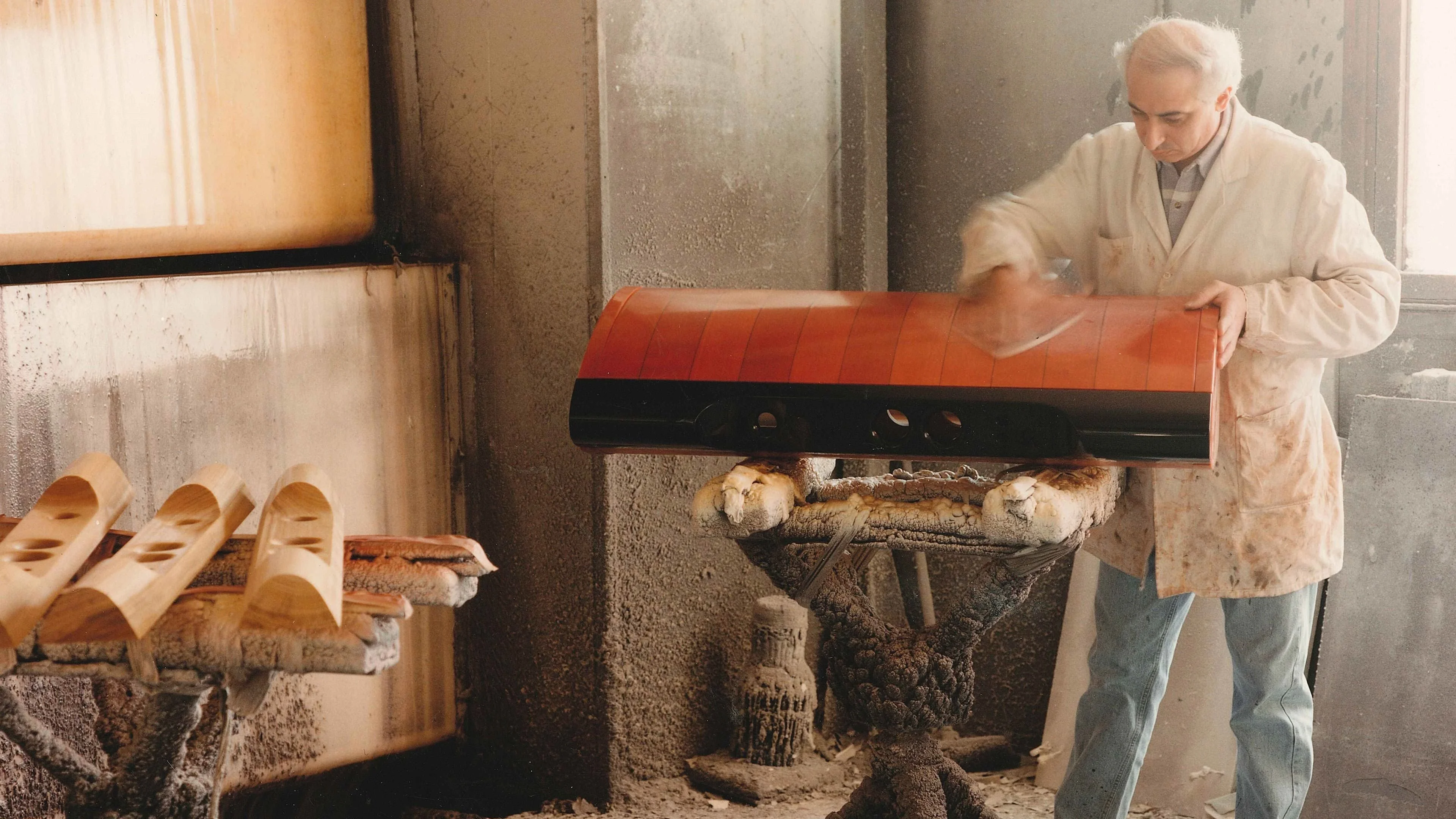
This standard is not reserved for the most expensive models. Every speaker in our selection is made in Italy, and even the entry-level Lumina range is hand-assembled in Arcugnano. From the moment you unpack them, the meticulous, craftsmanlike build quality is plain to see.
The technical signature of Sonus Faber speakers
Four design choices are found, to varying degrees, across the whole selection: tonal accuracy, balance and warmth.
Decoupled tweeter and cellulose-fiber diaphragms
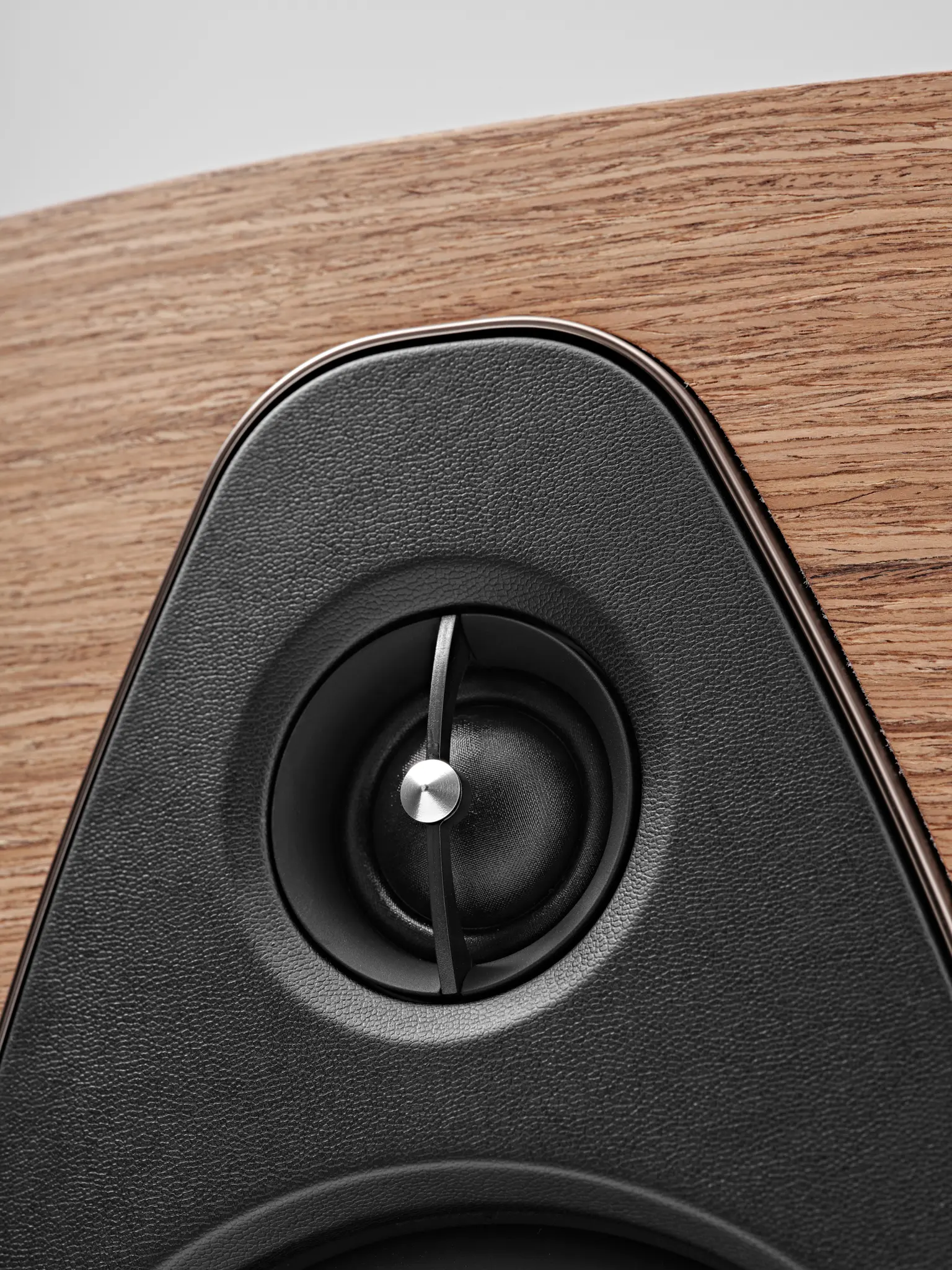
High frequencies are handled by a DAD dome tweeter, 29 mm on the Lumina and 28 mm on the Sonetto G2 and Concertino G4; on the Lumina and Sonetto G2, it is decoupled from the cabinet by a viscoelastic gasket that limits distortion and interference. Midrange and bass drivers use a cellulose-fiber diaphragm; on the Sonetto G2, the surround is joined to the cone by an asymmetric floral pattern that improves linearity of movement and dispersion.
Concrete, cork and solid walnut against vibration
The Sonetto G2 stand on a concrete composite base that increases stability and rigidity; on the floorstanders, it takes decoupling spikes. The midrange of the Sonetto V and VIII G2 works in a sealed cork enclosure, and the Concertino G4 takes the idea to the entire cabinet, machined from very rigid cork and held between solid walnut side panels.
Ports designed to make placement easier
On the bookshelf speakers, the laminar port vents at the front and at the base; on the floorstanders, it vents beneath the speaker, and even radiates through 360° on the Sonetto III, V and VIII G2. Placement becomes less critical relative to the walls, although it remains decisive.
Wood and leather, the brand’s visual signature
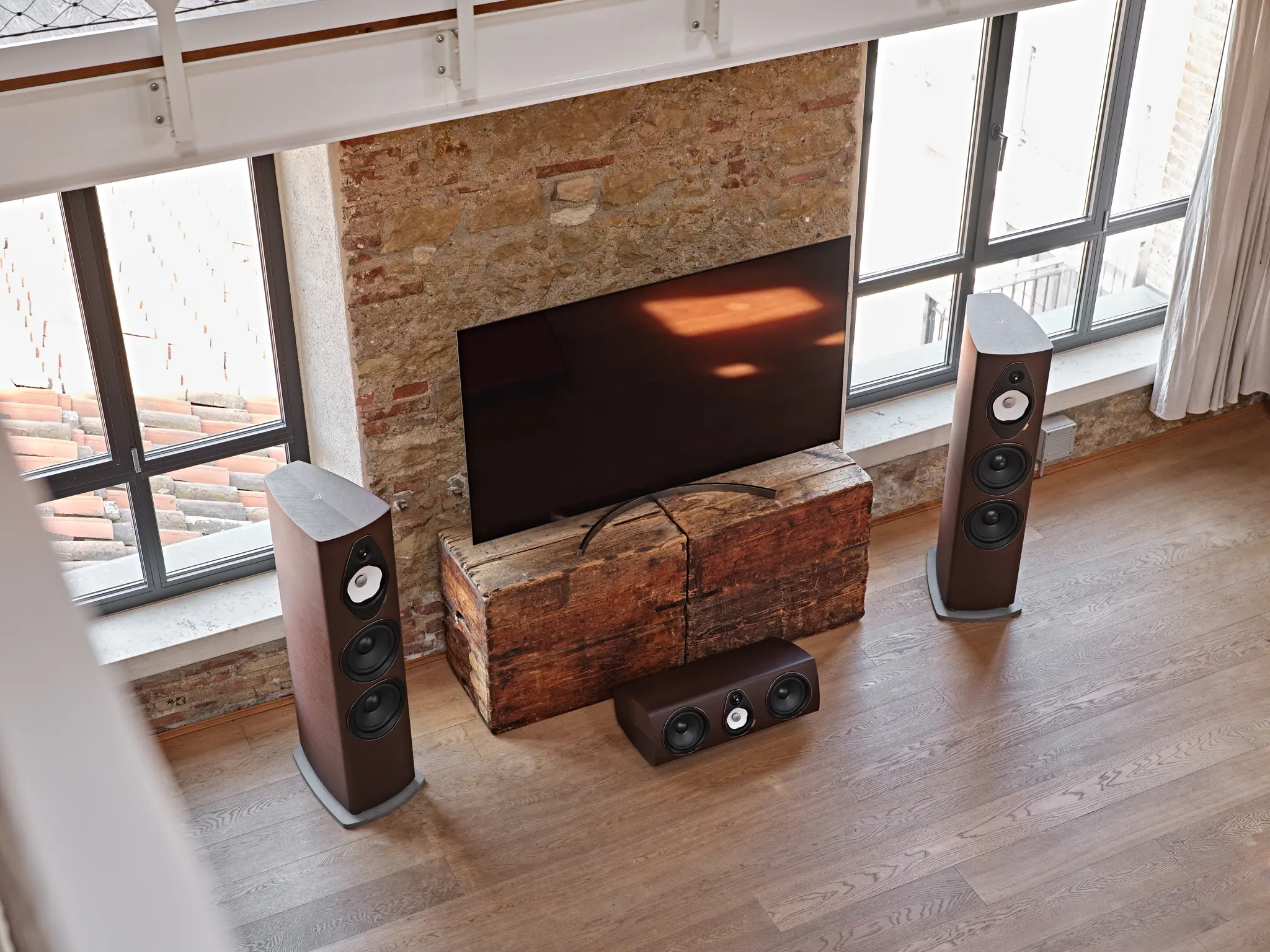
This is the brand’s visual signature: real multi-ply wood baffles and black leather-wrapped cabinets on the Lumina, high-gloss finish with 45° veneer on the Lumina Amator, a “ship’s bow” silhouette and leather-trimmed drivers on the Sonetto G2, and solid walnut with a plant-based leather alternative on the Concertino G4.
Passive speakers: an amplifier is essential
All the Sonus Faber speakers in this selection are passive speakers with a nominal impedance of 4 ohms. Our pairings therefore favor amplifiers whose power into 4 ohms is clearly specified (see our full range of integrated amplifiers).
Sonus Faber Lumina and Lumina Amator: accessible Italian craftsmanship
With Lumina, Sonus Faber opens its know-how to a wider audience: a more affordable range designed for music lovers on a sensible budget, without giving up hand assembly in Arcugnano. Real multi-ply wood baffle (black lacquer, wenge or walnut), black leather-wrapped cabinet, magnetic jersey grille: the minimalist design lets the materials speak.
The Lumina speakers at a glance
| Lumina I | Lumina II | Lumina III | Lumina V | |
|---|---|---|---|---|
| Format | Bookshelf, 2-way | Bookshelf, 2-way | Floorstanding, 3-way | Floorstanding, 3-way |
| Drivers | 29 mm DAD tweeter, 120 mm mid/bass | 29 mm DAD tweeter, 150 mm mid/bass | 29 mm DAD tweeter, 150 mm midrange, 2 x 150 mm woofers | 29 mm DAD tweeter, 150 mm midrange, 2 x 165 mm woofers |
| Crossover | 2,500 Hz | 1,800 Hz | 350 and 3,500 Hz | 260 and 2,600 Hz |
| Frequency response | 65 to 24,000 Hz | 55 to 24,000 Hz | 40 to 24,000 Hz | 38 to 24,000 Hz |
| Sensitivity | 84 dB | 86 dB | 89 dB | 90 dB |
| Recommended power | 30 to 100 W | 30 to 100 W | 50 to 250 W | 70 to 300 W |
| Dimensions (H x W x D) | 280 x 148 x 213 mm | 304 x 180 x 263 mm | 989 x 228 x 278 mm | 1,049 x 280 x 372.6 mm |
| Weight | 4.5 kg | 5.8 kg | 16 kg | 22.5 kg |
| Recommended room | 8 to 20 m² | Medium-sized or small | Over 20 m² | Over 30 m² |
Which Lumina speaker should you choose?
The Lumina I is the gateway to the range, an 84 dB 2-way bookshelf speaker. The Lumina I delivers a punchy, balanced sound, with surprising bass for its size. We recommend the Lumina I for rooms of 8 to 20 m², with a small, muscular and dynamic amplifier.
The Lumina II moves up to a 150 mm mid/bass driver and gains 2 dB of efficiency and 10 Hz of bass extension over the Lumina I. On rigid stands of 60 to 90 cm, the Lumina II draws a remarkable three-dimensional soundstage. Hi-Fi Choice singled out the Lumina II (“Recommended” 2021).
The Lumina III is the smallest floorstander in the range, a 3-way, four-driver design whose 150 mm midrange is identical to the one used in the Sonetto. Tested with a Musical Fidelity amplifier of around sixty watts, the Lumina III effortlessly fills a room of more than 20 m².
The Lumina V, the flagship of the range, reaches down to 38 Hz thanks to two 165 mm woofers, in a 22.5 kg cabinet. The Lumina V needs an amplifier of around a hundred watts to deliver a full, controlled and highly detailed sound. The Lumina V has received awards from SOUNDSTAGE!, Home Theater High Fidelity and GEAR.
Lumina Amator: revised crossover and high-gloss finish
Building on the success of Lumina, Sonus Faber reworked its two flagship models. The Lumina Amator keep the drivers of the Lumina II and V, but receive a completely revised crossover, 1 dB more sensitivity and a high-gloss finish in red, wenge or walnut, with 45° wood veneer.
The Lumina Amator compared with the Lumina
| Lumina Amator II | Lumina Amator V | |
|---|---|---|
| Based on | Lumina II drivers | Lumina V drivers |
| Crossover | 2,600 Hz (1,800 Hz on the Lumina II) | 260 and 2,850 Hz (260 and 2,600 Hz on the Lumina V) |
| Sensitivity | 87 dB (86 dB on the Lumina II) | 91 dB (90 dB on the Lumina V) |
| Recommended power | 30 to 100 W | 70 to 300 W |
| Placement | Stands of 60 to 75 cm, medium-sized or small room | Room over 30 m² |
The Lumina Amator II fills the room more easily than the Lumina II, with markedly greater transparency and dynamics. The Lumina Amator V gains in transparency and clarity over the Lumina V, with a more natural and informative midrange.
Key takeaways from the Sonus Faber Lumina range
Lumina I for 8 to 20 m², Lumina II and Amator II for medium-sized rooms, Lumina III for rooms over 20 m², Lumina V and Amator V for rooms over 30 m². The Amator versions add 1 dB, a reworked crossover and a high-gloss finish.
Recommended pairings for the Lumina and Lumina Amator ranges
| Speaker | Recommended pairing | Why? |
|---|---|---|
| Lumina I | Cambridge Audio CXA81 MK2 + Transparent The Wave cables | 80 W into 8 ohms and 120 W into 4 ohms: the current and dynamics an 84 dB speaker demands; built-in DAC and aptX HD Bluetooth. |
| Lumina II | Rega Elex MK4 + Gravis I subwoofer | 72 W into 8 ohms, over 110 W into 4 ohms, built-in MM phono stage and DAC. One customer added the Gravis I to his Lumina II: in his words, the subwoofer “changes everything”. |
| Lumina Amator II | Rega Elex MK4 + Viard Audio Silver HD12 HP cables | The Viard cables are our experts’ recommendation on the speaker’s product page; the Elex MK4 sits within the 30 to 100 W range. |
| Lumina III | Musical Fidelity M5 xi + Gravis I subwoofer | 160 W into 8 ohms and 240 W into 4 ohms according to its specifications, MM/MC phono stage: a continuation of the Musical Fidelity pairing tested by Franck (see our introduction to the xi range). The Gravis I lists the Lumina III among its pairings. |
| Lumina V | Rega Aethos + Transparent The MusicWave cables | 125 W into 8 ohms, dual-mono, Class A FET preamp: the current these floorstanders expect. No phono input: plan an external phono preamp for vinyl. |
| Lumina Amator V | Musical Fidelity M6 xi + Viard Audio Silver HD12 HP cables | 220 W into 8 ohms and 320 W into 4 ohms, MM/MC phono stage, DAC and HDMI ARC: well beyond the hundred or so watts recommended by Franck. |
Sonus Faber Sonetto G2: the range between Lumina and Olympica G3
The second generation of the Sonetto series, the G2 range sits between the Lumina and the Olympica G3. “Ship’s bow” silhouette, leather-trimmed drivers, concrete composite base, floral-pattern surround: each model is available in black lacquer, wenge or walnut and made in Italy. The largest floorstanders feature a Camelia midrange in a sealed cork enclosure.
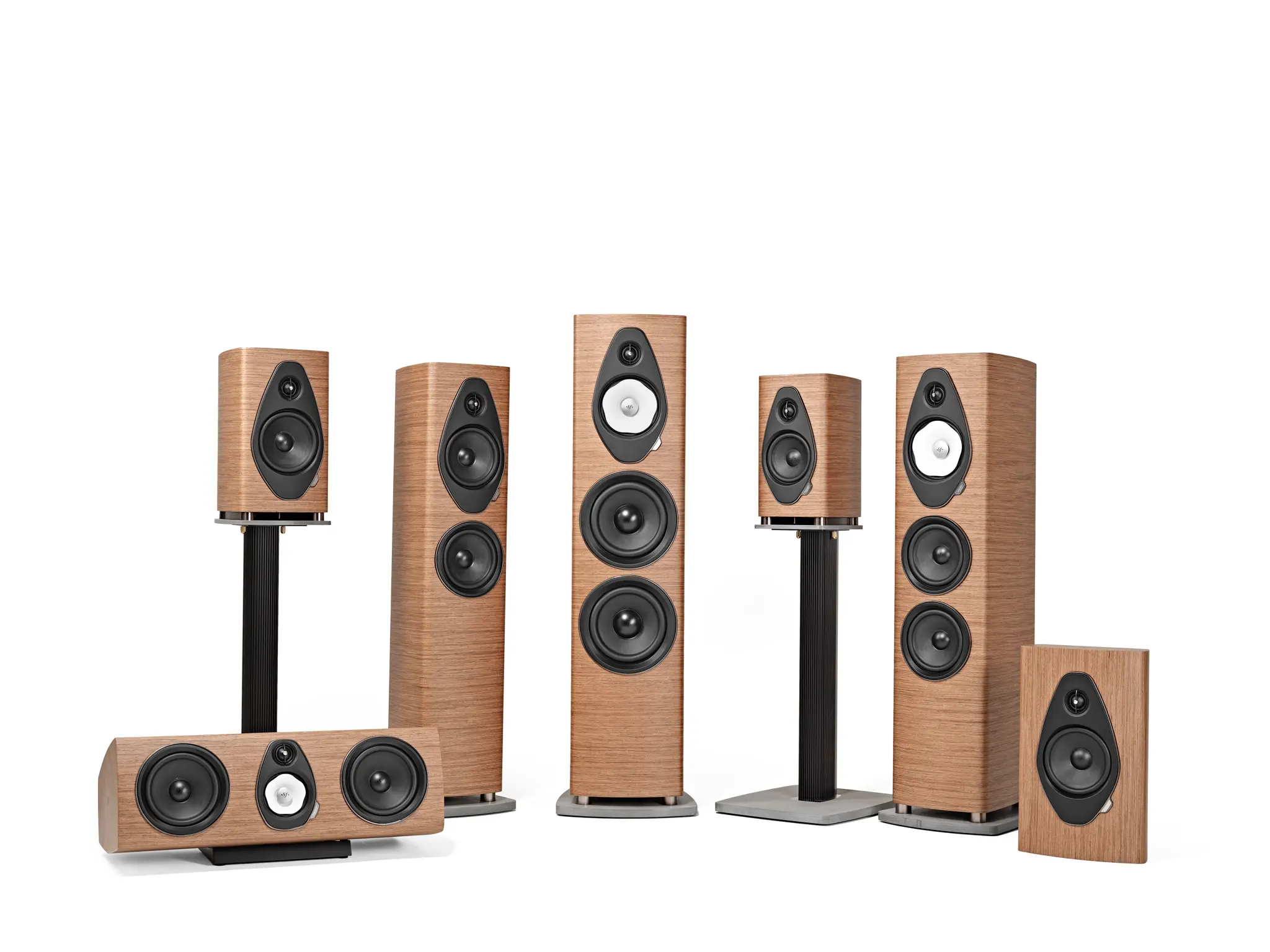
The Sonetto G2 speakers at a glance
| Sonetto I G2 | Sonetto II G2 | Sonetto III G2 | Sonetto V G2 | Sonetto VIII G2 | |
|---|---|---|---|---|---|
| Format | Bookshelf, 2-way | Bookshelf, 2-way | Floorstanding, 2.5-way | Floorstanding, 3-way | Floorstanding, 3-way |
| Bass / midrange | Cellulose mid/bass | Cellulose mid/bass | 165 mm + 165 mm | 165 mm Camelia midrange, 2 x 165 mm woofers | 165 mm Camelia midrange, 2 x 200 mm woofers |
| Crossover | 2.1 kHz | 3.1 kHz | 2.7 kHz | 280 and 2,500 Hz | 350 and 2,500 Hz |
| Response (-6 dB) | 52 Hz to 40 kHz | 42 Hz to 40 kHz | 38 Hz to 40 kHz | 38 Hz to 40 kHz | 33 Hz to 40 kHz |
| Sensitivity | 86 dB | 87 dB | 88 dB | 89 dB | 90 dB |
| Recommended power | 30 to 150 W | 30 to 200 W | 50 to 220 W | 50 to 300 W | 60 to 400 W |
| Weight | 8.4 kg | 10.4 kg | 26 kg | 33.5 kg | 45 kg |
| Recommended room | Small spaces | Medium-sized | 18 to 35 m² | 22 m² minimum | 30 m² minimum |
All share a 28 mm dome tweeter and a 4-ohm impedance. The Sonetto I and II G2 feature dual binding posts inherited from the Olympica range (bi-wiring or bi-amping); the floorstanders come with decoupling spikes.
Sonetto I G2 and Sonetto II G2: the bookshelf speakers
The Sonetto I G2 (86 dB, response from 52 Hz) is the answer for small spaces: a wide, three-dimensional soundstage, punchy and controlled bass, precise treble without harshness. The Sonetto II G2 (87 dB) reaches down to 42 Hz and targets medium-sized rooms, with beautifully present vocals. With the Sonetto I and II G2, placement can triple the result: Franck got his best results on the Sonetto Stand G2, with the speakers 2.5 m apart and 50 or 60 cm from the rear wall.
Sonetto III, V and VIII G2: the floorstanders
The Sonetto III G2, the first floorstander in the range, is an 88 dB 2.5-way design in which the 165 mm midrange and woofer each have their own chamber. The Sonetto III G2 is ideal for rooms of 18 to 35 m² with mid-range electronics, thanks to taut, articulate bass.
The Sonetto V G2, EISA Award 2025-2026, is a true 89 dB 3-way design with a Camelia midrange in a sealed cork enclosure. The Sonetto V G2 delivers remarkable performance in rooms of around 30 m² with very good electronics, with a less colored, more transparent sound than the Sonetto III G2.
The Sonetto VIII G2 entrusts the bass to two 200 mm woofers and reaches down to 33 Hz, with a sensitivity of 90 dB. In a room of 30 to 40 m² and with electronics that can deliver current, the Sonetto VIII G2 offers very organic timbres and excellent dynamics.
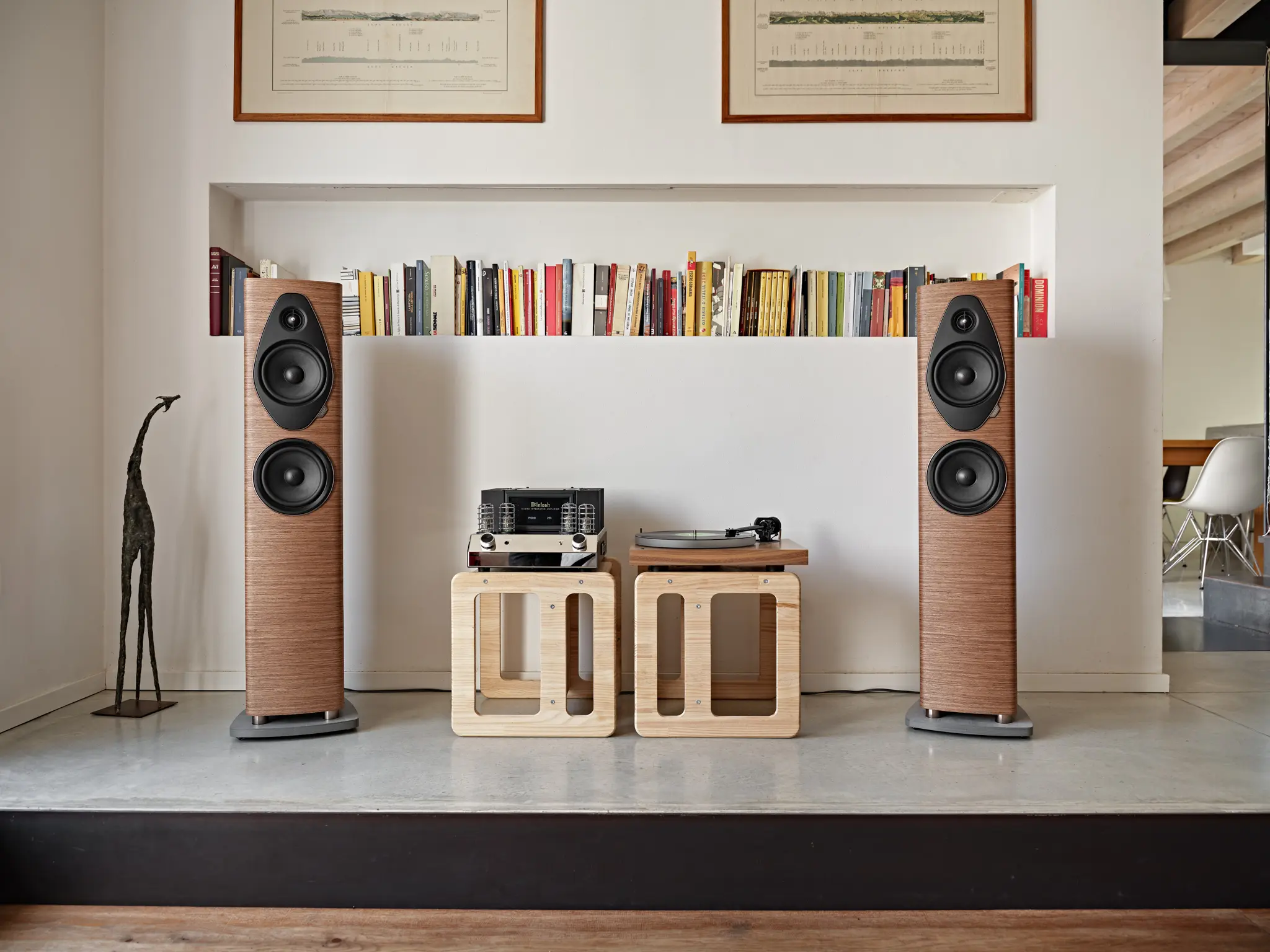
Key takeaways: the Sonus Faber Sonetto range
Sonetto I G2 for small spaces, Sonetto II G2 for medium-sized rooms, Sonetto III G2 for 18 to 35 m², Sonetto V G2 from 22 m², Sonetto VIII G2 for 30 to 40 m². Both bookshelf models perform best on the Sonetto Stand G2.
Recommended pairings for the Sonetto G2 range
| Speaker | Recommended pairing | Why? |
|---|---|---|
| Sonetto I G2 | Rega Elicit MK5 + Sonetto Stand G2 stands + Gravis I subwoofer | 105 W into 8 ohms, 162 W into 4 ohms, MM phono stage: the “good amplifier” this speaker demands. Stands and subwoofer are among our experts’ recommendations; Franck tested the Gravis I with the Sonetto I, crossover at around 55/60 Hz. |
| Sonetto II G2 | Musical Fidelity M5 xi + Sonetto Stand G2 stands + Gravis II subwoofer | 160 W into 8 ohms and 240 W into 4 ohms according to its specifications, MM/MC phono stage. The Gravis II was tested with the Sonetto II, crossover at around 50 Hz (the Gravis I, also recommended, suits tighter budgets). |
| Sonetto III G2 | Atoll IN300 EVO + Atoll ST200 Signature network player | 2 x 150 W, dual-mono: the mid-range electronics recommended by Franck. The ST200 adds a DAC, preamp and streaming (Qobuz, Tidal, Deezer) for a coherent Atoll system. |
| Sonetto V G2 | McIntosh MA 252 + Gold Note DS-10 EVO network player + Atlas Hyper Speaker 3.5 R1 cables | Hybrid tube/transistor design, 100 W into 8 ohms and 160 W into 4 ohms, MM phono stage: tube warmth in the service of timbre. The Roon Ready DS-10 EVO connects to the MA 252 via XLR. |
| Sonetto VIII G2 | McIntosh MA 352 + McIntosh DS200 network player + Transparent The MusicWave Plus cables | 200 W into 8 ohms and 320 W into 4 ohms: the current this large floorstander demands. The DS200 (32-bit / 384 kHz DAC) connects to the MA 352 in balanced mode for a coherent McIntosh system. |
Sonus Faber Concertino G4 Maestro Edition: the 30th-anniversary limited series
The Concertino G4 celebrates the thirtieth anniversary of the original Concertino, in a limited series of 300 pairs. Sonus Faber presents it as a “masterpiece” in the sense of the Renaissance workshops, where the journeyman became a master. It retains the brand’s historic trapezoidal monitor shape.
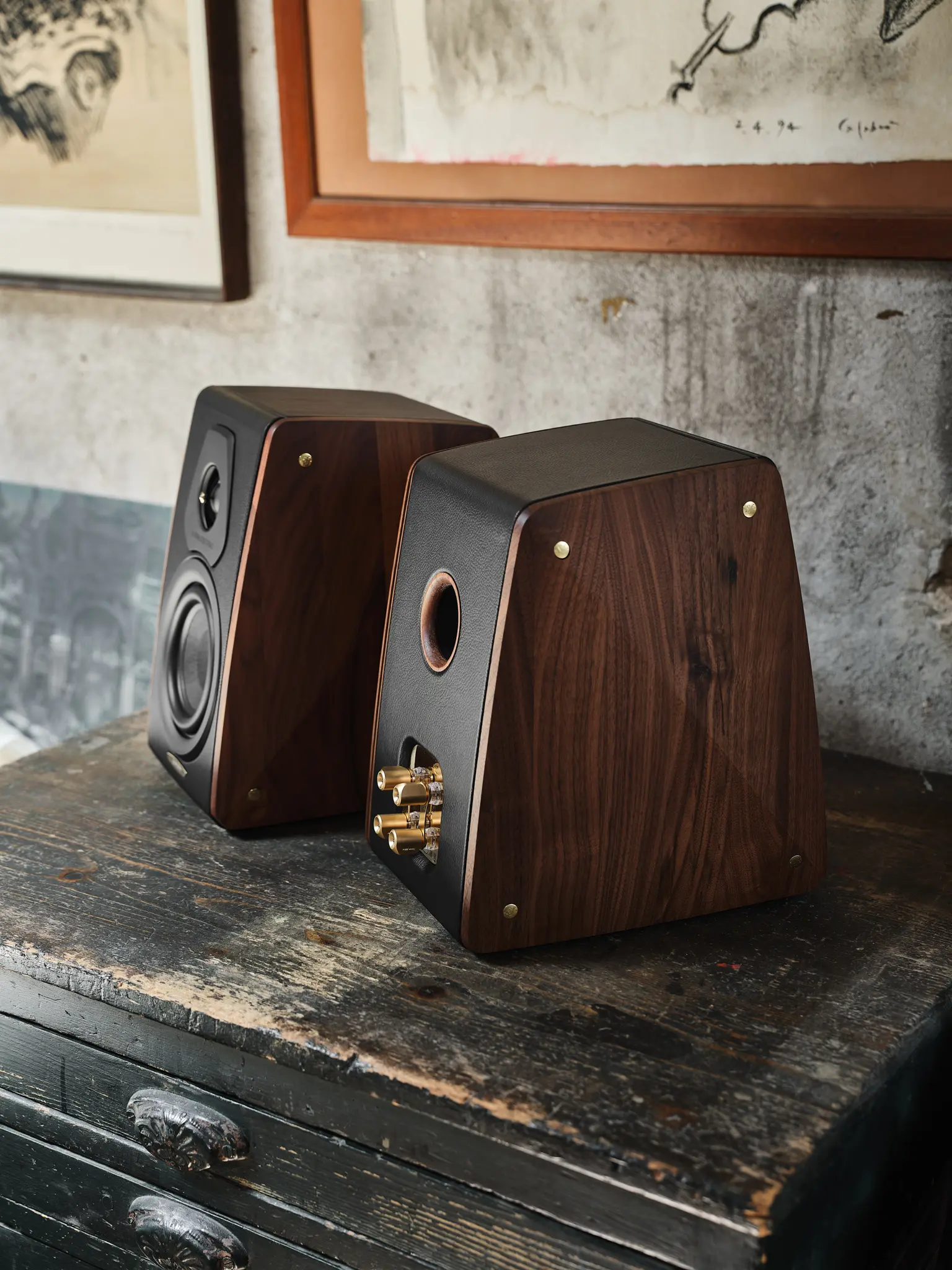
Concertino G4 Maestro Edition at a glance
Type: 2-way bass-reflex bookshelf speaker (solid wood rear port).
Drivers: 28 mm DAD dome tweeter; 135 mm mid/bass in cellulose pulp and natural fibers, cast aluminum basket.
Crossover and response: 1.7 kHz, minimalist crossover; 60 Hz to 25 kHz (-3 dB).
Sensitivity and impedance: 85 dB, 4 ohms.
Recommended power: 30 to 150 W: solid-state of at least 80 W, or tube of more than 40 W.
Cabinet: very rigid cork, solid walnut side panels, Ohoskin covering (a leather alternative made from orange and cactus, 100% vegan).
Dimensions and weight: 314 x 214 x 297 mm, 6.6 kg per speaker.
Heard on its Concertino Stand in steel and solid wood, it delivers a highly refined sound, with a strikingly realistic midrange and a musicality full of emotion and nuance. One customer listens to it with an Atoll amplifier and describes a clear, precise and dynamic sound.
Recommended pairings for the Concertino G4 Maestro Edition
| Speaker | Recommended pairing | Why? |
|---|---|---|
| Tube option | Audio Research I/50 + Concertino Stand stands | 50 W tube amplifier (6550WE): above the 40 W recommended for a tube amp, for a pairing of great finesse. |
| Solid-state option | Atoll IN300 EVO + Concertino Stand stands | 2 x 150 W, dual-mono, well above the recommended 80 W: the pairing chosen by a delighted customer. |
Sonus Faber Gravis subwoofers and dedicated stands
Gravis I or Gravis II: which Sonus Faber subwoofer?
Bookshelf speakers often lack deep bass. The Gravis I and Gravis II subwoofers, designed for the Sonetto and perfectly matched to the Lumina, fill that gap; Sonus Faber introduced its first subwoofer as early as 1986. Both connect at high level (Speakon, cable supplied) to the speaker’s or amplifier’s terminals, and radiate through 360° via a driver mounted underneath the cabinet.
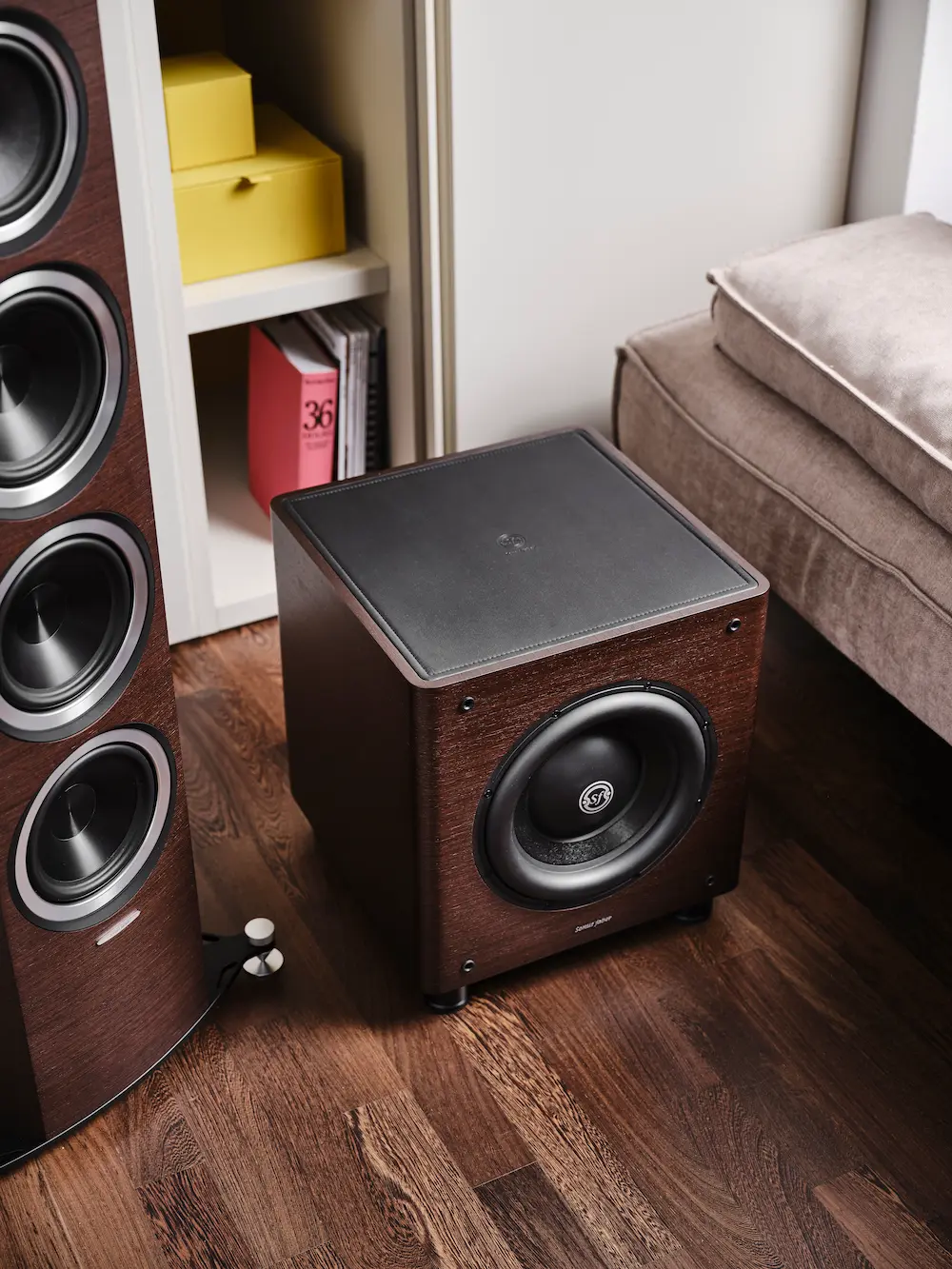
The Gravis subwoofers at a glance
| Gravis I | Gravis II | |
|---|---|---|
| Enclosure | Sealed | Passive radiator |
| Drivers | 1 x 210 mm, down-firing | 1 x 260 mm active, down-firing + 1 x 260 mm passive, front-firing |
| Amplification | Class AB, 150 W (250 W peak) | Class AB, 350 W (700 W peak) |
| Response (-6 dB) | 30 to 120 Hz | 25 to 120 Hz |
| Controls | Crossover 30 to 120 Hz, phase 0/180°, separate Line and LFE levels, On/Auto | Same as Gravis I |
| Dimensions and weight | 334 x 286 x 316 mm, 14.5 kg | 404 x 356 x 408 mm, 21.5 kg |
| Tested pairings | Sonetto I G2 (crossover 55/60 Hz), Lumina, Lumina III | Sonetto II G2 (crossover around 50 Hz), Sonetto III G2 |
In listening, what stands out most is the scale and space gained by adding one or two octaves of bass: more body on voices and strings, more realistic bass playing, better-respected timing. In our view, the Gravis I is “almost a no-brainer” with the brand’s speakers; the more powerful Gravis II stays tight and articulate, even at low volume. Browse all our subwoofers.
The Sonetto Stand G2 and Concertino Stand
The Sonetto Stand G2, sold in pairs, combine an aluminum column with a concrete base (700 mm high, 7.4 kg per stand), with decoupling spikes and cable management: they are perfectly suited to the Sonetto I and II G2. The Concertino Stand, in steel and solid wood (14.5 kg per stand), come with heavy-duty spikes, brass spike shoes and screws to secure the speaker. Our full range of speaker stands is available online.
Which Sonus Faber speaker should you choose for your room?
Room size and the amplification you have matter far more than the speaker format.
Choosing your Sonus Faber speaker at maPlatine.com
| Your room | Our selection | Key strength | Flagship pairing |
|---|---|---|---|
| Small room (8 to 20 m²) | Lumina I, Sonetto I G2 | Tonal accuracy, surprising bass for the size | Sonetto I G2 + Sonetto Stand G2 + Gravis I |
| Medium-sized or small room | Lumina II, Lumina Amator II, Sonetto II G2 | Three-dimensional soundstage, swing, realistic vocals | Lumina Amator II + Viard Silver HD12 HP |
| Room of 18 to 35 m² | Lumina III, Sonetto III G2 | Taut bass, warm timbres | Sonetto III G2 + Atoll IN300 EVO |
| Large room (over 30 m²) | Lumina V, Lumina Amator V, Sonetto V G2 | Scale, soundstage depth, transparency | Sonetto V G2 + McIntosh MA 252 |
| Room of 30 to 40 m² | Sonetto VIII G2 | Bass from 33 Hz, very organic timbres | Sonetto VIII G2 + McIntosh MA 352 |
| Exceptional system | Concertino G4 Maestro | Refinement, strikingly realistic midrange | Concertino G4 + Concertino Stand + Audio Research I/50 |
FAQ – Your questions about Sonus Faber speakers
How much amplifier power does a Sonus Faber speaker need?
All the Sonus Faber speakers in our selection have a 4-ohm impedance. Recommended power ranges from 30 to 100 W for the Lumina bookshelf models, up to 70 to 300 W for the Lumina V and Amator V, from 30 to 150 W for the Sonetto I G2 and up to 60 to 400 W for the Sonetto VIII G2. For the Concertino G4 (85 dB), choose a solid-state amplifier of at least 80 W or a tube amplifier of more than 40 W.
Are Sonus Faber speakers sold with their stands?
No. The Sonetto I G2 and Sonetto II G2 are sold without stands; their dedicated Sonetto Stand G2 (700 mm, aluminum and concrete) are sold in pairs. The Concertino G4 is designed for its Concertino Stand, also sold separately. For the Lumina II and Lumina Amator II, we recommend rigid stands of 60 to 90 cm and 60 to 75 cm respectively.
Can you listen to vinyl with Sonus Faber speakers?
Yes, provided a phono preamp is included in the system: a cartridge’s signal must be amplified and equalized (RIAA curve) before it reaches the amplifier, and a DAC card does not replace a phono stage. Several amplifiers in our pairings have a built-in phono input (Rega Elex MK4 and Elicit MK5 for MM, Musical Fidelity M5 xi and M6 xi for MM/MC, McIntosh MA 252 and MA 352 for MM); with a Rega Aethos, or an Atoll IN300 EVO without its phono card, plan an external phono preamp. Our guide Phono preamplifiers explains this link in the chain, and our Acoustic Signature selection will help you choose a turntable.
Where are Sonus Faber speakers made?
The Sonus Faber Lumina, Lumina Amator, Sonetto G2 and Concertino G4 speakers are made in Italy. The Lumina and Lumina Amator are hand-assembled at the Sonus Faber factory in Arcugnano; the Concertino G4 and its Concertino Stand are stated as Made in Italy.
How can I listen to Sonus Faber speakers before buying?
maPlatine.com has a Hi-Fi listening room in Rennes, open by appointment. Contact our team on +33 (0)2 99 65 41 63, Monday to Friday from 9 am to 5 pm (Paris time), to find out which Sonus Faber models are available for listening and to build your system with our experts. We can also look into a trade-in of your old equipment.
Sonus Faber at maPlatine.com: Italian craftsmanship within listening reach
More than forty years after Franco Serblin’s first loudspeakers, Sonus Faber remains true to a simple idea: a loudspeaker is an instrument, and it must be built like one. Real wood, leather, cork, cellulose-fiber drivers and Italian manufacturing: nothing is left to chance, from the entry-level model to the limited series.
At maPlatine.com, we have selected the best of each range, and paired each speaker with the electronics, sources and cables that serve it best. Whether you are looking for the compact Lumina I, the EISA award-winning Sonetto V G2 or the rare Concertino G4 Maestro, our team is here to advise you.
Need personalised advice?
Our technicians will help you choose the turntable best suited to your needs, your cartridge and your budget, and will check that your analogue system is working properly.
Telephone: 0 810 810 121, Monday to Friday, 9am to 5pm.
maPlatine.com Auditorium in Rennes: comparative listening sessions by appointment. Every turntable is checked and adjusted by our technicians before dispatch.