Today's hi-fi market offers a wide range of hi-fi speakers. For audiophile listening, there are two main types of speakers: bookshelf (also called compact or monitor) speakers and floorstanding speakers, each with its own characteristics. But how do you choose between bookshelf speakers and floorstanding speakers? To help you answer that question, maPlatine.com shares a few tips so you can make the choice that best suits your needs.
1. Bookshelf or floorstanding speakers: choosing based on placement
2. Bookshelf or floorstanding speakers: choosing based on the size of your listening room
3. Bookshelf or floorstanding speakers: choosing based on the sound you're looking for
4. Bookshelf or floorstanding speakers: choosing based on your hi-fi equipment
5. Bookshelf or floorstanding speakers: choosing based on your budget
1. Bookshelf or floorstanding speakers: choosing based on placement
When setting up a hi-fi system, you need to decide beforehand how the components will be arranged, where they will go, and how much space they will take up.
When it comes to hi-fi speakers, you need to know how much space you're willing to give them. For example, if you want something with a small footprint or a format that blends more easily into your interior, bookshelf speakers will probably be the best fit.

Being smaller than floorstanding speakers, they are easier to position. You can place them on a piece of furniture or on speaker stands, which remain less "visually" imposing than floorstanding models. Beware of their misleading name, though: no audiophile will ever advise you to put them on a bookcase shelf, as this tends to "compress" the sound!
For optimal listening, it is also recommended to have the speaker's tweeter at the same height as the listener's ears. Choosing a monitor speaker makes this easier since, as mentioned above, its placement is easier to adapt and fine-tune.
2. Bookshelf or floorstanding speakers: choosing based on the size of your listening room
Another criterion to consider when choosing between bookshelf and floorstanding speakers is the size of your listening room. Depending on it, one type of speaker will be better suited than the other.
If your listening room is relatively small (under 30 m²), bookshelf speakers are the most recommended option. For example, the Q Acoustics 3010i NEW speakers deliver excellent results in a 15 m² room. In a small room, a floorstanding speaker is not recommended, as it won't be able to express its full sonic potential.

If your listening room is relatively large, i.e. over 30 m², choosing floorstanding speakers seems more obvious given their larger size. This allows them to fill the whole space while you listen.
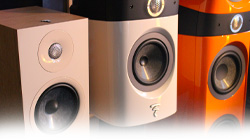
That said, in this scenario, a compact speaker can also fit in perfectly. For example, a pair of Focal Sopra 1 bookshelf speakers will deliver results as good as some floorstanding speakers in a 40 m² room!

3. Bookshelf or floorstanding speakers: choosing based on the sound you're looking for
Depending on the sound you want, your choice of hi-fi speakers may differ. This is mainly due to the size of the speakers, which plays a role in the sound they reproduce: the wider and taller a hi-fi speaker is, the more coloration there may be.
Being smaller, a bookshelf speaker will therefore offer a less colored sound. Thanks to its compact size, this type of speaker also delivers more detailed sound, as is the case with the Monitor Audio Bronze 2 bookshelf speakers. So if that's the kind of sound you're after, a bookshelf speaker may be right for you!

However, if you're looking for bass or a wide, deep soundstage, a floorstanding speaker will certainly be a better choice, such as the Balthus 90 from Davis Acoustics. This type of hi-fi speaker very often delivers a more intense and immersive sound. Worried about the risk of colored sound due to the larger size of a floorstanding speaker? Don't be: floorstanding speaker manufacturers now use technologies to minimize this phenomenon as much as possible!

4. Bookshelf or floorstanding speakers: choosing based on your hi-fi equipment
To unlock the full sonic potential of your pair of hi-fi speakers, you also need to make sure that the hi-fi components upstream, especially the amplifier, have enough power to "drive" them.
The power offered by the amplifier can give you an indication of the type of hi-fi speakers to choose. In theory, and depending on the range, a bookshelf speaker will require less power than a floorstanding speaker.
Bear in mind that most integrated amplifiers available on the market today can be paired with a wide range of hi-fi speakers, both bookshelf and floorstanding.
For example, Pro-Ject's Speaker Box 5 bookshelf speakers require a minimum of 10 watts, while floorstanding speakers such as Focal's Chorus 726 need at least 40 watts!

To help you choose the speakers that best suit your equipment, we've put together a guide titled “How to Choose Hi-Fi Speakers.” Feel free to check it out!
5. Bookshelf or floorstanding speakers: choosing based on your budget
Budget remains an important factor in the final decision, as it does for any hi-fi component. There are significant price differences between hi-fi speaker models.
Since bookshelf speakers are more compact and have fewer drivers, they require fewer materials to manufacture, which has an impact on price. Within the same range, compact speakers will therefore cost less than floorstanding models. This is the case, for example, with the Monitor range from Monitor Audio or the Aria range from the French brand Focal.

Of course, some floorstanding speakers are cheaper than some bookshelf speakers. This simply comes down to the materials and technologies used by the manufacturer. The price of a pair of hi-fi speakers can therefore range from a few hundred euros to several thousand euros, whichever format you choose!
When setting the budget for buying a pair of hi-fi speakers, you should also factor in any accessories you might add. Bookshelf speakers can be paired with speaker stands to optimize the sound, but this comes at an extra cost. Floorstanding speakers, on the other hand, by definition don't need stands. Most floorstanding speakers come with decoupling spikes as standard, but if not, you can add some to limit vibrations from the floor, all at little cost. This is also worth considering when choosing between bookshelf and floorstanding speakers!

*****
We hope these few tips will help you make your choice between bookshelf and floorstanding speakers. If you'd like more information, our technicians are available by phone (+33 810 810 121) or by email (contact@maplatine.com).