Cambridge Audio offered, until recently, just a single network player. Keen to make this source more accessible, the British manufacturer is launching two new, more affordable machines: the Cambridge AXN10 and the Cambridge MXN10. The latter is the simplest and most compact version. These two newcomers distil the brand's decades of streaming expertise.
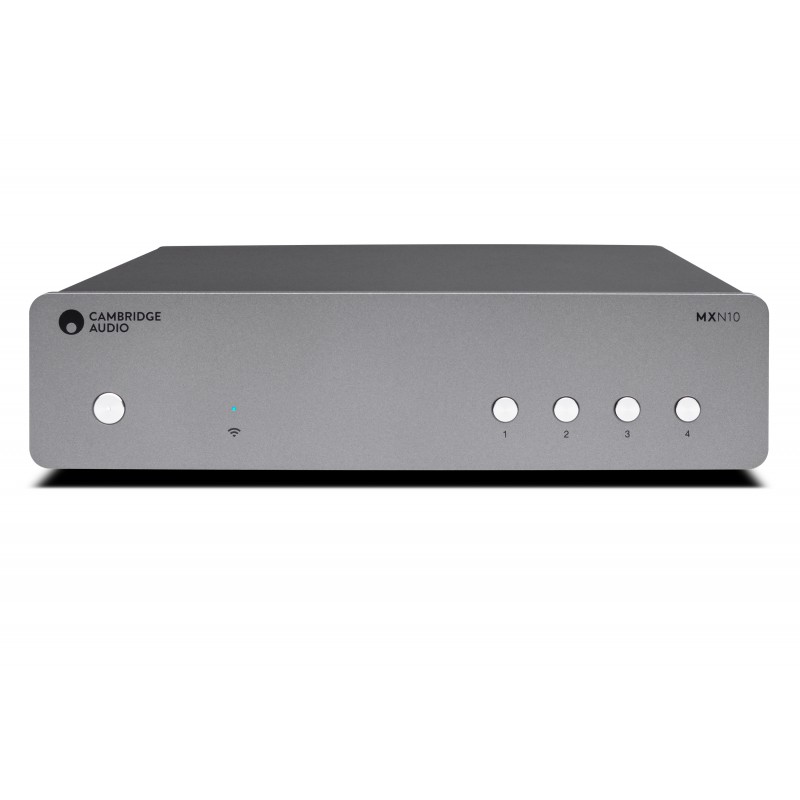
CAMBRIDGE AUDIO MXN10: front panel
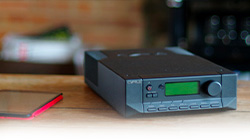
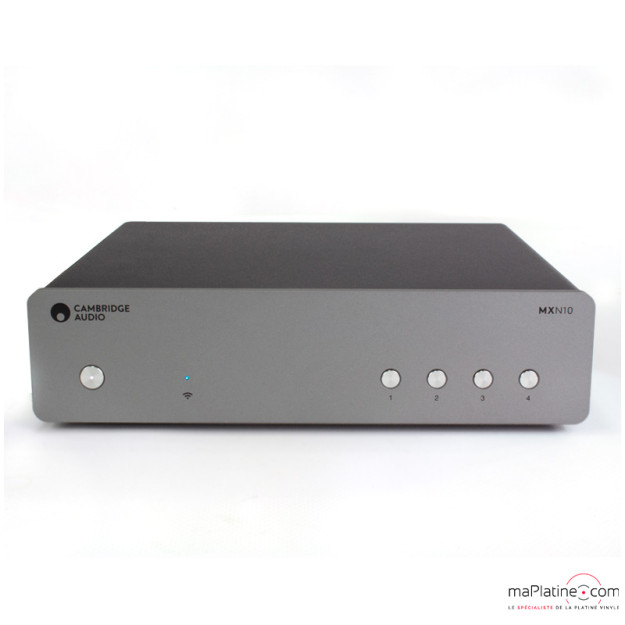
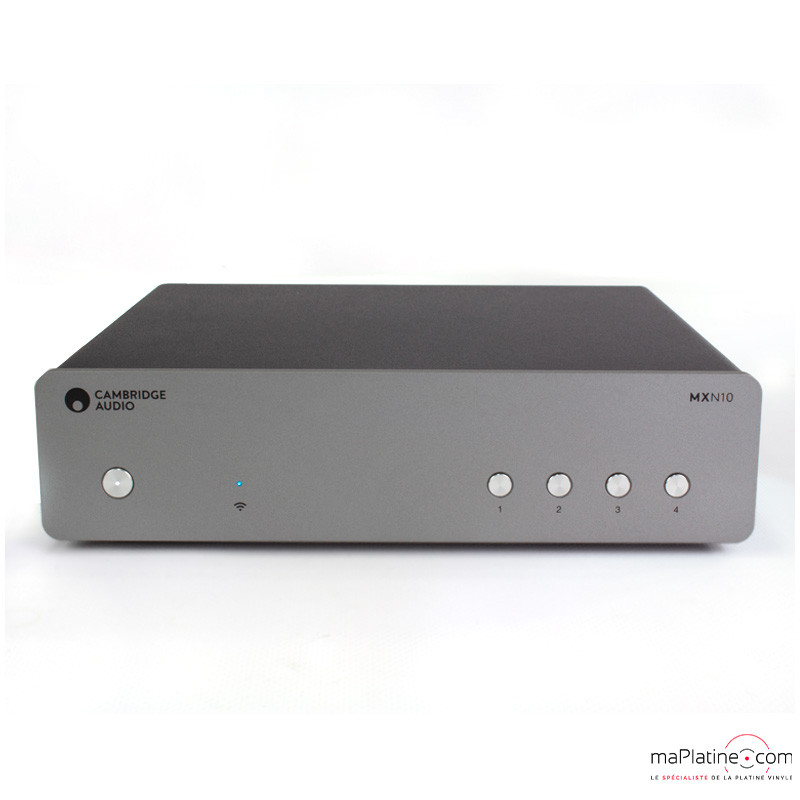
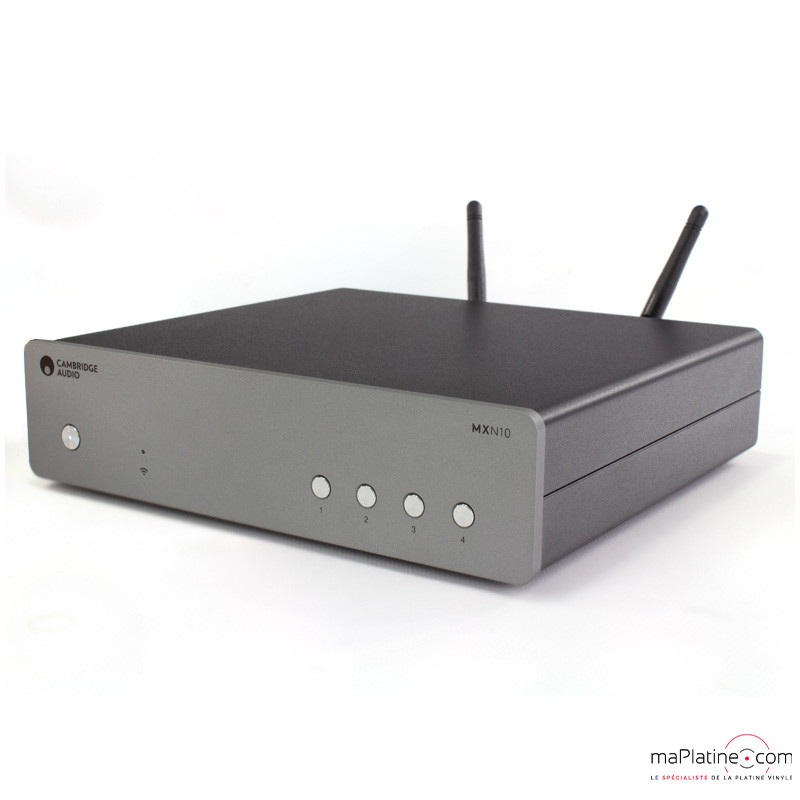
The Cambridge MXN10 network player is housed in an anthracite steel half-chassis also found in other products from the manufacturer (DacMagic 200M, Alva Duo phono preamplifier). The front panel is aluminium, offered in a single, now classic finish: "Lunar Grey".
On this front panel are four small touch buttons that can be programmed for direct access to Internet radio stations and favourite playlists. Another button powers the unit on, and a small blue LED shows that the Bluetooth connection is active.
CAMBRIDGE AUDIO MXN10: rear panel
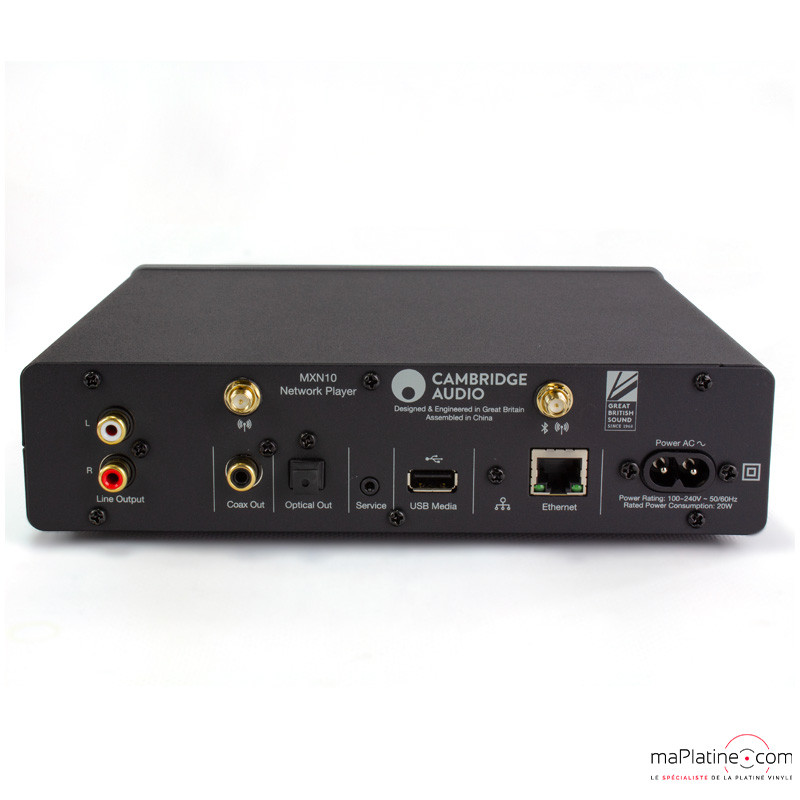
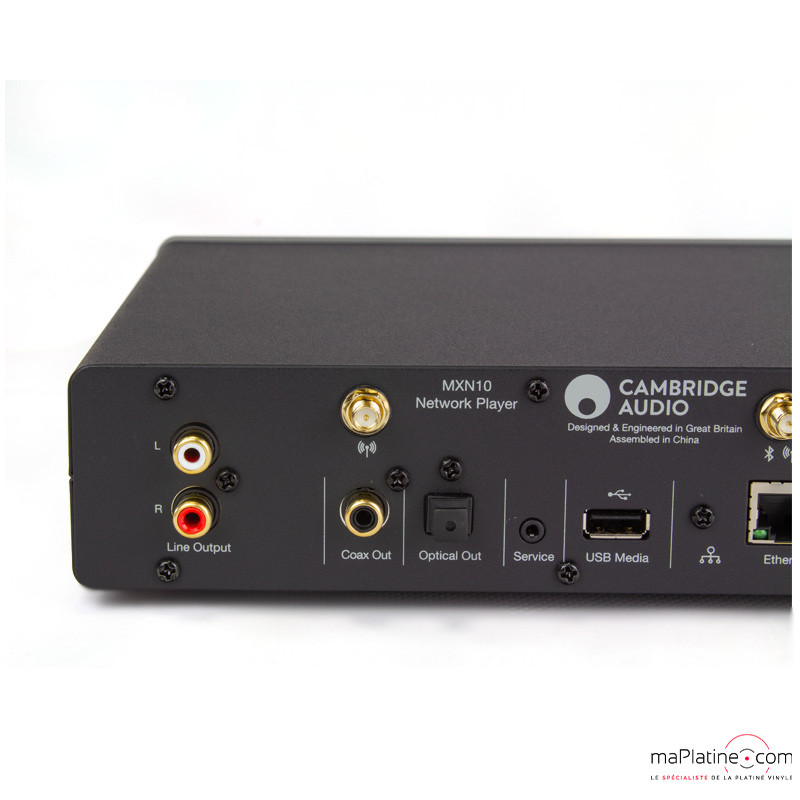
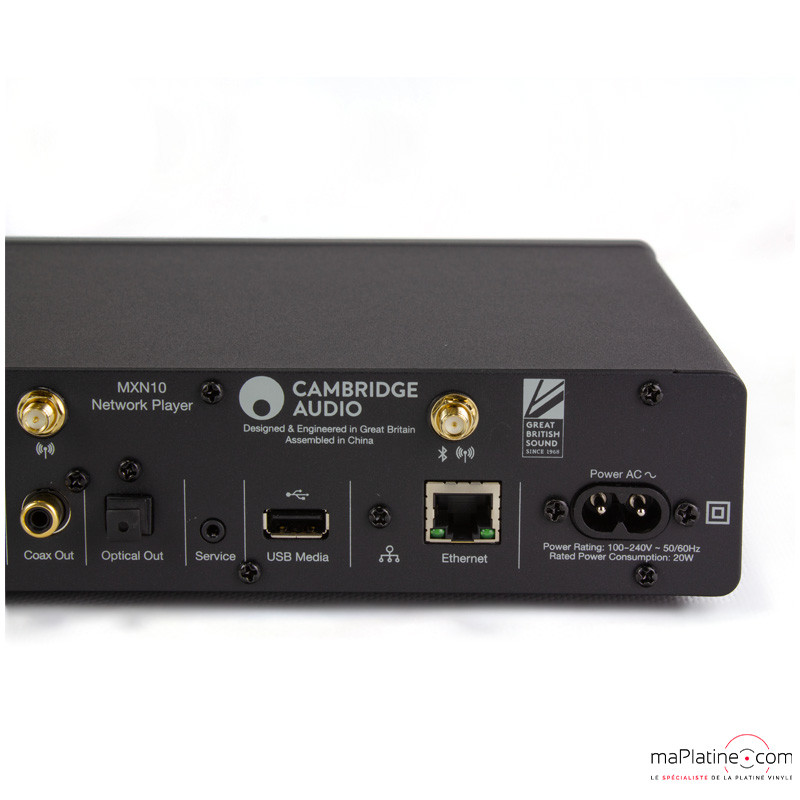
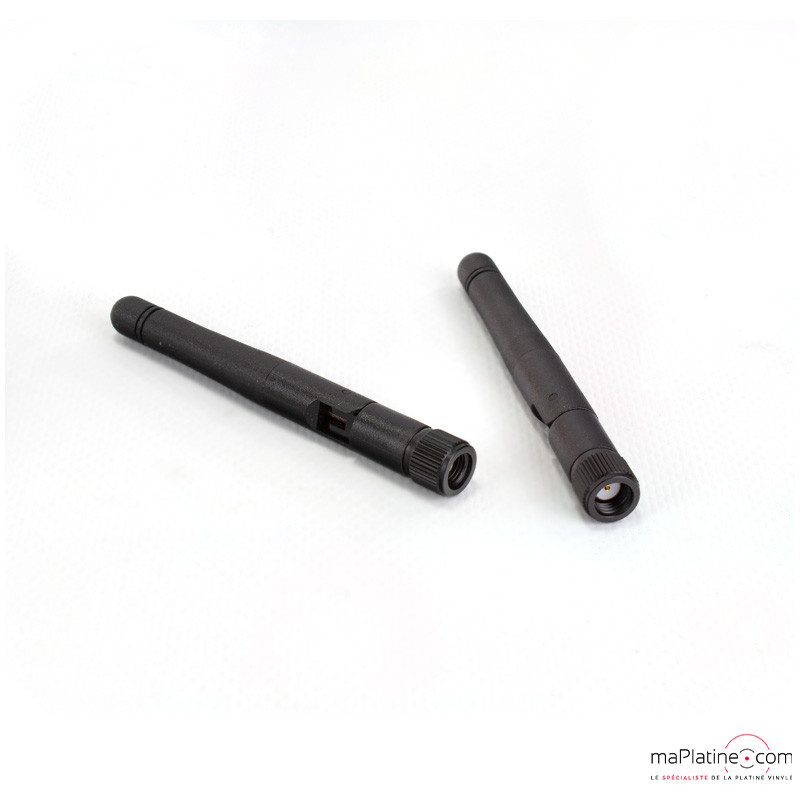
Despite the unit's small size, the back of the Cambridge MXN10 network player is well stocked. There is of course an analogue RCA output. Added to this are a coaxial digital output and an optical digital output. There is also a USB input, an Ethernet LAN socket (RJ45) and two mini antennas, one for Wi-Fi and one for Bluetooth. The MXN10's analogue and digital outputs work simultaneously, so these sources can be used within a multiroom setup.
CAMBRIDGE AUDIO MXN10: connectivity and technology
The Cambridge MXN10 network player is controlled by the 4th generation StreamMagic Gen4 app, developed specially by Cambridge. It has been considerably improved to offer more throughput, for ideal streaming quality, up to PCM 32-bit/768 kHz and DSD512 formats.
The MXN10 network player can access high-resolution streaming services such as Internet radio, Spotify Connect, Tidal, Qobuz and Deezer. The MXN10 is also Roon Ready, has a Bluetooth V5.0 module, and is fully compatible with Apple AirPlay 2 and Chromecast.
The Cambridge MXN10 network player can access free music, including Internet radio, as well as subscription services. It can also play high-resolution music from USB drives and NAS.
Cambridge has not cut corners on D/A conversion. The MXN10 gets the excellent ESS Sabre ES9033Q DAC, which guarantees first-rate performance and musicality.
CAMBRIDGE AUDIO MXN10: testing and listening
To start, you'll need to download the Cambridge app.
The StreamMagic Gen 4 app was developed in London for uncompromising Hi-Fi sound and remarkable streaming performance. It is very intuitive to use and stays simple and effective.
From the very first measurements, you notice that the MXN10 network player is transparent enough to make the most of high-resolution tracks. The sound is full and precise while remaining very neutral and realistic. The MXN10 offers a clean, very expressive sound with remarkable dynamics. It's surprising to see the progress made over the last 5 years in network players and digital music.
Of course, the Bluetooth connection often gives noticeably poorer results than the others, and it's best avoided with this unit where possible, as with most digital devices.
The Cambridge MXN10 network player offers remarkable performance at the price it's sold for, and its compact dimensions also make it a potentially attractive option for buyers who don't have much space.
FAQ: Everything you need to know before buying the Cambridge MXN10 network player
Which streaming services and wireless protocols are compatible with the MXN10?
The MXN10 can access high-resolution streaming services such as internet radio, Spotify Connect, Tidal, Qobuz and Deezer, directly from the StreamMagic app. It is also Roon Ready, has a Bluetooth V5.0 module, and is fully compatible with Apple AirPlay 2 and Chromecast. Find it in our DAC and network players section.
Which DAC does the Cambridge MXN10 use and what is the conversion quality?
Cambridge did not cut corners on conversion: the MXN10 features the excellent ESS Sabre ES9033Q DAC, which guarantees first-rate performance. This lets you enjoy ideal streaming quality up to PCM 32-bit/768 kHz and DSD512 formats. For more, read our guide DAC in Hi-Fi.
What connections are available on the back of the MXN10?
Despite the unit's small size, the rear is well equipped: there is an RCA analogue output, a coaxial digital output and an optical digital output. There are also a USB input, an Ethernet LAN socket (RJ45) and two mini antennas, one for Wi-Fi and one for Bluetooth.
How does the Cambridge MXN10 sound compared with a Bluetooth connection?
The MXN10 network player is transparent enough to take advantage of high-resolution tracks, with a full, precise reproduction while staying very neutral and realistic. The Bluetooth connection, on the other hand, often gives clearly inferior results and is best avoided where possible with this device.
FranckInputs: Ethernet, USB, Wi-Fi, Bluetooth
Outputs: Stereo RCA, digital (coaxial and optical)
DAC: ESS Sabre ES9033Q
Frequency response: 20 to 70,000 Hz
Bluetooth: V5.0 A2DP/AVRCP, supports SBC and AAC
Compatibility: UPnP, internet radio, Chromecast, Spotify Connect, Tidal, Qobuz, Roon Ready, AirPlay 2
Audio formats: ALAC, WAV, FLAC, AIFF, DSD (x512), WMA, MP3, AAC, HE AAC, AAC+, OGG Vorbis
Hi-Res support: up to 768 kHz, 32-bit PCM, DSD512
Power consumption: 20 W (max.), less than 0.5 W (standby)
Dimensions: 215 x 52 x 191
Weight: 1.2 kg







Customer reviews
Beaucoup, à prix raisonnable
maPlatine expédie à J+1 et Chronopost fait le reste. À force de le répéter, ça va finir par se savoir !
Mise en route du Cambridge MXN10 facile et intuitive y compris StreamMagic, l’appli de pilotage maison.
A – Comparaison directe entre Qobuz Hi·Res (24-bit 96 kHz) et CD sur un lecteur Arcam avec l’Histoire de Melody Nelson de Gainsbourg (Mercury). L’album est proposé en deux éditions : celle de base, et celle dite De Luxe avec des prises alternatives en prime. Verdict évident :
1. Le stream de base est étroit et sans texture. Autoradio FM ou MP3 ? J’ai failli tout remballer et renvoyer à maPlatine.
2. Car le CD le surpasse largement par un aigu détaillé et la présence propre et tendue du bas médium charnu de la ligne de basse électrique.
3. On passe au stream de l’édition De Luxe. Le pincement des cordes de la basse qui frisent sur les frettes, l’olive qui crachouille sur la charley, les harmonies du piano rageur dans L’Hôtel particulier, la subtile cavitation de la salive des occlusives de Gainsbourg. C’est ça ! Rien ne manque, pas même un léger battement sur le souffle des bandes d’origine.
Conclusion 1 : Le Cambridge est fidèle à ce qu’on lui fait lire. Pour le pire, qu’il n’embellit pas, comme le meilleur dont il transmet toutes les subtilités. La qualité des grands.
B – Comparaison directe stream contre CD avec des enregistrements moins sujets aux bidouillages hasardeux du marketing. En 16-bit 44,1 kHz tous les deux. Le Tricorne de Manuel des Falla avec Dutoit à Montréal (Decca, 1983) et Lopez-Cobos à Cincinnati (Telarc, 1987). Naim est le DAC-préampli commun. Pour les deux enregistrements de l’âge d’or du CD, le résultat est identique entre stream et galette.
Conclusion 2 : À la résolution du Red Book, le MXN10 est un lecteur CD. Et sacrément bon avec ça.
C – Les deux étant disponibles, comparaison directe des sorties numérique et analogique. Test avec les mêmes qu’en B.
Sur les deux enregistrements, la différence est imperceptible. Par la sortie numérique vers le DAC-préampli ou par l’analogique vers préampli, le résultat est quasi identique. Tout au plus, le DAC embarqué du CXN10 arrondirait-il un peu les angles, mais à peine.
Conclusion 3 : Prenez CXN10 tel qu’il est et ne vous posez pas la question d’un DAC externe. Le sien est parfait.
D – Un détour par un enregistrement d’époque. Le même Tricorne de Manuel de Falla avec Eduardo Toldrá et l’Orchestre national de la Radiodiffusion française (Columbia-EMI, 1957). Réédition par la Bibliothèque nationale de France qui a puisé dans ses vinyles en dépôt légal et les a numérisés en 24-bit 96 kHz. Du grand art !
Le Cambridge restitue la distance, la réverbération et le moelleux des prises de son de l’époque. Pourtant la soprano Consuelo Rubio et le picolo filent en douceur les « Cuco ! Cuco ! » Les timbales claquent, les cuivres pètent, les cordes sont soyeuses, le basson du Corregidor véhicule ironie et irrespect face au hautbois moqueur. Même le souffle inhérent au procédé est là, comme il se doit.
Conclusion 4 : Un bel outil pour redécouvrir les enregistrements légendaires pour ce qu’ils sont, avec leurs défauts et l’émotion de l’époque.
E – Câble réseau Audioquest Cinnamon ou Wifi ? Je n’ai pu l’évaluer en comparaison directe. Passer d’une configuration à l’autre prend une paire de minutes qui ont mis en échec ma faible mémoire auditive.
À ce prix, c’est une aubaine. Allez-y !