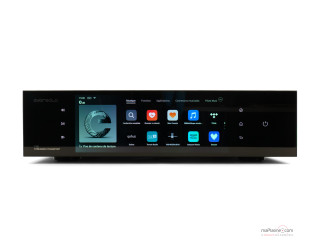
LAB 12 is recognised by audiophiles and music lovers for the quality of its tube electronics and for the musicality they deliver. The brand is best known for its phono preamplifiers but it also offers a surprising DAC, the DAC 1 Reference. In this new DAC, based on the same architecture and the same philosophy as the LAB 12 DAC 1 Special Edition, a successful model repeatedly awarded by the press, the brand set out to push the limits on every level, in order to obtain a sound as close as possible to the analogue original.
LAB 12 DAC 1 Reference: front panel
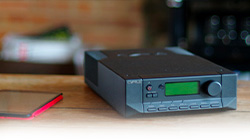
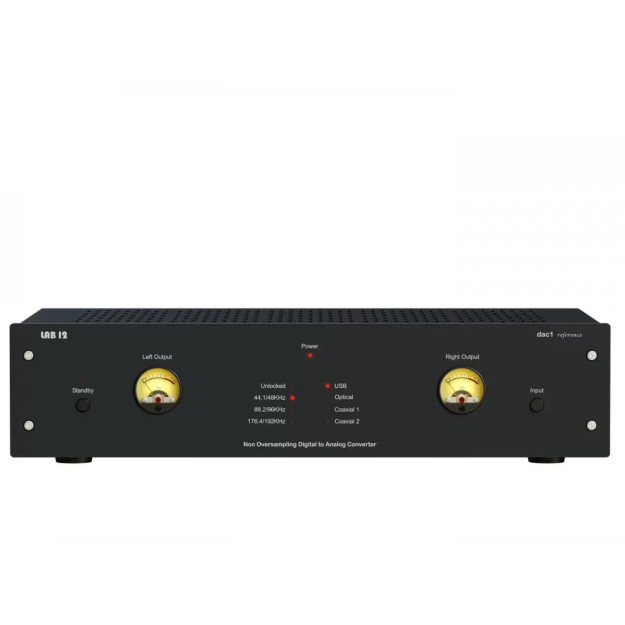
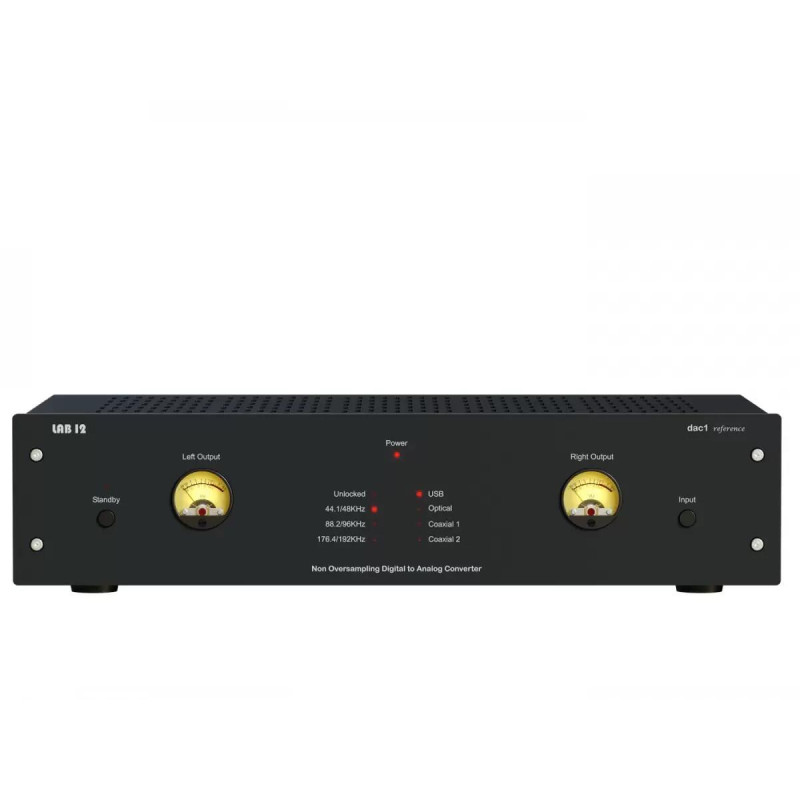
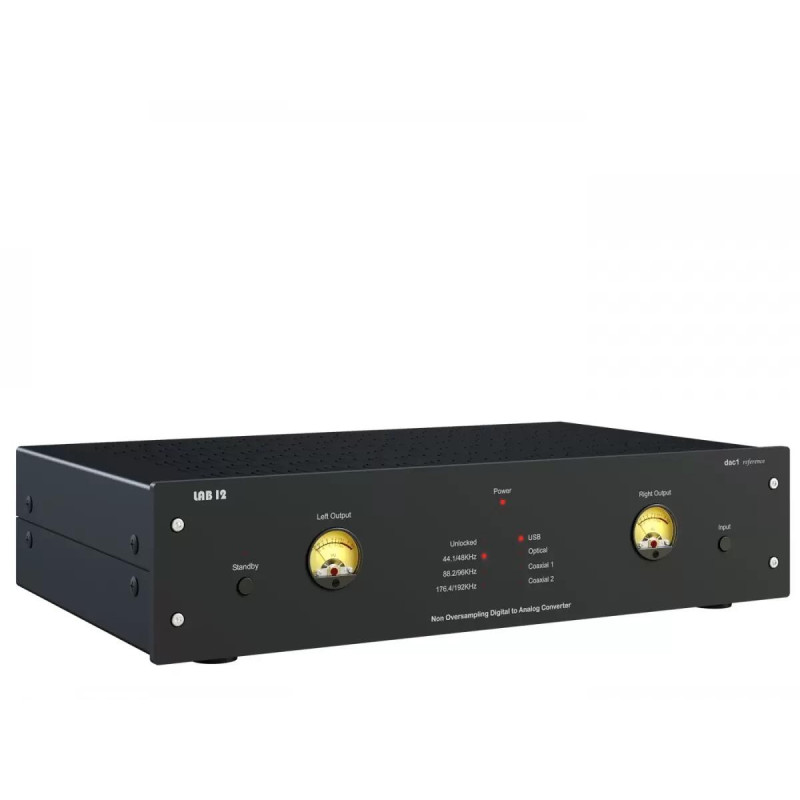
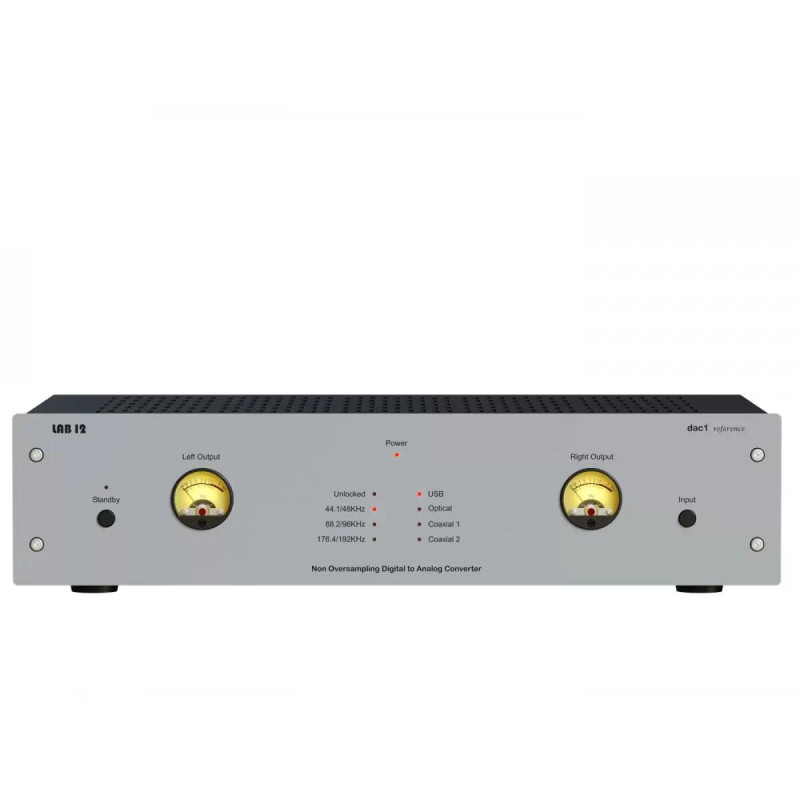
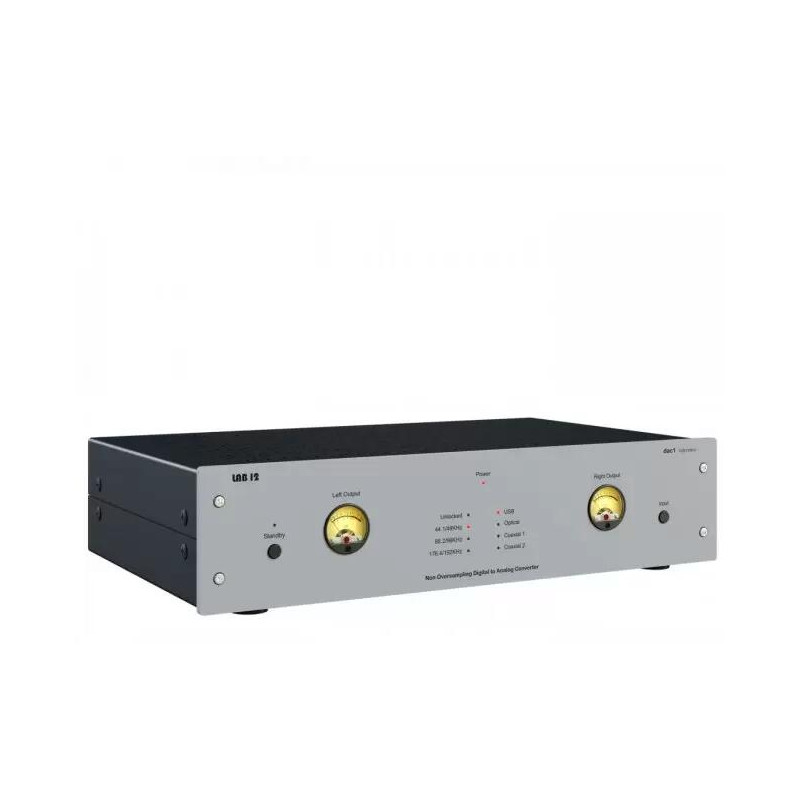
Like every product from this manufacturer, the DAC 1's aluminium front panel is very understated, even if it allows itself a few "vintage" flourishes. Left and right sit a VU meter showing the output level of each channel. At the centre of the panel are two vertical rows of four red LEDs. The left-hand row indicates the sampling frequency status and the right-hand row the selected input. A button on the right gives access to the various inputs.
LAB 12 DAC 1 Reference: connections
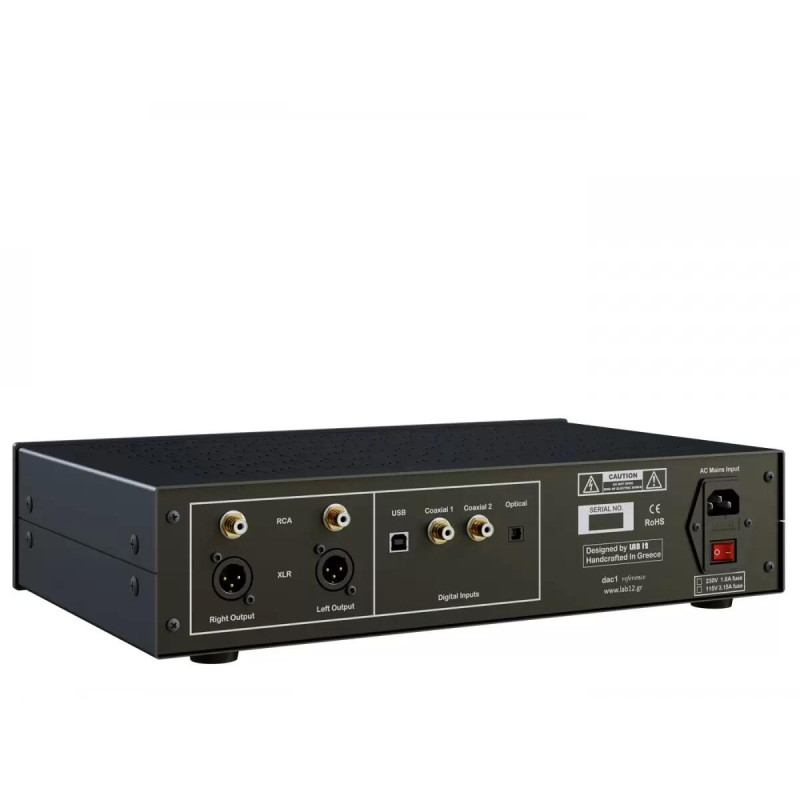
At the rear of the unit are 4 digital inputs: one USB-B, one Toslink optical and two RCA SPDIF. The outputs, for their part, are offered in RCA or XLR format. Power is supplied through a C13 IEC socket. It is worth using a high-quality power cable.
The RCA and XLR sockets are of excellent quality.
LAB 12 DAC 1 Reference: technology
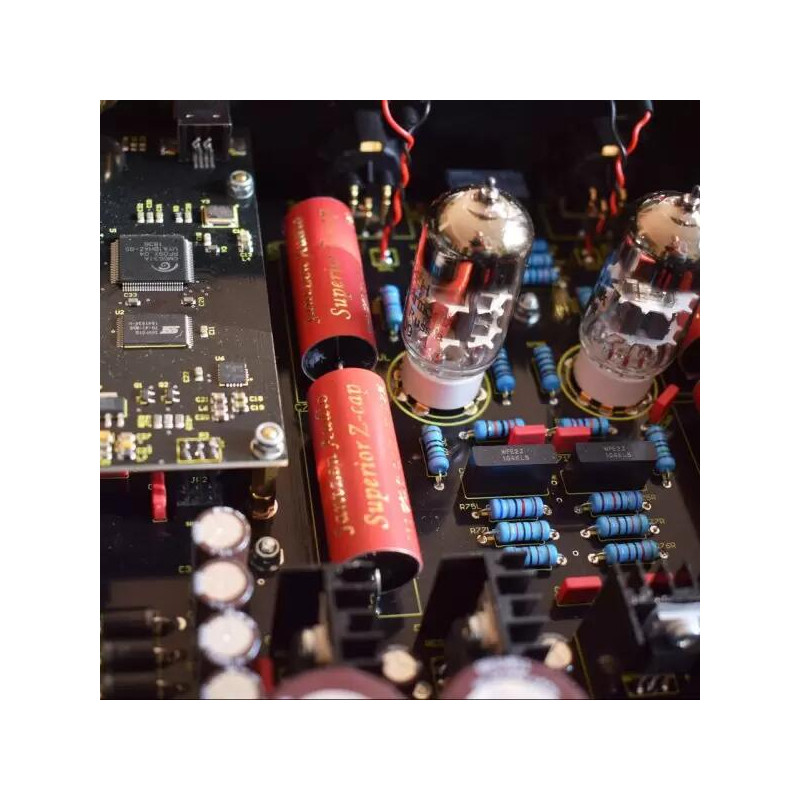
The DAC 1 Reference uses eight Philips TDA1543 multibit DAC chips, arranged in parallel, immediately after the digital input stage. The TDA1543 is an older Philips R-2R / multibit architecture, very different from modern delta-sigma DACs such as ESS Sabre or AKM. The point of the parallel arrangement is, in particular, to improve current capability and to reduce certain conversion errors.
The DAC 1 Reference also operates in Non-OverSampling mode. This means it does not resample the signal and does not use the classic digital oversampling filter found in most modern DACs. It accepts up to 24-bit / 192 kHz.
After conversion, the signal passes through an analogue dual-triode stage using two 6922 tubes. The manufacturer explicitly refers to a "dual triode tubes stage".
So the tubes are not there as a decorative buffer: they take a direct part in the current-to-voltage conversion and in shaping the richness of the analogue signal.
LAB 12 DAC 1 Reference: sound
The LAB 12 DAC 1 Reference is after naturalness, substance and embodiment rather than demonstration.
The midrange is slightly warm, rich and full-bodied, without becoming fat or coloured. Voices, of course, are particularly realistic and present.
The bottom end is full and deep while remaining textured, firm and dynamic, and even shows real authority on electronic music recordings.
It is paired with a treble that is smooth and fluid, with excellent transparency. Above all, there is none of the hardness that digital has accustomed us to over several decades.
Dynamics are excellent and the LAB 12 DAC 1 Reference reproduces dynamic swings brilliantly and realistically.
The soundstage is rendered with excellent depth and realistic width, which also allows excellent focus on individual instruments.
But the greatest strength of this DAC is probably the quality of its timbres. Voices, strings, piano and brass have a very natural density and texture. Instruments sound less "digital" and more embodied than on competing D/A converters.
The LAB 12 DAC 1 Reference can be listened to for hours without any listening fatigue. Yet this analogue "smoothness" never comes at the expense of resolution and dynamics, which is rather rare.
Our favourite!
AWARDS: HiFi Pig "Outstanding Product", PT Audio "Highly Recommended"
FAQ: Everything you need to know before buying the LAB 12 DAC 1 Reference
Which sources can be connected to the DAC 1 Reference?
The unit offers four digital inputs: one USB-B, one Toslink optical and two coaxial SPDIF on RCA. That covers virtually every current source, from a computer to a dedicated network player, including a television or a console through the optical link. Selection is handled by a front-panel button, confirmed by the right-hand row of LEDs.
What does the Non-OverSampling design actually bring?
Unlike the vast majority of current converters, the DAC 1 Reference does not resample the signal and does not use the classic digital oversampling filter. Combined with its eight parallel TDA1543 multibit chips, this approach aims for a sound closer to the analogue original, with particular attention paid to timbre and to the absence of hardness. It is a deliberate design choice, to be explored alongside the rest of our audio sources.
Does the DAC 1 Reference accept high-resolution files?
Yes, it accepts streams up to 24-bit / 192 kHz, with the sampling frequency shown in real time by the left-hand row of LEDs. It can therefore take a file-based stream just as easily as a CD transport through one of its two coaxial inputs.
Should you use the RCA or the XLR outputs?
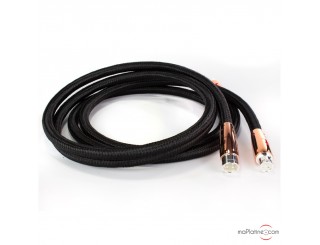
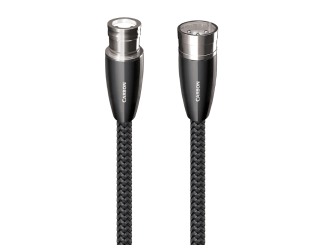
The DAC 1 Reference offers two unbalanced RCA outputs and two balanced XLR outputs, with a nominal output level of 2.5 Vrms. The sockets fitted to the unit are of excellent quality in both cases. A balanced link remains worthwhile over longer runs or in an electrically noisy environment: our selection of XLR interconnect cables will help you find the right one.
FranckSPDIF inputs: 2 x coaxial RCA
USB input: USB 2.0
Optical input: 1 x Toslink
Unbalanced outputs: 2 x RCA
Balanced outputs: 2 x XLR
Frequency response: 20 Hz to 20 kHz ±1 dB
Total harmonic distortion (THD): below 0.15%
Nominal output level: 2.5 Vrms
Tubes: 2 x 6922 dual triode
Dimensions (W × H × D): 43 × 11 × 29 cm
Weight: 7.5 kg