








Resume
A manual turntable is a record player on which you pick up the tonearm and lower it onto the record yourself, by hand or using the cue lever, then lift it off at the end of a side. It is the most widespread type on the market, and the one many audiophiles regard as a proper turntable.
Three advantages are documented in our experts.
1 A better tonearm as a rule, where the arm on an automatic deck is often of lower quality, which limits the scope for upgrades and for pairing cartridges.
2 Fully accessible adjustments, essential every time you change cartridge: levelling, azimuth, alignment, tracking force, arm height and anti-skating.
3 Simple mechanics, with no automated arm, maintained with the same three jobs as any other turntable.
In return, it calls for a gentle, confident hand and for you to be around at the end of a side. And in every case, a phono preamplifier is essential as soon as a vinyl source enters the chain. Our technicians are on hand on +33 (0) 299 654 163.
The turntable industry has been enjoying a marked revival for several years now, and picking a model often proves harder than it looks. Among the wide range available, two families stand clearly apart: the manual turntable and the automatic turntable.
Both play the same records, but they do not work the same way. On one, you pick up the tonearm and lower it gently onto the surface of the record. On the other, the deck does it for you. That is the main difference, and everything set out below follows from it.
This guide brings together what our buying guides and our Rennes workshop document about manual turntables. For a point-by-point comparison of the two modes, see our dedicated article on the difference between a manual and an automatic turntable, and browse our selection of manual turntables.
The one rule that never changes:
Manual or automatic, a turntable does not plug straight into an AUX input. The signal leaving the cartridge sits at around 3 to 5 mV for an MM cartridge and 0.2 to 0.5 mV for an MC cartridge, against the 0.3 to 0.5 V a line input expects. Without a phono stage the sound is barely audible, dull and bass-free.
A phono preamplifier is therefore needed in 95% of cases: it supplies the missing gain and applies RIAA equalisation. Only two exceptions apply: USB or digital turntables with a built-in RIAA stage, and amplifiers that still have a phono input, now rare given that nearly 97% of devices on the market lack one. A DAC never replaces a phono stage: they are two distinct functions. See our guide on how to choose a phono preamplifier.
What exactly is a manual turntable?
Every turntable has a tonearm carrying a cartridge, whose stylus rests on the record. There are two ways to make that happen: do it yourself, or let the deck do it. That is the only difference in principle between a manual and an automatic turntable.
What does the listener actually do on a manual turntable?
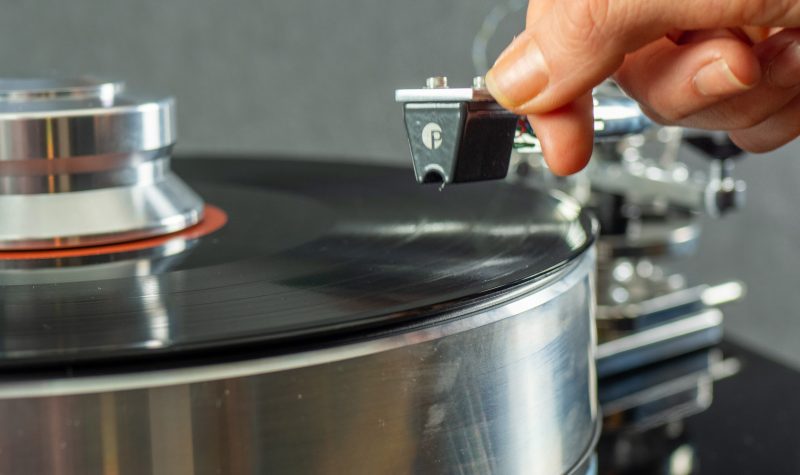
You pick up the tonearm and lower it gently onto the surface of the record, by hand or using the cue lever, which is the safer option. At the end of a side you lift the arm off with that same cue lever and stop the platter.
On an automatic turntable the principle is reversed: the arm moves across, lowers and lifts by itself, and the deck stops at the push of an On/Off button. The gesture disappears, and with it part of the risk of a slip.
How does a semi-automatic turntable differ?
A semi-automatic deck blends the two principles. The arm lifts automatically and the turntable stops at the end of the record, but you return the arm to its rest yourself. It is often a sensible middle ground.
The Technics SL-100 C illustrates this: a semi-automatic 33 and 45 rpm direct drive deck with an S-shaped tonearm, supplied with an AT-VM95C cartridge. So does the Audio-Technica AT-LP8X, whose semi-automatic system is operated by a side lever that raises and lowers the arm very smoothly, then lifts it at the end of the record before the motor stops. Both belong to our direct drive turntables family as well.
Keypoint:
The word manual does not describe a price bracket but a way of working. Manual decks are the most widespread type on the market and span a very wide price range, from entry level to the very high end, throughout our selection of manual turntables.
Simple mechanics, and maintenance that is just as simple
On a manual turntable the arm is driven by no mechanism at all. That simplicity does not make for a cruder machine: it means the maker concentrates its resources on the parts that make the sound, namely the platter, the bearing and the tonearm.
What does a manual turntable leave out?
The arm control mechanism, quite simply. On an automatic deck the tonearm is motorised: it moves across, lowers and lifts on its own. That assembly is absent from a manual turntable, where the gesture is entirely yours.
Each family has its strong point. The automatic deck reduces the risk of mishandling the cartridge to a minimum, since nothing depends on your hand. The manual deck lets the maker’s budget and attention go elsewhere, above all into the tonearm.
What maintenance does a turntable need?
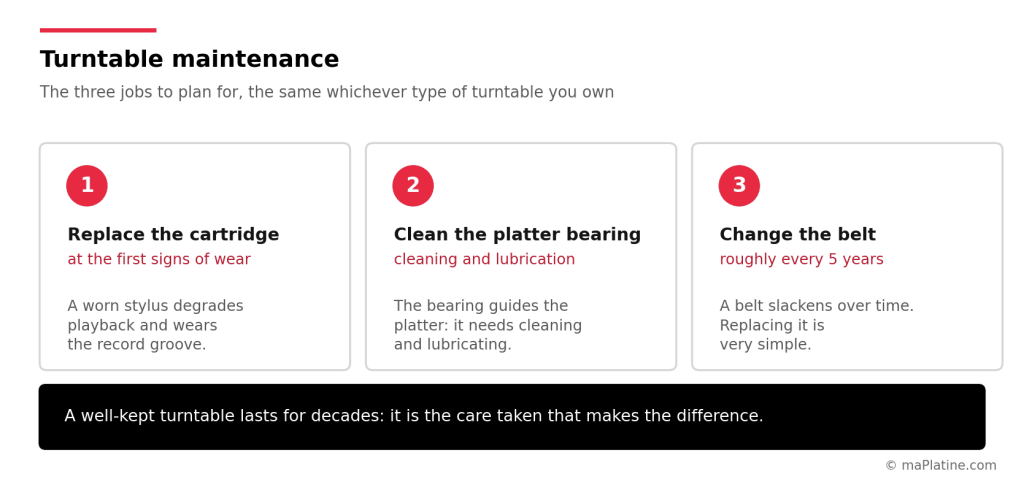
The same three jobs, whatever the type of deck. Replace the cartridge at the first signs of wear, because a tired stylus degrades playback and wears the groove. Grease and clean the bearing well, which guides the platter’s rotation. Change the belt roughly every five years on a belt-drive model: it slackens over time, and replacing it is very simple since it sits under or around the platter.
Replacement belts are offered by a great many manufacturers: find them among our belts and drive parts, alongside our setup kits and oils. Our our setup and maintenance videos walk through these jobs step by step.
It is this care, rather than the type of deck, that determines how long a turntable lasts. A well-kept machine runs for decades without difficulty.
A better tonearm, and therefore a real upgrade path
The tonearm on an automatic turntable is often of lower quality than the one on a manual deck. That has a direct consequence: it holds back the scope for upgrades, and above all for pairing hi-fi cartridges.
Why does tonearm quality govern what you can upgrade?
Because the first upgrade anyone wants to make to a turntable is a change of cartridge. A well-made arm accepts a wider range of cartridges, including low output MC cartridges, where a more modest arm narrows the field. On decks with a removable headshell, our range of headshells widens the options further still.
That is what sets the manual models in our catalogue apart. The Rega Planar 3 ships without a cartridge, with a 9-inch arm, a silica platter and a dust cover, made in the UK: the choice of cartridge is yours. The Rega Planar 6 with NeO PSU MK2 comes with or without a cartridge depending on the version, and the Rega Planar 6 with a Hana SL MKII cartridge arrives ready to listen with an MC cartridge already fitted and a 2 mm Rega spacer under the arm.
At Pro-Ject, the Pro-Ject RPM 3 Carbon with 2M Silver carries a 10-inch S-shaped carbon and aluminium arm paired with a separate motor, while the Pro-Ject T2 combines a one-piece 9-inch aluminium arm, a 10 mm glass platter and a Sumiko Rainier MM cartridge.
Do you have to reset the turntable after changing cartridge?
Yes, every time. As soon as you change the cartridge, the tonearm has to be set up again. That is precisely what a manual turntable puts within reach, and it is the subject of the next section.
To choose the cartridge itself, see our guide to phono cartridges. For the full mounting and setup method, see how to set up your turntable correctly. Our upgrade kits and motors cover the further steps.
Keypoint:
A good tonearm is only worth having if the adjustments are actually made. Turntables prepared in our workshop ship with a card and a diagram showing, where relevant, the exact anti-skating setting.
Adjustments you can reach, and why they matter
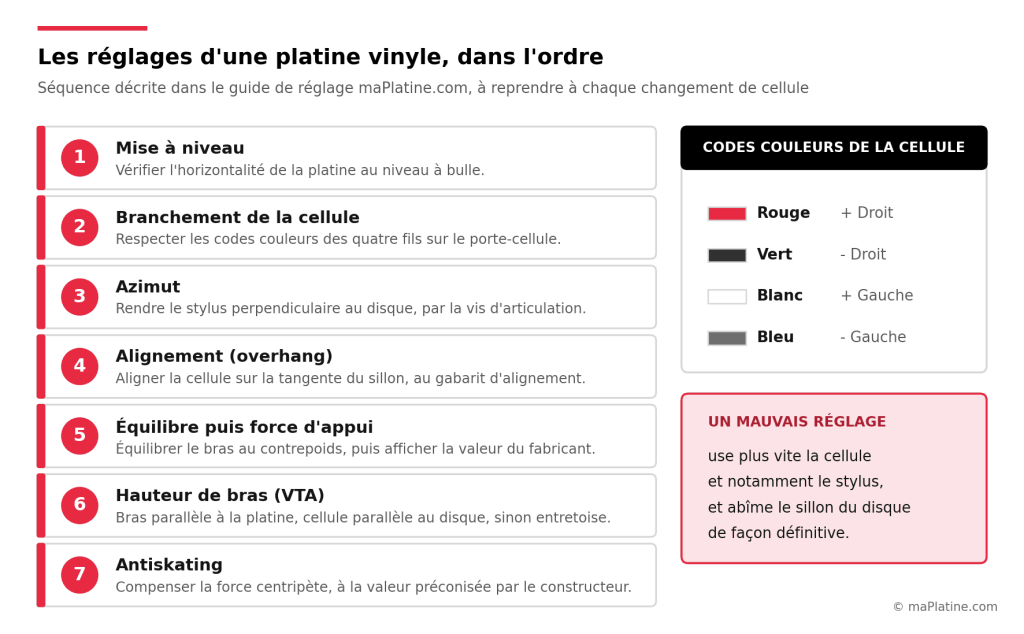
On a turntable, correct setup is essential. Skipping this step has damaging consequences both for your hi-fi equipment (stylus and records) and for the sound quality.
Poor setup causes faster wear of the cartridge, and of the stylus in particular. It also damages the groove of your records: if one of the adjustments is not made correctly, the recorded information is permanently damaged.
Where should you start, before any adjustment?
With levelling. Before any adjustment at all, make sure the turntable sits level, using a spirit level. Those accessories are part of our setup kits and oils.
How do you mount and set up the cartridge?
Wiring first. Once the cartridge is on the headshell, the four leads connect according to a set colour code: red for right positive, green for right negative, white for left positive, blue for left negative.
Azimuth next. This is the angle between the plane of the record and the vertical axis of the cartridge. The stylus must sit perpendicular to the record, to avoid any imbalance between the right and left channels of the groove. A small screw, on the arm hinge or in the headshell itself depending on the model, corrects it.
Alignment last. Using an alignment gauge placed on the platter, check that the cartridge lines up perfectly with the tangent of the groove, first horizontally and then vertically. This adjustment corresponds to the cartridge overhang.
How do you set the tracking force?
Start by finding balance: fit the counterweight at the end of the arm, lift the arm off its rest, then turn the counterweight until the arm floats on its own. Next set the graduated ring to zero, opposite the white line, without moving the counterweight itself.
All that remains is to turn the whole counterweight to dial in the tracking force recommended by the cartridge maker. This is the force the cartridge receives in a vertical plane, perpendicular to the record. As an example, a tracking force of 1.8 g corresponds to 18 on the graduated ring.
Some turntables have no graduated counterweight: the Rega Planar 1 and VPI models among them. An electronic stylus scale then becomes essential to check the recommended figure precisely.
What should you know about arm height and anti-skating?
Arm height, or VTA (Vertical Tracking Angle), is adjusted on some models via a screw at the base of the arm: the arm should be parallel to the plinth, and the cartridge parallel to the record. On other arms, Rega’s among them, height is not adjustable; to fit taller cartridges you insert a spacer between the three arm mounting points.
Anti-skating offsets the centripetal force acting on the cartridge. Depending on the model it takes the form of a graduated dial with a spring, a hanging weight or a magnetic device. In every case it is set to the value the maker recommends.
Keypoint:
These adjustments are not the preserve of specialists, but they do call for method. If you would rather not take them on, every turntable we sell is checked and set up by our technicians before shipping, cartridge included where one is supplied.
A wide range, suited to every kind of listener
The manual turntable is highly prized and widespread for its audiophile qualities. The format has evolved considerably over the decades into decks that are understated, modern and faithful in their reproduction, across a very wide range of prices.
How does musical taste steer the choice?
Some models suit certain repertoires better than others. The Rega Planar 3, for instance, is a very good choice for rock and its offshoots. It also comes in a wood finish as the Rega Planar 3 Wood.
Pro-Ject, a leading turntable maker, offers decks known for being versatile across musical styles. The Pro-Ject T2 W builds on the T2 by adding Wi-Fi streaming to compatible audio devices, without taking anything away from the analogue side.
What drives the price differences between models?
Prices vary according to the model, the maker and the precision of the assembly. Our selection of manual turntables covers Rega, Pro-Ject, Technics, Thorens and Clearaudio, with every deck checked, adjusted and tested before dispatch.
Across the system as a whole, the phono preamplifier ideally accounts for a quarter to a third of the analogue source budget. To build your configuration, see how to choose a turntable, our turntable buying guide and your very first turntable.
The gesture, experienced as a ritual
A manual turntable calls for several actions: lowering the tonearm, keeping an eye on the record as it nears the end. Some see these as chores. Others see rituals in their own right, part of what makes vinyl turntables so appealing.
How careful do you have to be?
Reasonably careful. A rough movement could damage the turntable, the cartridge in particular. The way it works simply calls for a gentle hand and a degree of confidence in the gesture: caution is the watchword.
That is also why the cue lever exists: it makes lowering the arm onto the record, and lifting it off at the end of a side, safe.
Why do people call it a proper turntable?
Because manual decks remain the most widespread on the market and meet the majority of what audiophiles are looking for today. A good many of them regard it as the proper turntable. You can hear that difference for yourself at our listening room in Rennes.
When an automatic or semi-automatic deck is still the right call
Every turntable, manual or automatic, suits a particular kind of listener, according to their needs and expectations. Recommending the manual deck on principle would make no sense.
When should you go for an automatic turntable?
An automatic deck calls for far fewer actions, which makes it very practical and easy to use. It is a sound choice for anyone with reduced mobility, or without full confidence in their hands, since the cartridge lowers and lifts without intervention.
The Dual CS 429 is a good example: the arm rises, moves across and lowers automatically at the push of a button, and those functions can be switched to manual. It also carries a small MM phono stage that can likewise be bypassed, and its phono cable is not captive, so it can be replaced. Browse the full selection of automatic turntables.
Is a semi-automatic deck a good compromise?
Yes, and it is often the most balanced answer if you are torn. You cue the arm yourself, while the mechanism does no more than lift it and stop the deck at the end of playback. All our models are gathered in the semi-automatic turntables category.
Manual, semi-automatic or automatic: the comparison
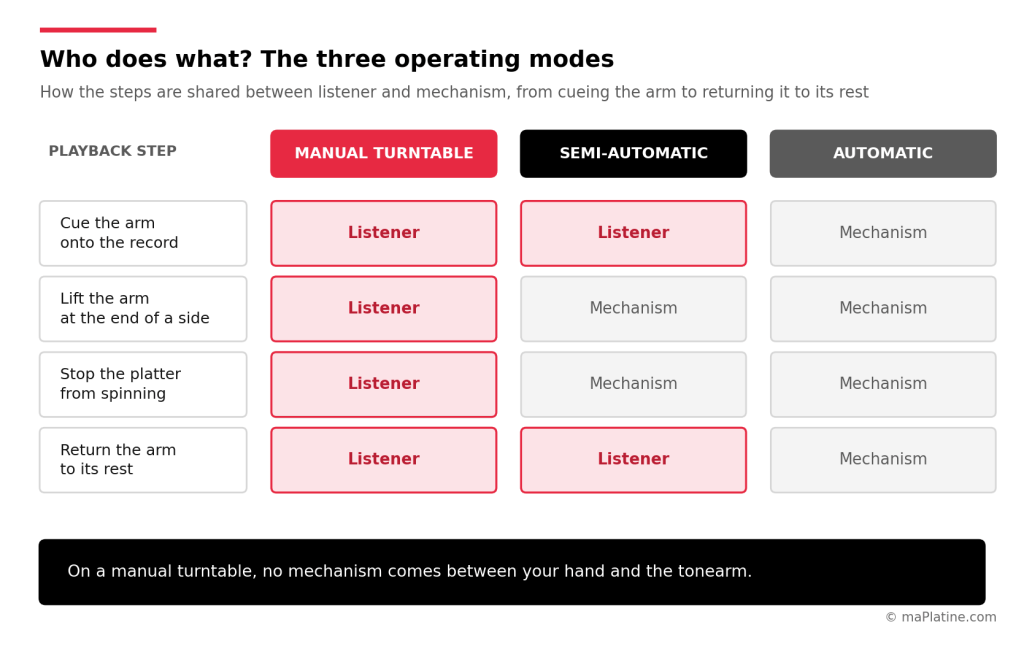
The table below sums up the differences our technicians observe. The comparison assumes decks of similar design within the same segment.
| Criterion | Manual turntable | Semi-automatic turntable | Automatic turntable |
|---|---|---|---|
| Cueing the arm onto the record | Listener, by hand or cue lever | Listener | Mechanism |
| Lifting the arm at the end of a side | Listener | Mechanism | Mechanism |
| Stopping the platter | Listener | Mechanism | Mechanism, On/Off button |
| Returning the arm to its rest | Listener | Listener | Mechanism |
| Risk of mishandling the cartridge | Present, gentle handling required | Present when cueing the arm | Reduced to a minimum |
| Routine maintenance | Cartridge, bearing, belt | Cartridge, bearing, belt | Cartridge, bearing, belt |
| Arm control mechanism | None | Lift and stop | Cueing, lowering, lift and stop |
| Tonearm quality | Generally higher | Varies by model | Often of lower quality |
| Upgrade path and cartridge pairing | Wide | Depends on the arm | Limited by tonearm quality |
| Who it suits | The most widespread type, meets most audiophile needs | Torn between convenience and performance | Reduced mobility, less confident hands, simplicity |
FAQ – Frequently asked questions about manual turntables
What is the difference between a manual and an automatic turntable?
On a manual turntable you pick up the tonearm and lower it onto the record yourself, by hand or using the cue lever, then lift it off at the end of a side and stop the platter. On an automatic turntable the arm moves across and lifts by itself, and the deck stops at the push of an On/Off button. That is the main difference between the two families.
What maintenance does a manual turntable need?
Three jobs, identical across all types of turntable. Replace the cartridge at the first signs of wear. Grease and clean the bearing well, which guides the platter’s rotation. Change the belt roughly every five years on a belt-drive model: it slackens over time and is very simple to replace, since it sits under or around the platter. It is this maintenance that determines how long the deck lasts.
Is a manual turntable difficult to use as a beginner?
It calls for a degree of care in the gesture, because a rough movement could damage the turntable, and the cartridge in particular. Nothing complicated, though: a gentle hand and a little confidence are enough, and the cue lever makes lowering the arm onto the record safe.
Why does the tonearm on an automatic deck limit upgrades?
Because it is often of lower quality than the arm on a manual turntable. That holds back the scope for upgrades, particularly when pairing hi-fi cartridges. On a manual deck the arm generally accepts a wider range of cartridges.
Do you need to reset the turntable after changing cartridge?
Yes. As soon as you change the cartridge, the tonearm has to be set up again. The full sequence covers levelling the deck, wiring the cartridge to the colour codes, azimuth, alignment with a gauge, balancing the arm and then tracking force, arm height where it is adjustable, and anti-skating.
What happens if a turntable is poorly set up?
Two kinds of damage. To the equipment first: poor setup causes faster wear of the cartridge, and of the stylus in particular. To your records second: the groove suffers, and if one of the adjustments is not made correctly, the recorded information is permanently damaged.
How do you set the tracking force on a tonearm?
Fit the counterweight at the end of the arm, lift the arm off its rest and turn the counterweight until the arm floats on its own. Then set the graduated ring to zero opposite the white line, without moving the counterweight, and turn the whole counterweight to dial in the figure recommended by the cartridge maker: a tracking force of 1.8 g corresponds to 18 on the ring, for example.
What if the counterweight is not graduated?
Some turntables have none, the Rega Planar 1 and VPI models among them. An electronic stylus scale then becomes essential to check the tracking force recommended by the cartridge maker precisely.
Do you need a phono preamplifier with a manual turntable?
Yes, in 95% of cases. The cartridge signal, around 3 to 5 mV for MM and 0.2 to 0.5 mV for MC, sits far below the 0.3 to 0.5 V a line input expects, and it needs RIAA equalisation. The only exceptions are an amplifier with a phono input, now rare, or a USB turntable with a built-in RIAA stage. A DAC never replaces a phono stage.
Belt drive or direct drive on a manual turntable?
Both exist. Belt drive keeps the motor away from the platter spindle, which ensures accurate rotation while reducing the vibration the motor sends through: it remains the most accomplished method for audiophile listening. Direct drive gives instant starting and stopping and an unfailingly steady speed, but the motor’s proximity sends vibration into the platter; it is found above all in professional use, for mixing techniques.
Need advice tailored to your system?
Our technicians will help you choose the turntable that suits your needs, your cartridge and your budget, and will check that your analogue chain holds together.
Calling from outside France: +33 (0) 299 654 163, Monday to Friday, 9am to 5pm.
maPlatine.com listening room in Rennes, comparative auditions by appointment. Every turntable is checked and set up by our technicians before shipping.