





Resume
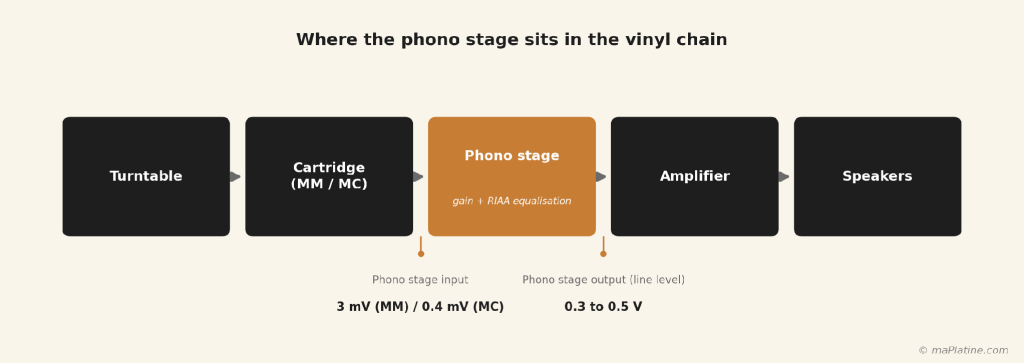
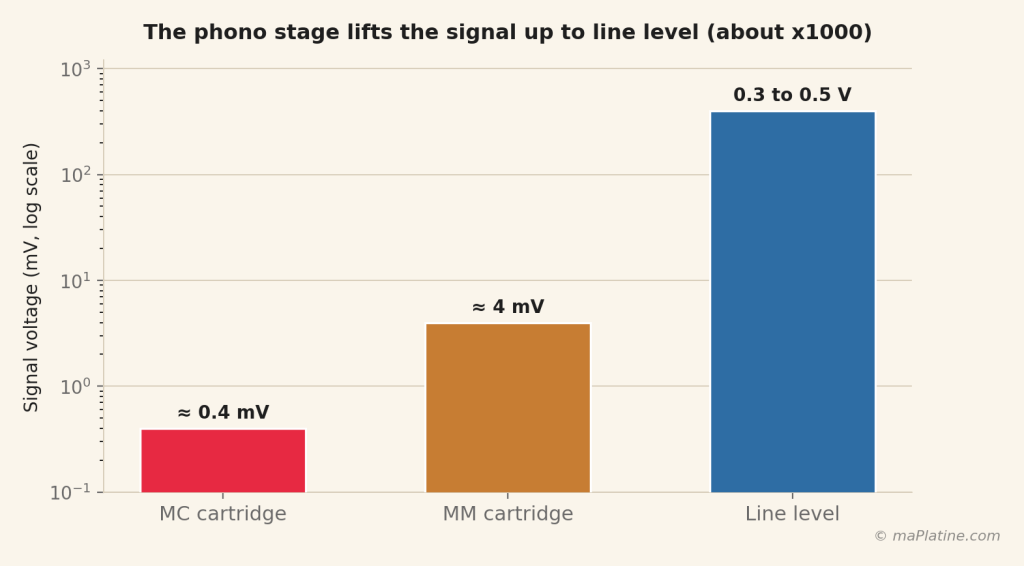
A phono preamplifier (or phono stage) is essential between your turntable and your amplifier in 95% of cases: it amplifies the very low signal from the cartridge (around 3 mV for an MM cartridge, 0.4 mV for an MC cartridge) up to line level (0.3 to 0.5 V) and applies RIAA equalisation.
Four criteria drive the choice. (1) The cartridge: an MM stage offers around 40 dB of gain on a 47,000 ohm load; an MC stage requires at least 58 dB of gain and an adjustable load from 50 to 1,000 ohms. (2) The settings: gain, resistive load, capacitance loading (100 pF for MM, adjustable up to 500 pF on advanced models). (3) The technology: transistors (neutrality, precision) or tubes (warmth, scale). (4) The budget: €150 to €500 for an entry-level cartridge, €500 to €1,000 for a mid-range cartridge, over €1,500 for a high-end MC cartridge, roughly one quarter to one third of the analogue source budget.
A phono stage is never replaced by a DAC. Our technicians can advise you on 0 810 810 121.
The phono preamplifier is the most discreet, and one of the most decisive, links in a vinyl chain. People carefully choose the turntable, the tonearm and the cartridge, then overlook the stage that carries that fragile signal to the amplifier. That is a mistake: a mediocre phono stage holds back a good cartridge, while a good one reveals its full potential.
It is also worth knowing that today the vast majority of amplifiers sold no longer have a phono input (nearly 97% of devices on the market lack one). Unless you use a USB turntable with a built-in stage, you therefore need to insert a dedicated phono stage between the record player and the amplifier.
This guide reflects the principles our technicians apply every day in the maPlatine.com listening room in Rennes: understanding what a phono stage really does, identifying the model suited to your cartridge, prioritising your budget and avoiding the most common pairing mistakes.
Fundamental rule
As soon as a vinyl source enters the chain, a phono preamplifier is mandatory. A DAC (digital-to-analogue converter) never replaces a phono stage: these are two distinct functions. The DAC converts a digital signal into an analogue one; the phono stage amplifies and corrects a very low-level analogue signal.Only two exceptions: USB/digital turntables with a built-in RIAA stage (connected to an AUX/line input) and amplifiers that already have a phono input. In 95% of cases, a separate phono stage remains necessary.
Reference framework: all the figures in this guide (gain, load, budget) apply to a standard home Hi-Fi chain. Special cases (exotic cartridges, very low output) call for personalised advice.
Why is a phono preamplifier essential?
The signal at the cartridge output is about a thousand times too weak for an amplifier: on the order of 3 mV (MM) to 0.4 mV (MC) against 0.3 to 0.5 V for a line input. The phono stage plays two roles: it provides the missing gain and applies RIAA equalisation.
Without a phono stage, connecting a turntable straight to an AUX input gives an almost inaudible, dull, bass-less sound. The two functions of the phono stage are therefore complementary and non-negotiable.
What is RIAA equalisation and why is it necessary?
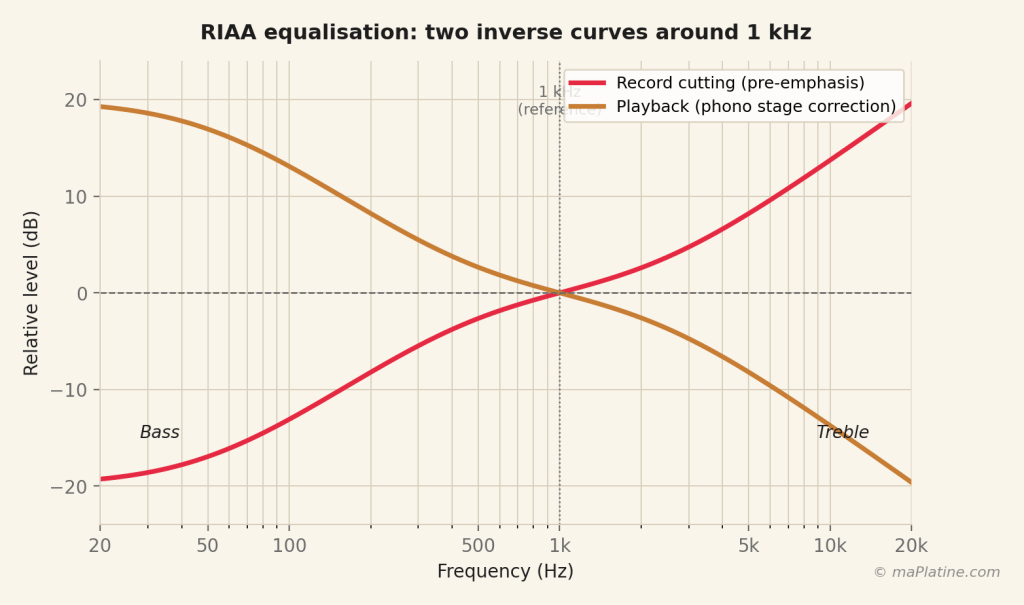
The RIAA standard (Recording Industry Association of America) was adopted in 1954: almost all records pressed after 1955 follow this equalisation. When cutting the record, the bass is deliberately reduced and the treble boosted (pre-emphasis), so that the groove stays physically cuttable and playable.
On playback, the phono stage applies the inverse curve: it re-amplifies the bass and reduces the treble to restore a balanced signal. This equalisation is defined by three standardised time constants (75 µs, 318 µs and 3,180 µs). Without it, a record would sound thin, harsh and without foundation. The accuracy of this correction is one of the main quality criteria of a phono stage.
Why must the cartridge signal be amplified?
The cartridge turns the tiny groove movements into a minuscule electrical voltage. An MM cartridge delivers around 3 to 5 mV, an MC cartridge only 0.2 to 0.5 mV. The phono stage lifts this signal up to the line level (0.3 to 0.5 V) expected by the amplifier.
That is why the gain expressed in decibels must be matched to the cartridge: too low, and the sound lacks level and dynamics; too high, and it saturates and raises the noise floor. The table below summarises the reference values.
| Characteristic | MM phono stage | MC phono stage |
|---|---|---|
| Target cartridge voltage | ≈ 3 to 5 mV | ≈ 0.2 to 0.5 mV |
| Gain | ≈ 40 dB | ≥ 58 dB |
| Resistive load | 47,000 Ω | 50 to 1,000 Ω (adjustable) |
| Capacitance loading | 100 pF (0 to 500 pF on advanced models) | Not relevant |
How to choose a phono stage based on your cartridge?
The cartridge drives the choice. An MM cartridge calls for an MM stage (gain ≈ 40 dB); an MC cartridge calls for an MC stage (gain ≥ 58 dB, adjustable load). If you plan to upgrade your cartridge, a versatile MM/MC stage is the safest choice.
What is the difference between an MM and an MC cartridge?
A moving magnet (MM) cartridge delivers a relatively high signal (3 to 5 mV) and works with most phono stages, which are MM-compatible by default. It is the most common type, affordable and easy to re-tip (replaceable diamond).
A moving coil (MC) cartridge delivers a much lower signal and requires a stage capable of high gain and an adjustable resistive load. There are high-output MC cartridges (close to an MM, sometimes compatible with an MM input) and low-output MC cartridges, which demand a true MC stage. For choosing the cartridge itself, see our guide to choosing a Hi-Fi cartridge.
Do I need an MM, MC or MM/MC stage?
Many manufacturers offer MM/MC stages: both modes coexist in a single unit. This kind of stage is versatile and makes cartridge changes easier. If you later move from an MM to an MC, you will not necessarily have to change your phono stage.
Key takeaway
First check the type and the output level of your cartridge (shown on the manufacturer’s data sheet). That value, not the brand of your turntable, determines the gain and load you need.
Which technical characteristics should you check?
Three settings define compatibility: the gain (amplification level, in dB), the resistive load (impedance, in ohms) and the capacitance loading (in pF, mainly for MM). Advanced models make all three adjustable.
How to match the gain to your cartridge?
The gain must match the cartridge’s output voltage. An MM stage generally offers 40 dB; an MC stage should offer at least 58 dB, sometimes 60 to 66 dB for the quietest MC cartridges. The best phono stages provide several switchable gain positions to fine-tune the match.
Why does the load (impedance and capacitance) matter?
The manufacturer designs the cartridge to work on a precise load. An MM cartridge targets 47,000 ohms of resistive load, combined with around 100 pF of capacitance (cable plus phono stage). That capacitance directly affects the treble: too high, and the top of the spectrum becomes harsh or recessed.
An MC cartridge requires a much lower resistive load, usually adjustable from 50 to 1,000 ohms. This setting acts as a fine tuning: it balances the reproduction between smoothness and liveliness. A good MC stage therefore offers several load values selectable on the front panel.
Beyond gain, the phono stage also corrects an electrical issue: it matches capacitance and impedance as closely as possible to the needs of the cartridge and cable, which conditions the flatness of the frequency response.
Key takeaway
An MC cartridge without a properly matched load will rarely sound at its best. If you are aiming for an MC, favour a stage with an adjustable load.
How to choose based on your turntable and amplifier?
Three scenarios. Amplifier with a phono input: an external stage stays optional, but is often beneficial. USB turntable with a built-in stage: no addition needed. Switchable built-in stage: you can switch to a line output and add a better external stage.
Should I add an external stage if my amplifier already has a phono input?
If your turntable is connected to an amplifier with a phono input, you a priori do not need to add a phono stage. However, if that input does not satisfy you in terms of reproduction, a dedicated external stage almost always improves the sound and reveals the potential of your turntable.
What about a USB turntable with a built-in stage?
A USB/digital turntable has a built-in RIAA stage: you have nothing to add, but you will not be able to upgrade that stage either. Some turntables are an exception: their built-in stage is switchable (can be turned off). You can then use the line output to connect a better external phono stage and improve the sound.
How to set your phono stage budget?
As a guide: €150 to €500 to go with an entry-level cartridge (under €300), €500 to €1,000 for a mid-range cartridge, over €1,500 for a high-end MC cartridge. The phono stage ideally represents one quarter to one third of the analogue source budget.
Phono stages range from a few tens to several thousand euros. Coherence comes first: a stage costing several times the price of the cartridge is rarely justified, while too modest a stage holds back a fine cartridge. Set your budget according to the value of your cartridge and your system.
Key takeaway
A phono stage of €150 to €500 suits an entry-level cartridge, €500 to €1,000 a mid-range cartridge, and over €1,500 a high-end MC cartridge. If in doubt, our technicians will calibrate the whole system with you.
Tubes or transaistors: which sound signature to choose?
Transistor stages favour neutrality, precision and a low noise floor, at more affordable prices. Tube stages offer a warmer, more expansive reproduction, sometimes at the expense of neutrality, and require a little maintenance. The choice is a matter of listening taste.
Transistor stages are the most affordable: proven circuits, and on the high end, discrete components (class A biased transistors) and separate or battery power supplies. The quality of the components, the contacts and the power supply makes all the difference.
Tube stages (12AX7, 6922, 6H30) are reputed to be particularly musical. Long reserved for the high end, they are becoming more accessible: affordable tube stages now exist. Bear in mind that tubes have a limited lifespan and need replacing periodically.
Depending on the type of music and the sound you are after (dynamics, timbre, neutrality, precision, realism), the direction differs. Our experts detail the sound signature of each model tested in the Rennes listening room.
How to digitise your vinyl records with a phono preamplifier?
Use a phono preamplifier with a USB output. Connect the turntable to the USB stage, itself connected to the computer via USB, then record with the free Audacity software. Your records are then stored in digital format on your hard drive.
A USB phono stage has a built-in analogue-to-digital converter. It is the simple way to archive your records while still listening to them on your Hi-Fi system. Some models also offer an optical output (Toslink) for digital amplifiers.
Does the phono stage need to be the same brand as the turntable?
No. The phono preamplifier is independent of the turntable: you can pair a stage from a different brand with no constraint. Only compatibility with the cartridge truly matters.
The single-brand approach still makes sense when a manufacturer covers the whole analogue chain (turntable, tonearm, cartridge, phono stage): staying within one brand ensures a coherence designed by the maker. Outside that case, free pairing is perfectly fine, provided you respect your cartridge’s gain and load requirements.
Our phono preamplifier comparison
Here is a selection of phono stages tested by our technicians and auditioned in our listening room in Rennes, organised by budget segment. Each model is shown with its compatibility, its settings and its technology. Contact us on 0 810 810 121 for advice tailored to your cartridge.
| Model | MM / MC | Key settings | Technology | Segment |
|---|---|---|---|---|
| Pro-Ject Phono Box DC | MM / MC | MM/MC switch | Transistors | Entry |
| Pro-Ject Phono Box S2 | MM / MC | 4 gains, adjustable load and capacitance | Transistors, external 18 V PSU | Entry |
| Pro-Ject Phono Box S3 B | MM / MC | Gain 40/45/60/65 dB (+6 dB XLR), load 10 Ω to 47 kΩ, capacitance 50 to 400 pF | Discrete transistors, balanced | Mid |
| Lehmann Audio Black Cube SE II | MM / MC | Gain 36/46/56/66 dB, load 47 kΩ/1 kΩ/100 Ω, subsonic filter (16 curves) | Transistors, passive RIAA, separate PSU | Mid / High |
| Pro-Ject Tube Box DS3 B | MM / MC | 2 turntable inputs, balanced, RIAA to 0.5 dB | 6922 tubes | Mid / High |
| Rega Aria | MM / MC | 2 independent stages, adjustable MC load | Discrete transistors | High |
| VIDA PRIMA | MM / MC | Audiophile stage, adjustable load | Discrete components | High |
Budget markers by segment: entry level up to about €250, mid range from €250 to €1,000, high end above €1,000. These markers match the one-quarter-to-one-third rule of the analogue source budget.
Frequently asked questions about phono stages
Do I need a phono stage if my amplifier already has a phono input?
If your amplifier has a phono input, you a priori do not need to add an external phono preamplifier. However, if that phono input does not meet your expectations in terms of reproduction, a dedicated external phono stage often reveals the potential of your turntable more fully.
Can a DAC replace a phono preamplifier?
No. A DAC (digital-to-analogue converter) and a phono preamplifier are two distinct functions. The DAC converts a digital signal into an analogue one, whereas the phono stage amplifies and corrects (RIAA equalisation) the very low analogue signal from a cartridge. As soon as a vinyl source enters the chain, a phono stage is mandatory.
What is the difference between an MM and an MC cartridge?
A moving magnet (MM) cartridge delivers a relatively high signal (around 3 to 5 mV) and works with most phono stages, which are MM-compatible by default. A moving coil (MC) cartridge delivers a much lower signal (0.2 to 0.5 mV) and requires a phono stage compatible with low-output cartridges, with high gain and an adjustable load.
What gain do I need for an MM or MC phono stage?
An MM phono stage generally offers around 40 dB of gain. An MC phono stage should offer at least 58 dB. Gain is the level of amplification applied to the cartridge signal, expressed in decibels: it must be matched to your cartridge’s output voltage.
Do I need a phono stage if my turntable already has one?
If your turntable has a built-in RIAA phono stage (a USB/digital turntable), you do not need to add one. You will also not be able to upgrade your system with a better phono stage, unless the built-in stage can be switched off: some turntables then offer a line output that lets you add an external phono stage.
Should the phono stage be the same brand as my turntable?
No. The phono preamplifier is independent of your turntable: you can pair a phono stage from a different brand. A single-brand approach still makes sense when a manufacturer covers the whole analogue chain (turntable, tonearm, cartridge, phono stage), for overall coherence.
What budget for a good phono preamplifier?
For an entry-level cartridge (under €300), a phono stage between €150 and €500 is a good choice. For a mid-range cartridge, plan for €500 to €1,000. For a high-end MC cartridge, a budget over €1,500 lets you get the most out of it. As a rule, the phono stage represents roughly one quarter to one third of the analogue source budget.
Tube or transistor phono stage?
Tube phono stages generally offer a warmer, more expansive reproduction, sometimes at the expense of neutrality, and require a little maintenance (tube lifespan). Transistor phono stages offer a more neutral, precise and quiet reproduction. The choice is mostly a matter of listening taste.
Can you digitise vinyl records with a phono preamplifier?
Yes, by using a phono preamplifier with a USB output. Connect your turntable to the USB phono stage, itself connected to your computer via USB. The free Audacity software then lets you record your records in digital format onto your hard drive.
What is the load (impedance and capacitance) of a phono stage?
The load corresponds to the resistance and capacitance values that the phono stage presents to the cartridge. An MM cartridge works on a standard resistive load of 47,000 ohms, combined with a capacitance of around 100 pF. An MC cartridge requires an adjustable resistive load, typically 50 to 1,000 ohms. A well-matched load balances the treble response and avoids a reproduction that is too harsh or too dull.
Need personalised advice?
Our technicians help you choose the phono stage suited to your cartridge, your turntable and your budget.Phone: 0 810 810 121, Monday to Friday, 9am to 5pm.
maPlatine.com listening room in Rennes, comparative auditions by appointment.