Rega Mercury: chassis
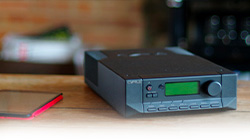
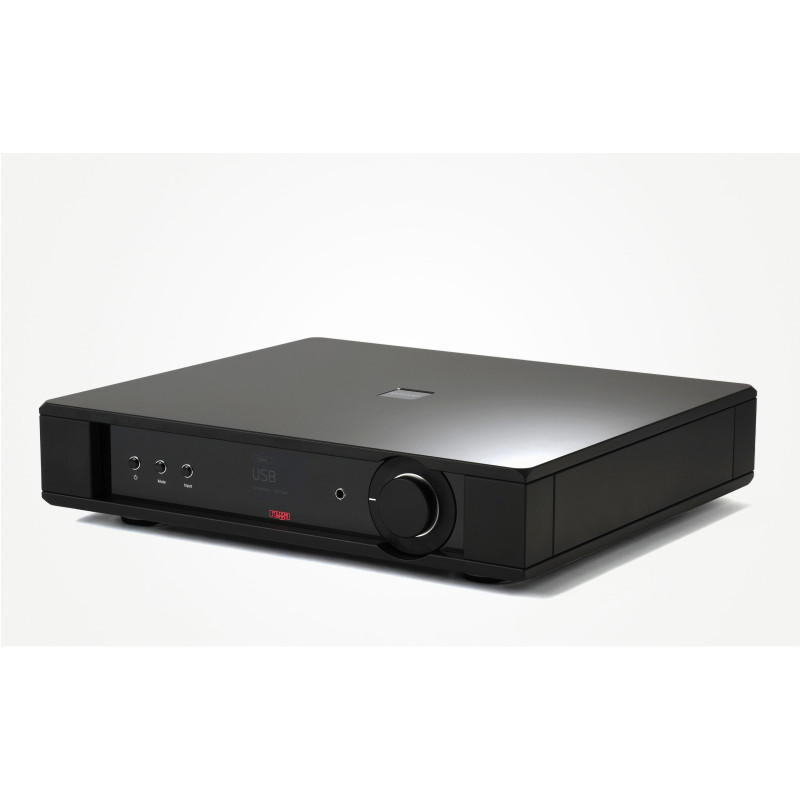
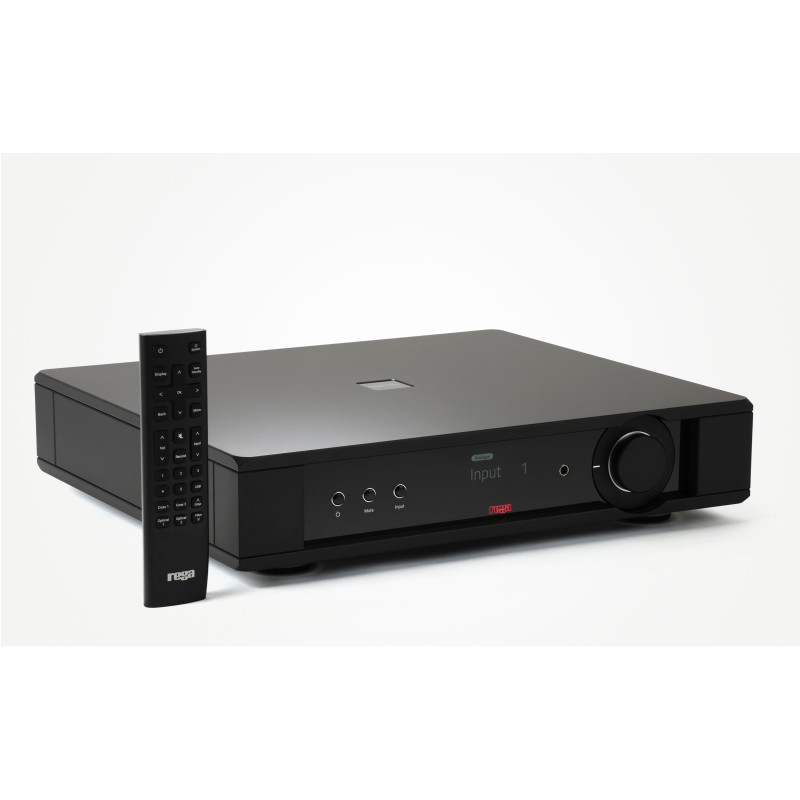
The Rega Mercury is machined from solid material. Its enclosure is made from extremely dense and rigid solid aluminum. This is in fact the same chassis used for the Rega Aura MC phono preamplifier. As a result, the unit has a substantial weight of more than 14 kg.
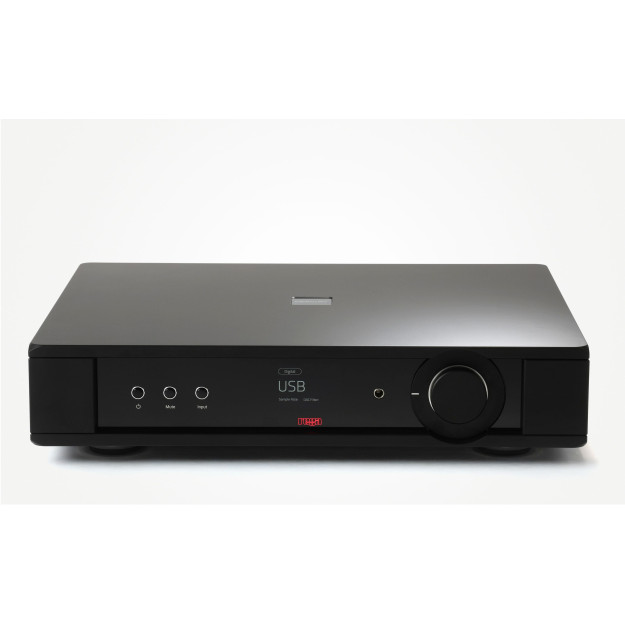
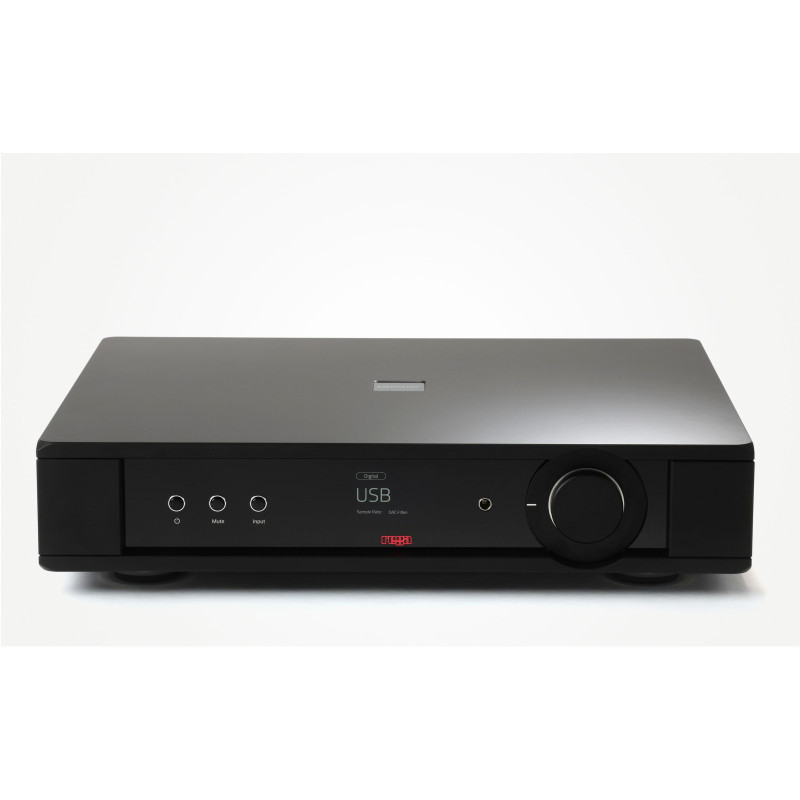
On the front panel, there is a large rotary volume control on the right and three small push buttons on the left. One controls power on/off, another activates mute, and the third selects the input source.
At the center of the front panel, a display shows the selected source and its status, including DAC information. Naturally, the remote control also provides access to these functions.
Rega Mercury: connections
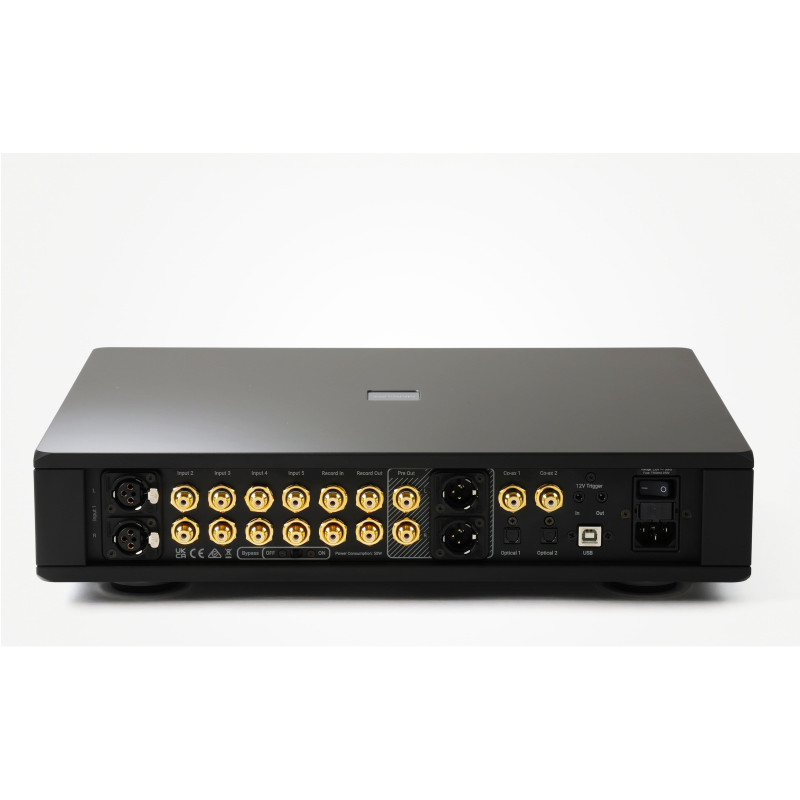
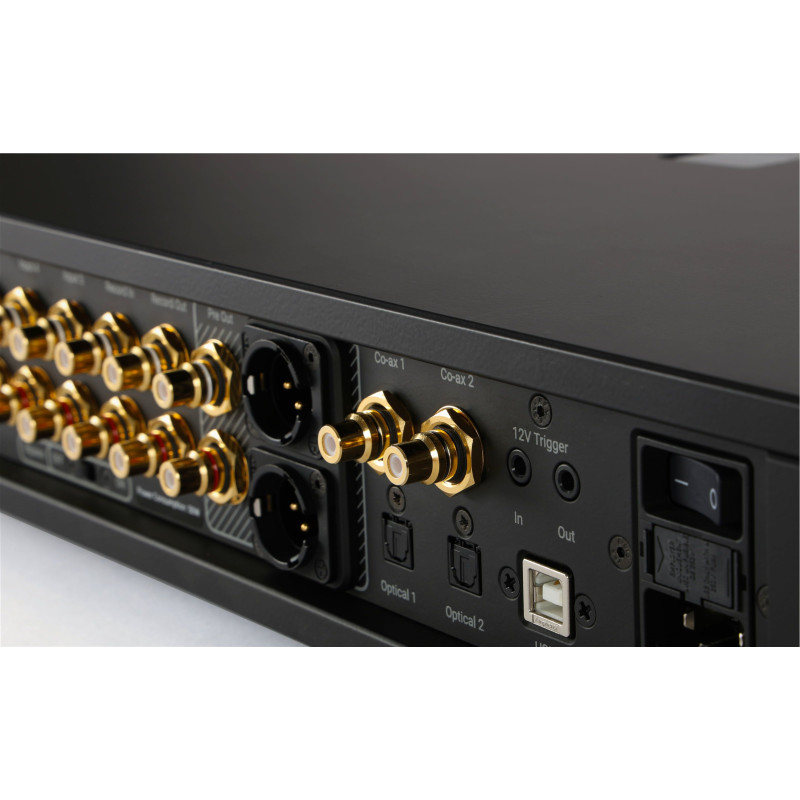
On the rear panel, the Mercury offers extensive connectivity. There are 4 RCA analog inputs and one balanced XLR analog input. In addition, the unit includes digital inputs with 2 coaxial, 2 optical and 1 USB connection.
The Mercury also provides an unbalanced RCA analog output, a balanced XLR analog output and a switchable bypass input.
Rega Mercury: technology
Throughout the signal path, the Mercury uses a fully balanced, differential-driven discrete common-base voltage amplifier with high linearity and wide bandwidth. Each stage employs high-current Class A complementary output amplifiers. This balanced amplifier topology provides the voltage and current necessary for the Mercury to operate with extremely low distortion.
Critical amplification stages use ultra-low-noise Linear Systems FET transistors in quad-pair differential input stages. This is the same circuit topology used in the second stage of the Aura MC amplifier.
The Mercury uses the famous Alps Blue Velvet RK27 volume potentiometer, also found in the Osiris amplifier, combined here with balanced common-base driver amplifiers. The main outputs are DC-coupled in order to eliminate output coupling capacitors. These outputs are protected against overvoltage by a dedicated protection circuit.
Rega drew inspiration from the circuit designs of its reference range and from the post-DAC analog filter stages used in the Saturn CD player to implement this topology using the balanced common-base driver circuit. This means that the signal path from the DAC chip analog output to the preamplifier output remains fully balanced.
The Mercury uses a high-power toroidal transformer feeding a linear power supply. This power supply is discrete, balanced and phase-tracking, using fast diodes and a low-noise voltage reference. Each stage benefits from its own localized capacitance, multiplier supply and LED-referenced current generators for voltage references.
To maximize dynamic headroom, the Mercury uses a supply voltage approximately 60% higher than typically found in a preamplifier of this type.
Rega Mercury: headphone amplifier
Particular care has been taken with the headphone circuit integration. The headphone amplifier operates like a miniature Solis power amplifier, as it uses the same balanced common-base driver stage.
This circuit offers high voltage and current drive capability, enabling the headphone output to easily power both low-impedance and high-impedance headphones.
Rega Mercury: DAC
The asynchronous USB input is galvanically isolated with its own dedicated power supply, combined with extensive reclocking of PCM and DSD clocks and data streams. It integrates two highly stable oscillator modules, ensuring ultra-low-jitter clocks for both professional and consumer sampling frequencies.
The S/PDIF input uses a Wolfson digital interface receiver and PLL system to recover low-jitter clock and data signals from incoming S/PDIF streams. Special attention has been paid to clock and data integrity in both PCM and DSD modes throughout the DAC input stage.
The recovered PCM and DSD data feed two parallel-connected Wolfson DACs, which in turn drive the balanced post-DAC analog filtering and amplification stages described in the analog amplification section.
The analog amplifier/filter stage uses ultra-low-noise Linear Systems FET transistors in the differential input stage.
The Wolfson DACs were selected for both their technical and sonic performance. Although they belong to a long-established lineage, they still deliver exceptional sound quality. Wolfson succeeded in achieving an ideal balance between technical precision and musicality.
Rega Mercury: sound performance
The Rega Mercury delivers an extremely transparent, fast and quiet sound, combined with a remarkable sense of naturalness and fluidity. It offers excellent transparency and seems to add nothing to the signal while taking nothing away.
Micro-details are highly intelligible without ever becoming overly analytical, preserving a very natural presentation. The soundstage is expansive and extremely stable. Instrument separation is very clear, while the stereo image is precise and exceptionally open.
Although the presentation is generally neutral, it never becomes boring. The bass is nuanced and precise without sounding exaggerated. Voices and acoustic instruments are reproduced with excellent texture and presence.
The treble is refined and very clean, free from excessive aggressiveness or artificial brightness. Rega set out to design a truly high-end and ultra-high-performance preamplifier. The result is an exceptionally balanced, faithful and lively component.
The Rega Mercury is naturally the ideal partner for the Rega Solis amplifier, as both share the same sonic philosophy. The Rega Mercury preamplifier represents the culmination of nearly forty years of Rega expertise.
FranckUnbalanced analogue inputs: 4 x RCA
Balanced analogue input: 1 x XLR
Unbalanced analogue outputs: 1 x RCA
Balanced analogue output: 1 x XLR
Bypass input: Yes (input 5)
Digital inputs: S/PDIF 2 x coaxial and 2 x optical
S/PDIF formats: 16–24-bit at 32/44.1/48/88.2/96/176.4/192 kHz
USB digital input: Asynchronous 16–32-bit, 44.1/48/88.2/96/176.4/192 kHz PCM, DSD64
Total harmonic distortion plus noise (THD+N): 0.001% at 1 kHz,
Frequency response: 8 Hz (point at -0.5 dB) to 28 kHz (point at -0.5 dB)
Headphone amplifier: 33 Ω
Headphone amplifier: Max. level at 240 Ω
Dimensions: 435 x 97 x 380 mm
Weight: 14 kg (31 lbs)