






Direct answer
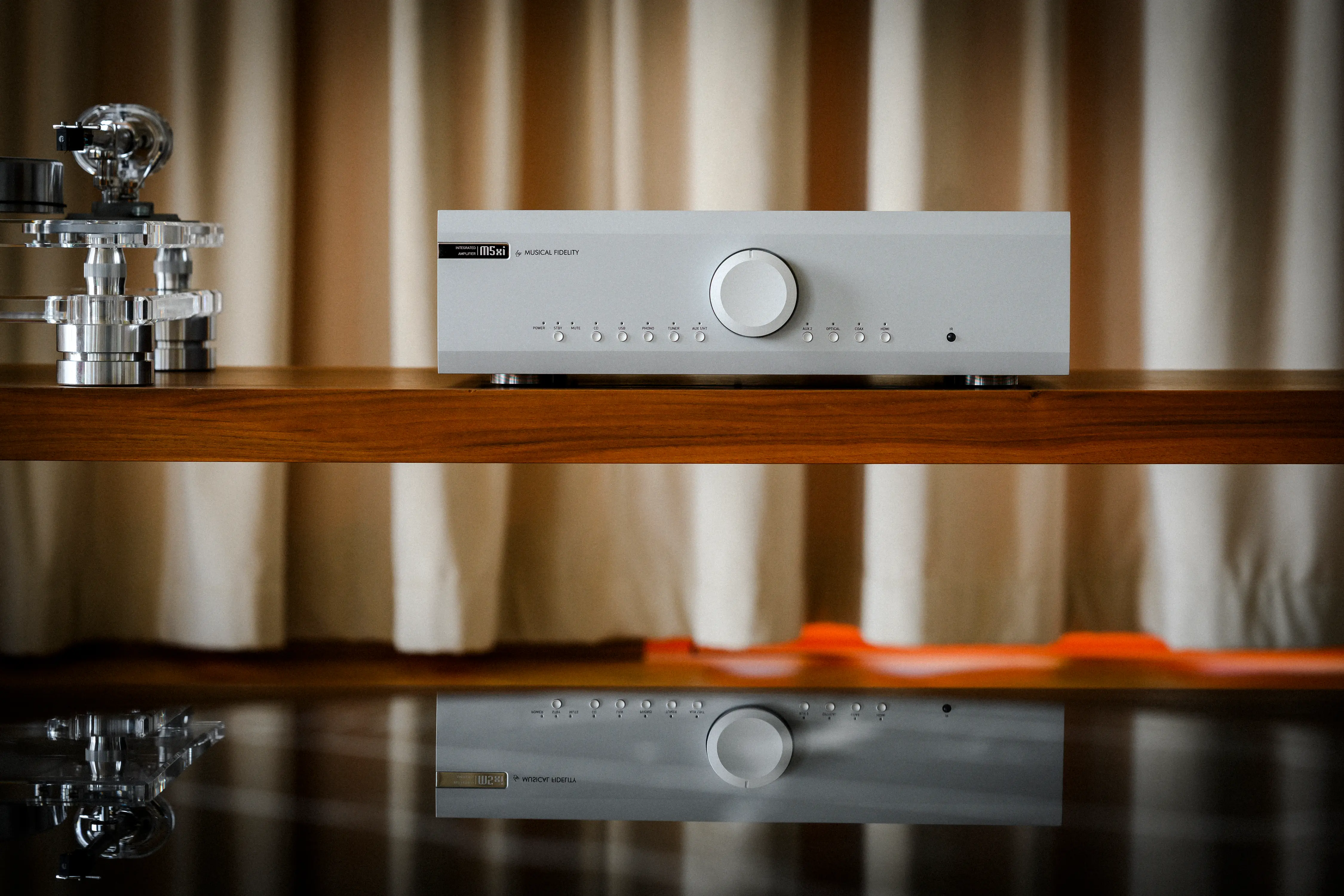
The new Musical Fidelity integrated amplifier range comprises three models: the B1xi at 790 €, the M5 xi at 2,289 € and the M6 xi at 2,989 €. All three share a preamplifier running entirely in Class A, a dedicated phono input and a digital board physically separated from the analogue stages with its own linear power supply. The B1xi delivers 2 x 60 W into 8 ohms with an MM phono input, the M5 xi 180 watts per channel and the M6 xi 220 watts per channel, the latter two with a switchable MM or MC phono input. None of them carries network streaming, a deliberate choice by the manufacturer.
Musical Fidelity has renewed its entire integrated amplifier range. Two letters sum up the operation: xi. Behind that suffix sits a complete redesign of the B1, the M5 and the M6, and a single conviction held from end to end, that of the modern analogue amplifier which refuses to age.
The manufacturer deliberately left network streaming out, judging all-in-one amplifiers to be more expensive, less capable and shorter lived. That leaves the real question: which of the three suits your speakers and your turntable? We put every manufacturer sheet up against the maPlatine.com catalogue to find out.
What does the Musical Fidelity xi range actually change?
The xi range replaces the Si series and carries over part of the technology developed for the Titan, the manufacturer’s flagship amplifier. The M6 xi replaces the M6 Si, the M5 xi succeeds the M5 Si, and the B1xi opens the range.
Three design decisions run through the whole range. The preamplifier operates entirely in Class A, which guarantees transparency and dynamics. The digital and ARC boards are physically separated onto their own printed circuit boards, each with its own linear power supply, so they never disturb the analogue stages. And the phono input is not an afterthought: on every model it gets the treatment of a standalone phono preamplifier.
On the M5 xi and the M6 xi, the output stage is built around a dual Push Pull of Sanken Darlington transistors per channel. This low-distortion design eliminates crossover artefacts while keeping residual distortion extremely low.
Full catalogue on the Musical Fidelity brand page, and our guide how do you choose the amplifier.
Pourquoi choisir le Musical Fidelity B1xi ?
B1 xi resume
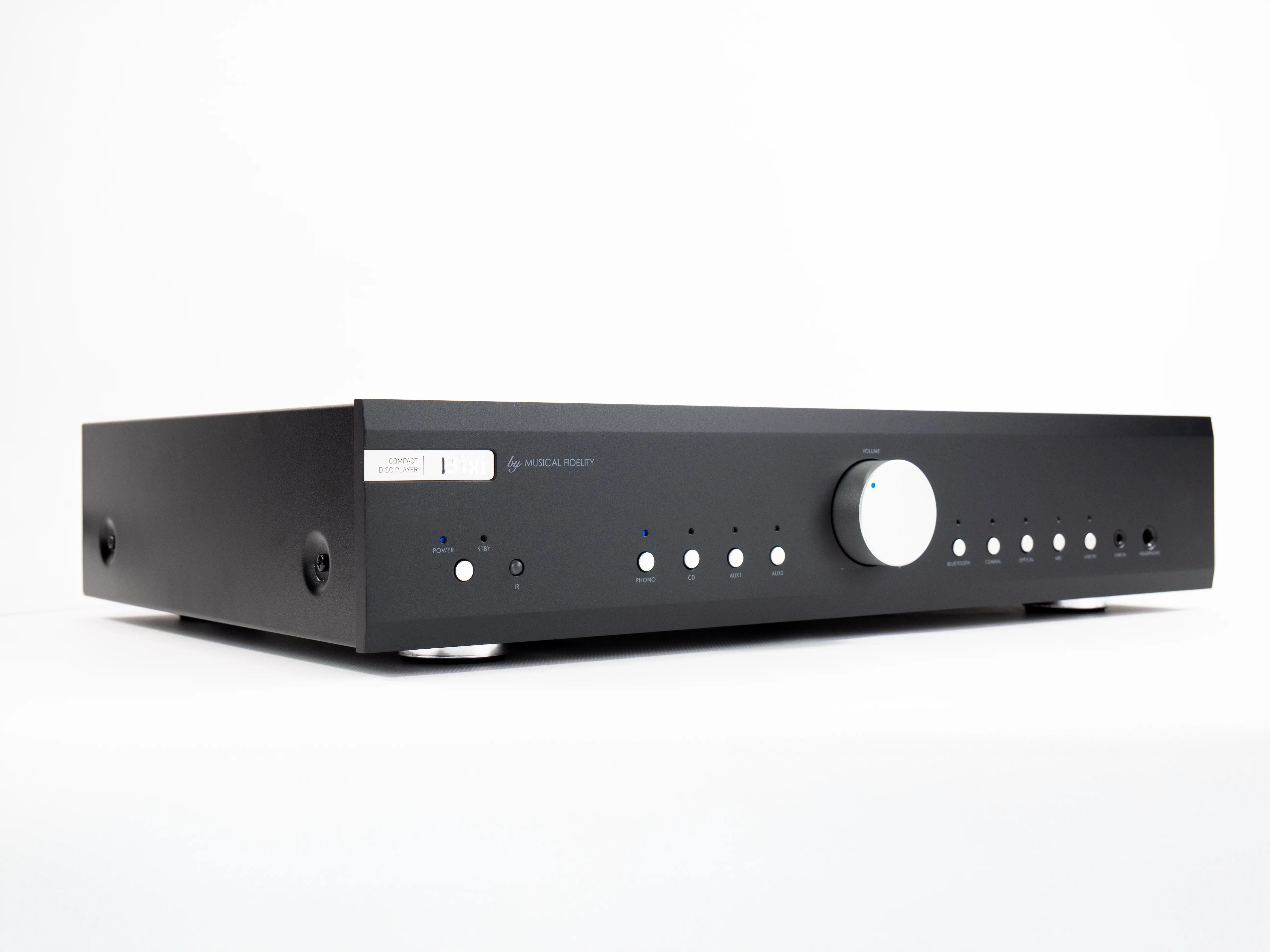
The B1xi delivers 2 x 60 W into 8 ohms and 100 W per channel into 4 ohms through a Class A/B circuit, with a preamplifier running entirely in Class A. It carries an MM phono input with its own dedicated linear power supply, an ESS Sabre ES9018 DAC handling up to 24 bit / 192 kHz, an HDMI ARC input, Bluetooth and a 6.35 mm headphone output.
The most remarkable thing about this amplifier is not its power. The phono preamplifier section has its own dedicated linear power supply, which is rare at this price point, and it delivers ultra-low noise and excellent channel separation. Its high 42 dB gain and its sensitivity from 1.5 mV make it compatible with moving magnet cartridges and with high output moving coil cartridges.
In listening, the B1xi surprises with a performance that feels well above its price. It keeps a firm grip on the bass and never pushes the top of the spectrum forward. On some counts its balance recalls a valve amplifier: tonal accuracy is its strongest suit, backed by fine clarity and an excellent sense of rhythm.
B1 xi‘s specifications at a glance
- 2 x 60 W into 8 ohms, 100 W per channel into 4 ohms, Class A/B
- MM phono input, 42 dB gain, sensitivity from 1.5 mV, dedicated linear power supply
- ESS Sabre ES9018 DAC, asynchronous processing up to 24 bit / 192 kHz
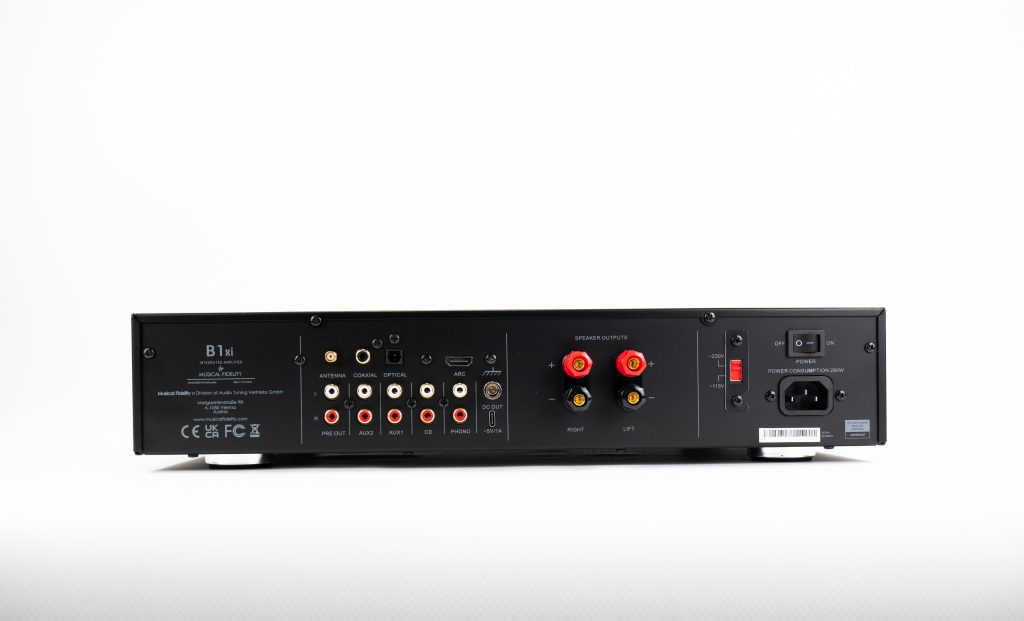
- Inputs: 3 line level, MM phono, coaxial, Toslink optical, HDMI ARC, Bluetooth
- Outputs: speaker terminals (banana plugs), pre-out, 6.35 mm headphone, USB-C 5 V
What should you pair with the B1xi?
The 42 dB gain on its MM input opens the door to high output moving coil cartridges, which put out more than 2 mV and need at least 40 dB of gain. You get the character of a moving coil without a separate MC phono preamplifier.
| Component | Our pick | Why this pairing works |
|---|---|---|
| Turntable | Pro-Ject Debut Carbon EVO II 749,00 € | The most balanced budget match: the carbon arm and heavy platter give the B1xi a rhythmic foundation that entry-level decks cannot reach. |
| Turntable | Rega Planar 1 429,00 € | Supplied with its MM cartridge, immediately compatible with the phono input, with no extra box required. |
| Cartridge | Denon DL-110, high output MC 349,00 € | The way into moving coil on an MM input, sitting exactly within the B1xi’s gain window. |
| Cartridge | Nagaoka MP200, MM 479,00 € | A 4 mV output and a richly textured, analogue presentation that matches the character of the amplifier. |
| Speakers | Rega Kyte 589,00 € | Fast and rhythmic, they make direct use of the B1xi’s sense of timing. An obvious choice for rock and jazz. |
| Speakers | Dynaudio Emit 10 729,00 € | More demanding on current, they draw on the 100 W into 4 ohms and reward the Class A preamplifier. |
| Speakers | Indiana Line Utah 5 689,00 € | For anyone who wants a floorstander at this budget, with bass extension the B1xi holds without softening. |
Key Takeaways from B1 xi
Choose the B1xi if your main source is a turntable fitted with an MM or high output MC cartridge, if you want to connect your television over HDMI ARC, and if your room is around 20 to 30 m².
Why is the M5 xi the best compromise in the range?
M5 xi resume
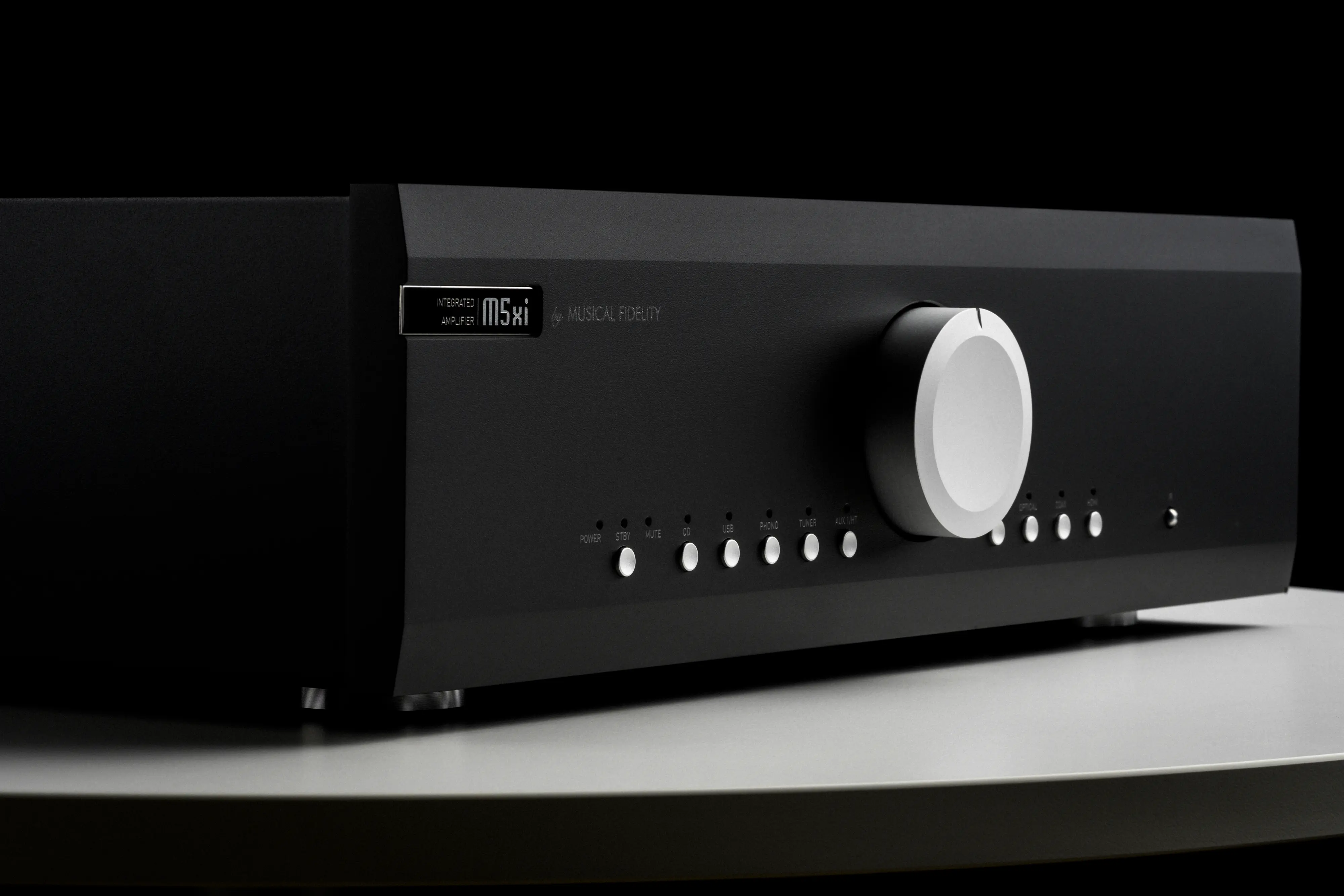
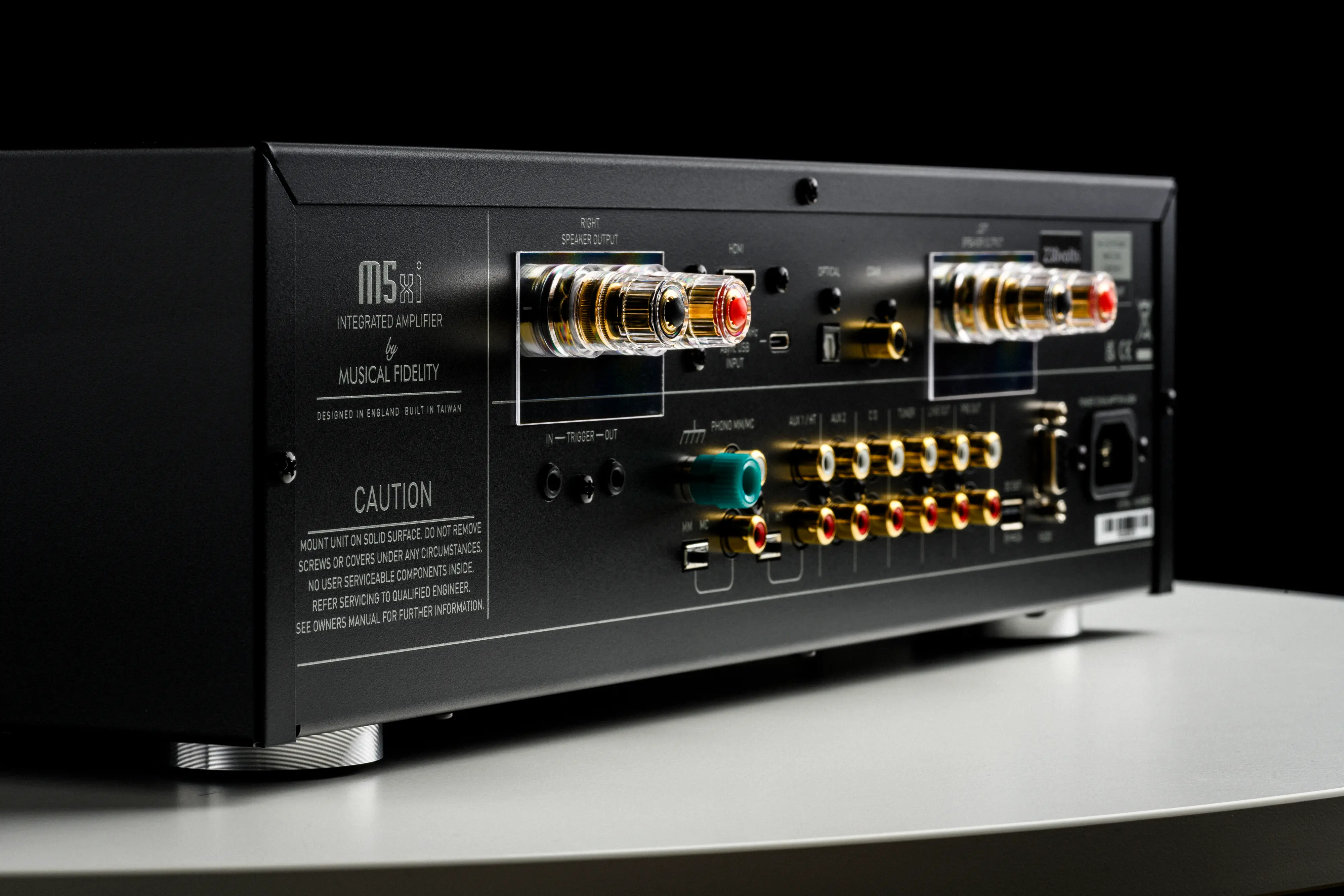
The M5 xi pairs a fully analogue preamplifier with a power amplifier in the same chassis. It delivers 180 watts per channel into 8 ohms and more than 450 watts peak into 4 ohms. It offers a switchable MM or MC phono input, 4 RCA line inputs, a separate digital board handling up to 24 bit / 192 kHz and an HDMI eARC input.
The decisive difference from the B1xi is the MM/MC switch. The phono input, substantially revised compared with the previous model with reinforced shielding and circuit optimisations, now accepts low output moving coil cartridges. It is genuinely usable and delivers a level of quality few integrated amplifiers offer in this price bracket, particularly in MC.
Power comes from a large encapsulated toroidal transformer with dual windings, each winding feeding one channel separately. From the first bars you hear how easily this amplifier drives loudspeakers, even those that are hard to feed. The presentation is dynamic and physical while staying nuanced, transparent without ever turning clinical or fatiguing.
M5 xi’s specifications at a glance
- 180 W per channel into 8 ohms, more than 450 W peak into 4 ohms
- Dual Push Pull of Sanken Darlington transistors per channel, Class A preamplifier
- Switchable MM or MC phono input, compatible with high and low output MC cartridges
- Inputs: 4 RCA line level (AUX1 switchable to bypass), coaxial, optical, USB-C (24/192), HDMI eARC, USB-B (24/96)
- Outputs: WBT speaker terminals (bananas and spades), pre-out, Line Out, IEC mains socket
- 9 selectable sources, black or natural aluminium finish
What should you pair with the M5 xi?
With a phono input of this calibre, the M5 xi deserves a turntable good enough to justify the move to moving coil, and speakers that call for current.
| Component | Our pick | Why this pairing works |
|---|---|---|
| Turntable | Rega Planar 3 879,00 € | The RB330 arm handles a good moving coil cartridge comfortably, which unlocks the best of the phono input straight away. |
| Turntable | Rega Planar 6 + NeO PSU MK2 1 689,00 € | The balanced pairing for anyone treating vinyl as their main source. Supplied without a cartridge, it leaves the MC choice open. |
| Turntable | Technics SL-1500 C 999,00 € | Direct drive and unshakeable speed stability, echoing the M5 xi’s firm hold in the bass. |
| Cartridge | Hana SL MK II, low output MC 759,00 € | Nude Shibata stylus, timbre and body first, precisely what the M5 xi conveys without hardening it. |
| Cartridge | Dynavector DV 10X5 MKII 659,00 € | For staying on the MM setting and keeping things simple, without giving up dynamics. |
| Speakers | Dynaudio Emit 30 1 489,00 € | The floorstander that draws fully on the M5 xi’s reserves. Bass stays taut, impact is remarkable, nothing blurs. |
| Speakers | Sonus Faber Lumina II 1 390,00 € | The choice for timbre. Since the M5 xi is transparent without being clinical, the match works beautifully on voices and strings. |
| Speakers | B&W 707 S3 1 590,00 € | Demanding on amplification, they reveal the Class A preamplifier. Put them on stands to get the best from them. |
Key Takeaways from M5 xi
Take the M5 xi if you are aiming at demanding speakers, if you listen to vinyl seriously with a moving coil cartridge, and if you want an amplifier that will outlast several generations of digital sources.
What does the M6 xi change compared with the M5 xi?
M6 xi resume
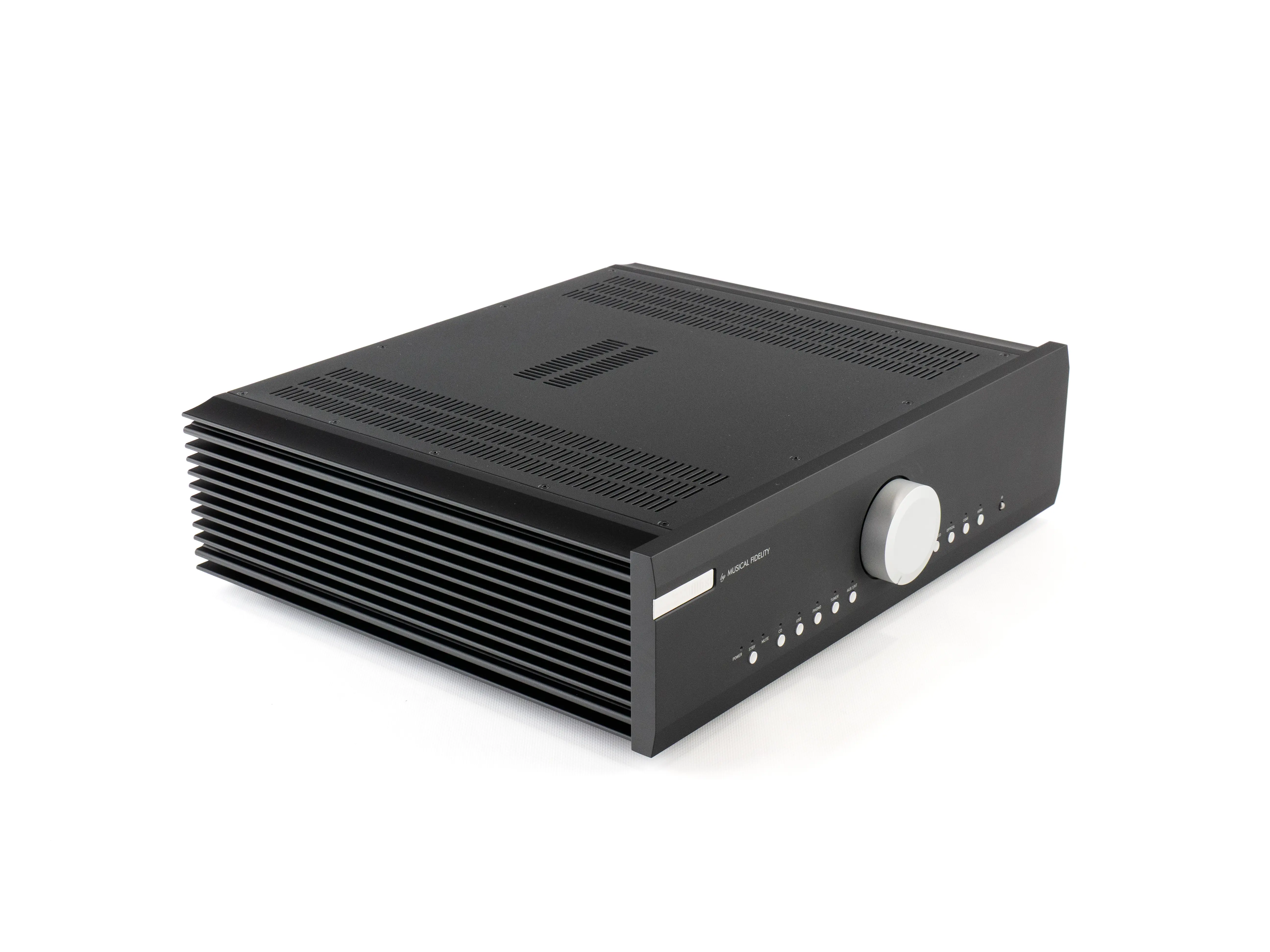
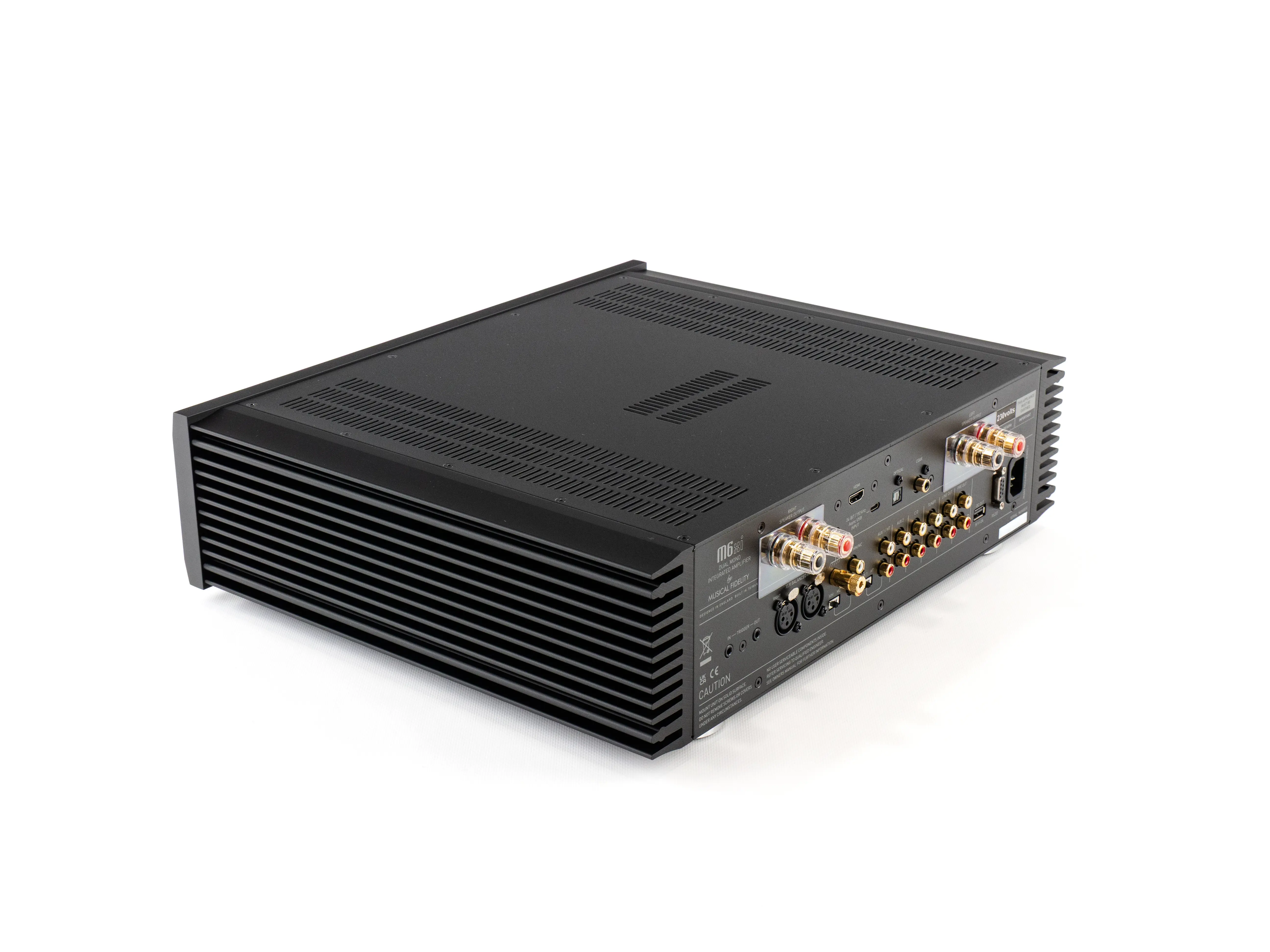
The M6 xi pairs a fully analogue preamplifier with two monobloc power stages sharing the same chassis. It delivers 220 watts per channel into 8 ohms and more than 450 watts peak into 4 ohms. It differs from the M5 xi through a balanced XLR input, 10 selectable sources and a more substantial build, with extruded aluminium side panels acting as heatsinks.
The gap with the M5 xi comes down to three concrete points: 40 extra watts per channel, the twin monobloc architecture, and the balanced XLR input the lower model does not have. The switchable MM/MC phono input and the separate digital board are identical.
In listening, the M6 xi is dense and fluid, with a remarkable sense of space and scale. The soundstage is precise and close to holographic, which makes classical music particularly convincing. The bass is full, deep and thoroughly analogue, organic and warm yet firmly held. Voices, brass and strings have a genuinely natural texture.
M6 xi‘s specifications at a glance
- 220 W per channel into 8 ohms, more than 450 W peak into 4 ohms
- Analogue preamplifier and two monobloc power stages in the same chassis
- Dual Push Pull of Sanken Darlington transistors per channel, Class A preamplifier
- Switchable MM or MC phono input, compatible with high and low output MC cartridges
- Inputs: 4 RCA line level, 1 balanced XLR, coaxial, optical, USB-C (24/192), HDMI eARC, USB-B (24/96)
- 10 selectable sources, WBT speaker terminals, black or natural aluminium finish
What should you pair with the M6 xi?
Its current reserve lets it drive a wide range of loudspeakers, including those considered difficult. At this level, the turntable becomes the limiting factor in the system.
| Component | Our pick | Why this pairing works |
|---|---|---|
| Turntable | Rega P6 RS 2 689,00 € | RB880 arm, Rega Nd9 MM cartridge and TTPSU power supply: an equal partner for the M6 xi. |
| Turntable | Rega Planar 6 + NeO PSU MK2 1 689,00 € | Supplied without a cartridge, it leaves full freedom to choose a low output MC worthy of the phono input. |
| Cartridge | Hana MH, high output MC 1 149,00 € | Definition and control, the ideal complement if your speakers lean towards warmth. |
| Cartridge | Hana SL MK II, low output MC 759,00 € | Timbre first, reinforcing the organic character of the M6 xi. Very musical on classical and jazz. |
| Speakers | Sonus Faber Sonetto I G2 2 190,00 € | A marriage of timbre: the organic presentation of the M6 xi chimes directly with the Sonus Faber signature. |
| Speakers | B&W 603 S3 2 290,00 € | An ambitious floorstander that calls for power and control. The 220 W into 8 ohms are fully justified here. |
| Speakers | B&W 705 S3 3 189,00 € | The summit of the bookshelf format. The M6 xi has the reserves to hold them properly. |
Key Takeaways from the M6 xi
The M6 xi is the culmination of the range. Choose it if your speakers are high end or difficult to drive, if you need a balanced XLR input, and if you want a full, organic presentation that gives up nothing in definition. It is our favourite.
How do you choose between the B1xi, the M5 xi and the M6 xi?
All three share the Class A preamplifier, the separate digital board with its linear power supply and the deliberate absence of network streaming. What separates them comes down to three things: power, the nature of the phono input, and connectivity.
| Criterion | B1xi | M5 xi | M6 xi |
|---|---|---|---|
| Price at maPlatine.com | 790,00 € | 2 289,00 € | 2 989,00 € |
| Power into 8 ohms | 2 x 60 W | 180 W per channel | 220 W per channel |
| Power into 4 ohms | 100 W per channel | 450 W peak | 450 W peak |
| Phono input | MM, 42 dB gain | Switchable MM or MC | Switchable MM or MC |
| Compatible cartridges | MM and high output MC | MM, high and low output MC | MM, high and low output MC |
| Line inputs | 3 | 4 RCA | 4 RCA and 1 XLR |
| HDMI input | ARC | eARC | eARC |
| Headphone output | Yes, 6.35 mm | Via Line Out | Via Line Out |
| Network streaming | No | No | No |
Our experts’ word of caution
In a vinyl system, the link most often underestimated is neither the amplifier nor the speakers, but the match between cartridge and phono input. Check your cartridge output before ordering: below 2 mV, a moving coil cartridge will need the MC input of the M5 xi or the M6 xi, or a separate MC phono preamplifier. The B1xi covers MM and high output MC cartridges, but not low output MC. A digital converter, however good, never replaces a phono preamplifier.
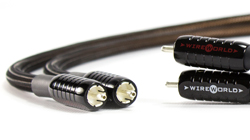
Going further: our guides how to choose your Hi-Fi speakers and how do I choose a turntable, our network players for the digital inputs, our speaker cables, banana and fork connectors, our XLR interconnect cables for the balanced input on the M6 xi, and our speaker stands for the bookshelf models. If your current amplifier has no phono input, see our phono preamplifiers.
FAQ : Everything to know before buying a Musical Fidelity xi amplifier
Can I connect a turntable directly to an amplifier in the xi range?
Yes. All three models have a dedicated phono input, so you do not need a separate phono preamplifier. The B1xi offers an MM input with its own linear power supply, which is rare in this bracket. The M5 xi and the M6 xi offer an input switchable between MM and MC.
What is the difference between the phono input on the B1xi and the one on the M5 xi or M6 xi?
The B1xi is MM only, with 42 dB of gain and sensitivity from 1.5 mV, which makes it compatible with high output moving coil cartridges putting out more than 2 mV. The M5 xi and the M6 xi additionally accept low output moving coil cartridges, which the B1xi cannot handle on its own.
Do these amplifiers offer network streaming?
No, and that is a deliberate choice. Musical Fidelity considers all-in-one amplifiers with streaming to be more expensive, less capable and quicker to age. You keep high quality digital inputs for connecting a network player of your choice, which you can upgrade independently of the amplifier.
How much power do I need for my listening room?
The B1xi is comfortable in a medium-sized room of around 20 to 30 m². A larger room, or less sensitive speakers, will call for more: the M5 xi at 180 W per channel, or the M6 xi at 220 W per channel, then take over.
Is the M6 xi worth the 700 € gap over the M5 xi?
The gap rests on three points: 220 W per channel against 180 W, an architecture built around two monobloc power stages, and a balanced XLR input the M5 xi does not have. If your speakers are high end or hard to drive, the difference is justified. If not, the M5 xi remains an excellent choice.
Can I connect my television to a Musical Fidelity xi amplifier?
Yes. The B1xi has an HDMI ARC input, the M5 xi and the M6 xi an HDMI eARC input. You connect the television straight to the amplifier, with no box in between.
Which Musical Fidelity xi amplifier should you choose?
The B1xi is the best entry point for anyone who listens to vinyl and also wants to improve their television sound. The M5 xi opens the door to low output moving coil cartridges and to demanding speakers, and it is the versatile choice with nothing given away. The M6 xi remains our favourite, for its density and that sense of space which makes classical listening so convincing.
These three amplifiers are not chosen on paper. They are chosen in front of your speakers, in your room, with your records.
Need personalized advice?
Our technicians will help you choose the turntable that best suits your needs, your cartridge, and your budget, and will check that your analog system is properly set up.
Phone: 0 810 810 121, Monday through Friday, 9 a.m. to 5 p.m.
maPlatine.com Auditorium in Rennes: comparative listening sessions by appointment. Each turntable is inspected and adjusted by our technicians before shipping.