




DIRECT ANSWER
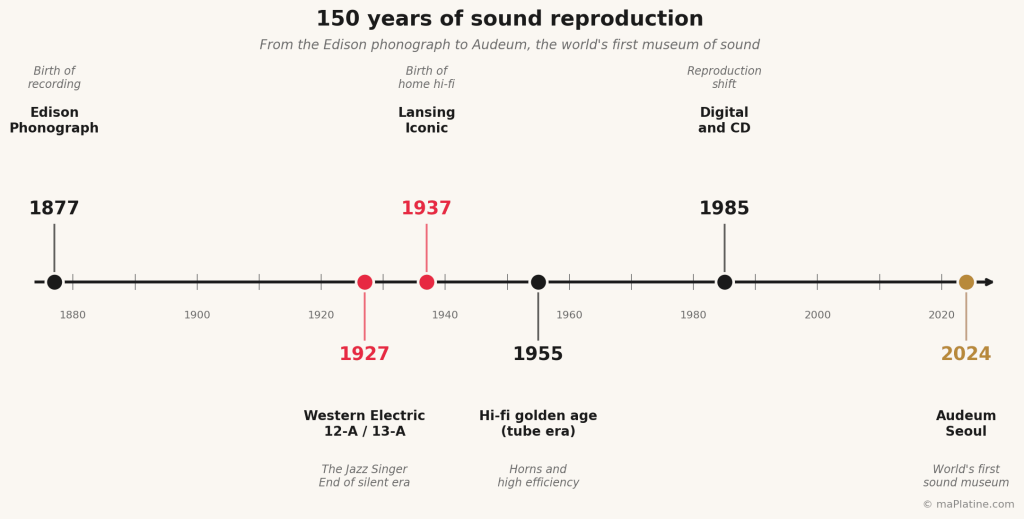
Audeum is the world’s first public museum entirely devoted to sound reproduction. Founded by Michael Chung, the creator of South Korean audio brand Silbatone Acoustics, in memory of his father, it opened its doors in May 2024 in the Seocho-gu district of Seoul. The seven-storey building, designed by Japanese architect Kengo Kuma, houses one of the world’s largest audio equipment collections and traces 150 years of sound reproduction history, from the Edison phonograph to the hi-fi systems of the 1960s.
There are museums for nearly everything: photography, cars, perfume, comics. For sound, though, we had to wait until 2024 and Seoul. And not just any museum.
The Audeum (오디움) is not only the world’s first public institution dedicated to audio equipment. It is also the combined work of a visionary collector, one of the greatest living architects, and an art director famous for shaping the visual identity of Muji. In short, a project that goes well beyond a thematic museum.
For any hi-fi enthusiast, Audeum has become a pilgrimage destination in just a few months. For design and architecture lovers, it is a fascinating object. Here is why.
A family project turned temple of sound
Behind Audeum lies a story of transmission. Michael Chung, founder of Silbatone Acoustics, conceived this museum as a tribute to his father, himself an acoustician. The project, plotted for years backstage at the Munich High End show where Silbatone exhibited regularly, took shape with a colossal budget: roughly 150 million US dollars.
For regulars at the Munich show, Silbatone’s conspicuous absence in 2024 felt like something serious was brewing. And for good reason: the team was finalizing the grand opening in Seoul.
The collection on display draws on the Silbatone holdings, already famous in the audiophile world for their vintage Western Electric systems and demonstrations that turned heads in Munich. At Audeum, however, these pieces no longer travel. They have finally found their permanent home.
Kengo Kuma signs a building that looks like frozen sound
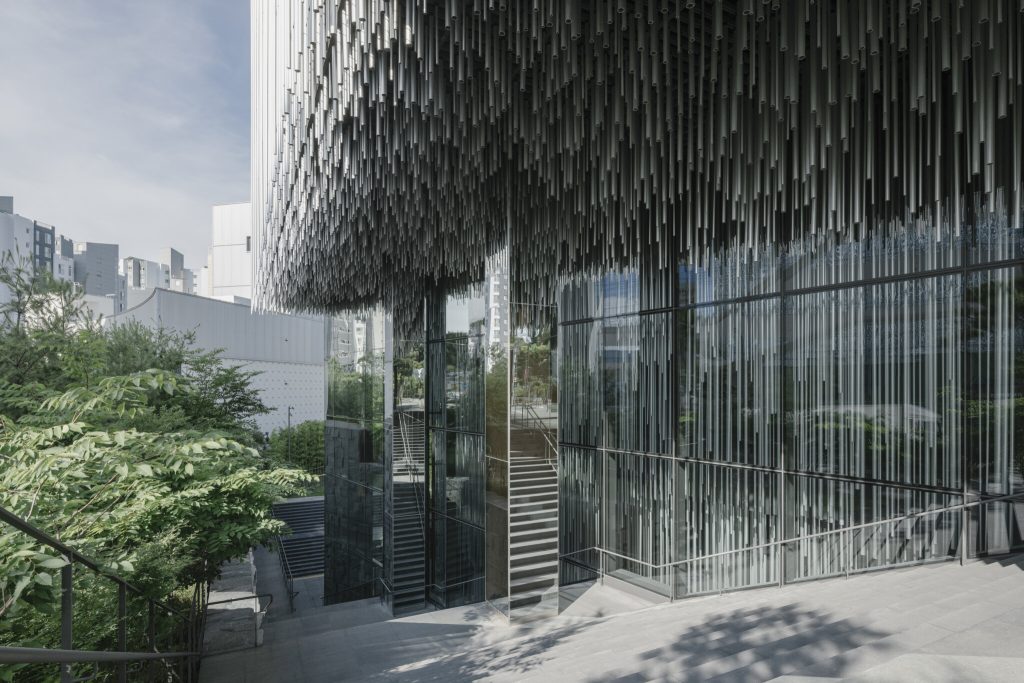
Architecture is inseparable from the experience. Kengo Kuma, together with YKH Associates, designed a building of seven floors totalling 11,009 sqm. The facade alone is worth the trip.
Twenty thousand vertical aluminum tubes wrap the building, cascading at varying lengths and casting shifting shadows that evoke light filtering through a dense forest. Kuma has spoken of a komorebi effect, the dappled light through leaves that the Japanese have a name for. Kenya Hara, art director of the project and head of Muji design, sees something else in it: music put on pause, frozen like ice.
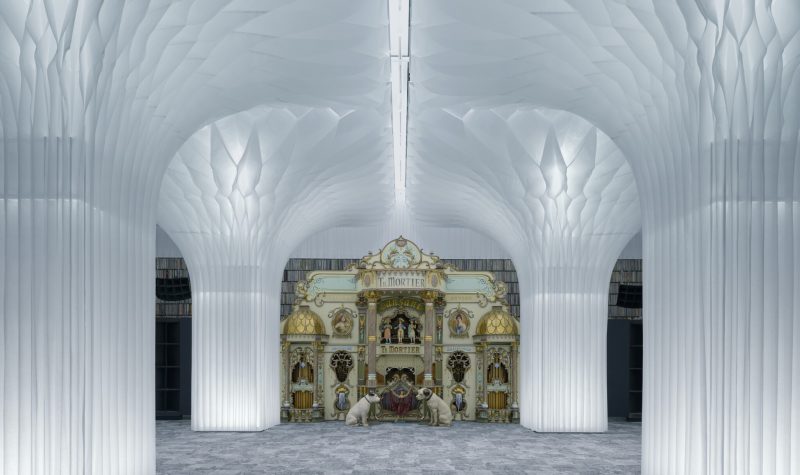
Inside, the atmosphere shifts. Alaska cypress lines walls and floors, chosen for its lingering scent and a so-called « draped » finish that produces remarkable acoustic effects. Some exhibition rooms are entirely wrapped in fabrics with specific sound-conductive properties. The idea: that the building itself becomes an instrument.
The gamble pays off. In 2025, the Prix Versailles ranked Audeum among the « World’s Most Beautiful Museums » and awarded it the Special Prize for Interior Design.
KEY TAKEAWAYS
20,000 aluminum tubes vertically arranged compose the facade, evoking forest light (komorebi effect).
Alaska cypress inside, for its scent and acoustic properties.
Prix Versailles 2025: Special Prize for Interior Design.
One hundred and fifty years of sound reproduction in a single collection
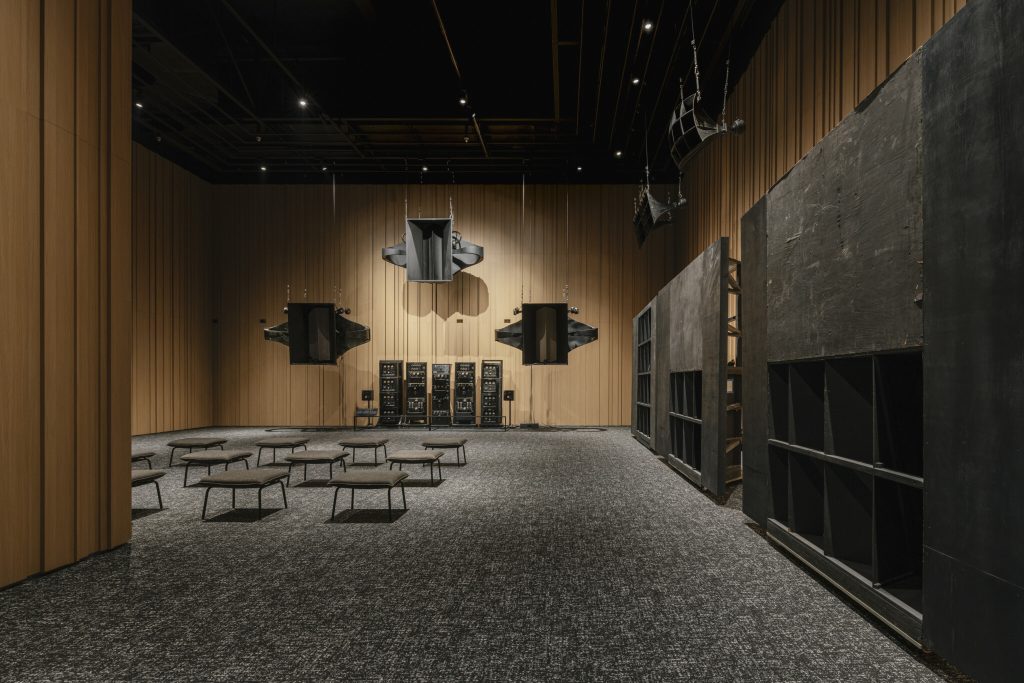
Audeum’s strength is that visitors do not look at the equipment behind glass. They listen to it. The museum does not present its objects as frozen artefacts: it makes them play.
Four exhibition floors cover the period from 1917 to the 1960s. The journey starts with the pioneers, gramophones and Edison phonographs, then moves on to the great cinema sound systems and the first masterpieces of home audio. Each room has been acoustically calibrated to suit its content.
The inaugural exhibition, « Jung Eum (正音): In Search of Sound », offers one possible definition of « good sound »: high fidelity. It is also a way to invite visitors to find, among all possible sound aesthetics, the one that resonates with them.
Which masterpieces draw audiophiles on this pilgrimage?
Several treasures justify the trip on their own. Here are a few:
- Western Electric 16-A and 16-B Sound Systems, used in small movie theatres from 1932 onwards
- Lansing Iconic Loudspeaker from 1937, considered the starting point of modern home audio
- Western Electric 12-A and 13-A Sound Systems, the world’s first large cinema systems, with snail-shaped horns unfolding over four metres, used for The Jazz Singer in 1927
- Siemens/Klangfilm system from the mid-20th century
- Western Electric M1 Mirrophonic, probably the only one in the world still in working condition, installed in the museum’s café
Yes, you read that right. The museum’s café plays its music on a historic cinema sound system that is unique in the world. The detail says everything about the level of ambition of the place.
maPlatine note: the sonic signature of Western Electric (very high efficiency, compression horns, tube amplification) remains a reference for many contemporary manufacturers. Our auditorium in Rennes, France, regularly showcases systems inspired by this philosophy, built around high-efficiency loudspeakers and tube amplifiers.

How to visit Audeum
Before booking your flight to Seoul, a few practical details. Audeum is located at 6 Heolleung-ro 8-gil, in the Seocho-gu district, at the foot of Cheonggyesan mountain. It can be reached by bus, or with a fifteen-to-twenty minute walk from Cheonggyesan station.
Admission is free, but conditional on online booking via audeum.org. Demand is high and slots are hard to secure: book well in advance and watch for cancellations.
The museum is open Thursday to Saturday, 10am to 6pm. Guided tours are conducted in Korean, with an English audio guide available on the website. There is no self-guided option: the visit is timed, which frustrates photographers but preserves the collective listening experience.
| Item | Detail |
|---|---|
| Official opening | May 2024 |
| Founder | Michael Chung (Silbatone Acoustics) |
| Architect | Kengo Kuma & Associates, with YKH Associates |
| Art direction | Kenya Hara (visual identity, Muji designer) |
| Total area | 11,009 sqm spread over 7 floors |
| Facade | 20,000 vertical aluminum tubes |
| Period covered | From the 19th century to the 1960s (150 years) |
| Distinction | Prix Versailles 2025 (Special Prize for Interior Design) |
| Location | 6 Heolleung-ro 8-gil, Seocho-gu, Seoul |
| Official website | audeum.org |
| Access | Free, online booking required |
| Opening hours | Thursday to Saturday, 10am–6pm |
A museum that reinvents what a museum is
Beyond the fact sheet, what is striking about Audeum is the inversion of priorities. In most museums, you look. Here, you listen first. The museum favours experience over instruction: rather than overwhelming visitors with text, it invites them to explore by ear.
Kengo Kuma has summed up the intent in a single phrase: this is not simply a place where one listens to sound; it is a vast architectural instrument that brings people back to their essential natural state and activates all their senses.
Audeum also claims a function of preservation and research. The exhibited pieces are not locked away under glass: they are restored, maintained and played. For objects whose technical lifespan can be measured in decades, this amounts to an active preservation of the world’s sound heritage.
Why Audeum matters to hi-fi enthusiasts
For an enthusiast, visiting Audeum means hearing under real conditions what specialist literature has been describing for fifty years. The grain of Western Electric. The presence of brass instruments restored by a four-metre horn. The sonic signature of an era when tube amplification was not an aesthetic choice but a technical necessity.
It is also a way to measure the path travelled, and the path that remains. Many current trends in hi-fi, from the revival of tube amplifiers to the fascination with horns and transducer efficiency, have their roots in this 1917-1960 period that Audeum lets you hear.
Explore the hi-fi that inspires Audeum
Audeum reminds us that sound quality is built one link at a time. Here are a few starting points to compose yours, drawn from our catalogue:
- Phono preamplifiers, the discreet but decisive link between turntable and amplifier
- Audiophile network players, the bridge between your digital library and your system
- High-resolution DACs, cornerstone of the modern digital chain
- High-fidelity headphones, for focused and intimate listening
- Audiophile cables, too often the neglected links of the chain
FAQ: everything you need to know about Audeum
What exactly is Audeum?
Audeum is the world’s first public museum entirely dedicated to sound reproduction and audio equipment. It opened in Seoul in May 2024.
Who created Audeum?
Michael Chung, founder of South Korean audio manufacturer Silbatone Acoustics, designed and funded the project in memory of his father.
Who is the architect of Audeum?
The building was designed by Japanese architect Kengo Kuma, in collaboration with YKH Associates. Kenya Hara, Muji’s art director, designed the visual identity.
What are the flagship pieces of the collection?
The Edison phonograph, Western Electric 12-A, 13-A, 16-A and 16-B systems, the 1937 Lansing Iconic, a Siemens/Klangfilm system, and a Western Electric M1 Mirrophonic in working condition, installed in the café.
How much does admission to Audeum cost?
Admission is free, but online booking is mandatory via audeum.org. Slots fill up quickly.
What are the opening hours?
The museum is open Thursday to Saturday, 10am to 6pm. It is closed Sunday to Wednesday.
Where is Audeum located in Seoul?
At 6 Heolleung-ro 8-gil, Seocho-gu district, at the foot of Cheonggyesan mountain, in the southern edge of Seoul.
Are tours available in English?
Guided tours are conducted in Korean. An English audio guide is available on the museum’s official website.
How much time should you plan for the visit?
The guided tour lasts about two hours. Plan a little more to enjoy the café and the view from the top floor.
Can you take photos?
Photography is only allowed in a dedicated area and during a specific time slot at the end of the tour, in order to preserve the collective listening experience.
You don’t have to fly to Seoul to experience hi-fi
You do not need to fly to Seoul to hear, under optimal conditions, what a fine hi-fi system can do for your record collection. Our maPlatine.com auditorium in Rennes, France, is open by appointment: come and compare turntables, amplifiers, loudspeakers and headphones, with our team alongside you.
To prepare your visit or to discuss your project, reach us at +33 (0)810 810 121, Monday to Friday, 9am to 5pm CET.