





DIRECT ANSWER
A DAC (Digital Analog Converter) is a hi-fi device that turns the digital audio signal from a source (computer, smartphone, network player, CD player, streaming turntable, TV) into an analog signal that a traditional amplifier can use.
It is the decisive link of every modern hi-fi system: on the digital side, it holds the place a phono preamplifier holds on the analog side. A quality external DAC unlocks the native resolution of your high-definition files (PCM 24-bit / 192 kHz, DSD64 to DSD512, MQA) and reveals detail, dynamics and a tonal foundation that the chip built into a computer or smartphone cannot deliver.
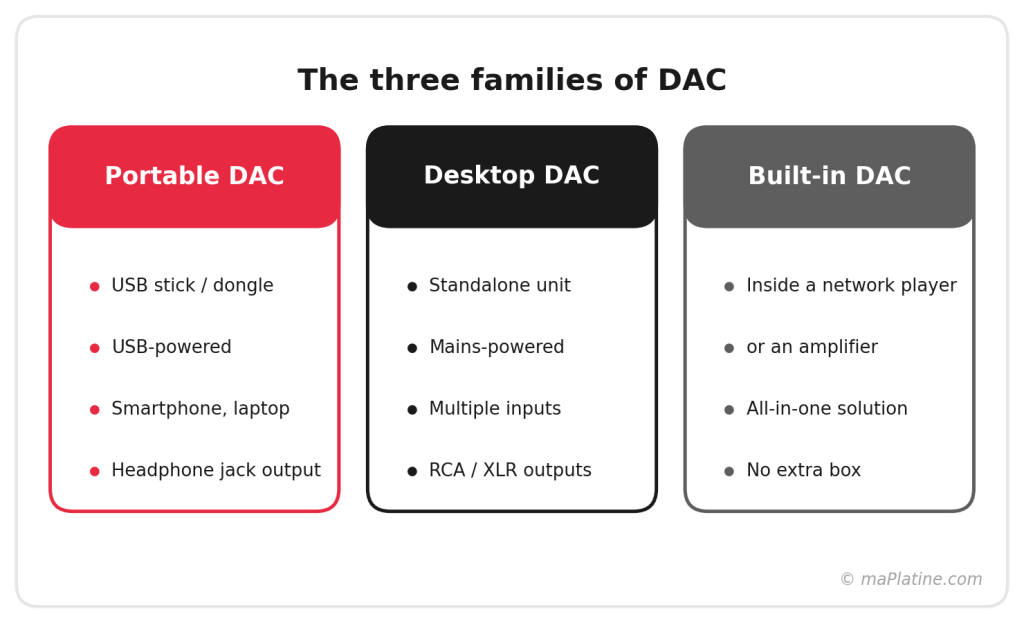
Three families coexist: the portable DAC (USB stick or dongle for smartphone and laptop), the desktop DAC (standalone unit with multiple inputs) and the built-in DAC (already inside most recent network players, amplifiers and streamers). maPlatine.com stocks DACs from Cambridge Audio, Atoll Electronique, Audiolab, Pro-Ject, Audioquest and Eversolo, auditioned in real conditions at our Rennes auditorium.
Digital now dominates how we listen to music. Smartphones, computers, tablets and network players have become the main sources for millions of music lovers, driven by the rise of Qobuz, Tidal, Apple Music, Deezer and Spotify, which put tens of millions of tracks a few clicks away.
This convenience has a downside: the digital-to-analog conversion handled by the built-in chips of these devices falls well short of what modern files can offer. That is exactly the role of the external DAC: to take the digital stream before it is converted by the source’s generic electronics, then process it with a dedicated, calibrated and cleanly powered circuit.
The benefit is immediately audible: airier highs, fleshier mids, tighter bass, suppressed background noise and a precisely reconstructed soundstage. This guide gives you the keys to understand what happens inside a DAC, identify the criteria that matter, choose the family suited to your use and match it correctly to your system.
⚠ SCOPE OF THIS GUIDE
This guide is for newcomers and seasoned audiophiles alike who want to understand the role of the DAC and make an informed choice. Covered: DACs for home hi-fi systems (portable, desktop, built into a network player or amplifier). Excluded: phono preamplifiers for turntables (a DAC only converts digital signals, never the analog signal from a cartridge). Brands are mentioned for guidance only: check the current technical sheets on maPlatine.com.
Why does your source’s built-in conversion show its limits?
Every digital source already includes a DAC: that is the minimum needed to produce sound from an MP3, a Qobuz stream or a CD. But between an entry-level built-in DAC and a dedicated external DAC, the differences in circuit, power supply and analog stage translate into a considerable gap in sound. Here are the four situations where built-in conversion shows its limits.
Why is a computer’s sound card a compromise?
The audio chip in a PC or Mac is designed to reproduce system sounds, video-call voice, videos and music alike. Its brief is versatility, not fidelity. A power supply polluted by other components (graphics card, processor, fans), a basic output stage and often non-existent shielding produce a signal littered with background noise and digital artefacts, immediately audible on good speakers.
Why is a smartphone’s audio output limited?
Most manufacturers have removed the headphone jack and handed conversion to a mini-DAC tucked into the USB-C or Lightning adapter. Extremely miniaturised and constrained by power draw, this component cannot extract the dynamics and finesse of a hi-res 24-bit / 96 kHz file or higher. A simple portable DAC plugged into the phone’s port then lifts listening to another level.
How good are the DACs in entry-level CD and network players?
An entry-level CD player or streamer includes a DAC, but often a generic, older-generation chip, with no dedicated linear power supply and a limited output stage. For anyone investing in fine speakers or a good amplifier, the external DAC becomes the link that unlocks the real potential of the components downstream. It is also the preferred way to upgrade a system without replacing everything.
What is the difference between compressed and lossless streaming?
MP3 files and standard Spotify streams are compressed: part of the musical information is permanently lost to reduce data size. By contrast, Qobuz, Tidal HiFi and Apple Music Lossless deliver CD quality (16-bit / 44.1 kHz) or even high resolution (24-bit / 96 or 192 kHz). An external DAC cannot recover what has been compressed, but it accurately renders everything a lossless or hi-res stream contains, where a built-in chip levels every source down.
⚠ KEY TAKEAWAY
Four signals indicate an external DAC will bring an audible benefit: (1) listening mainly from a computer or smartphone; (2) a hi-res subscription (Qobuz, Tidal, Apple Music Lossless); (3) a quality speaker or amplifier setup whose digital source seems to cap its potential; (4) a plan to upgrade in stages rather than replace everything at once.
What is a DAC and how does it work?
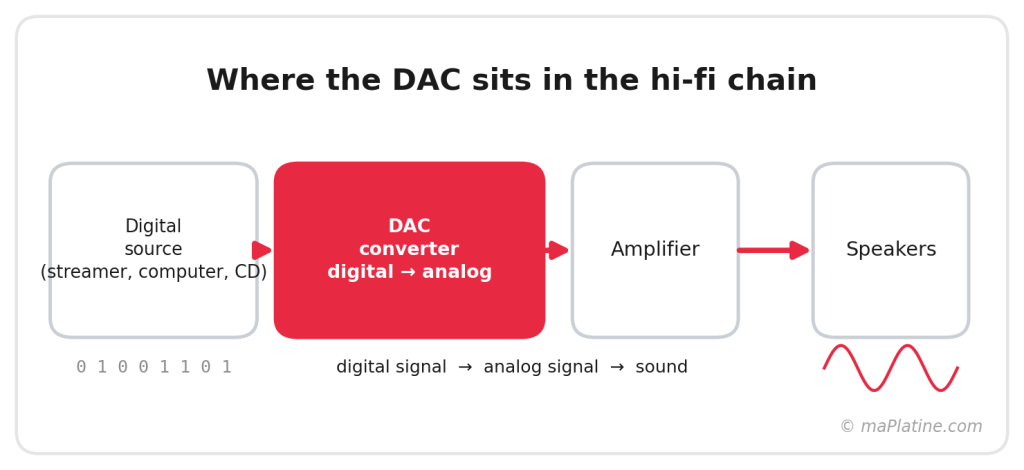
DAC stands for Digital Analog Converter. This device sits between a digital source and an amplifier to translate the binary language of an audio file into a continuous electrical signal able to move your speaker cones. Without a DAC, no digital music listening is physically possible.
What is the role of the DAC in the hi-fi chain?
Digital music comes as sequences of 0s and 1s stored in a file or stream. The DAC converts these sequences into an analog electrical voltage that varies over time, exactly as a turntable’s stylus once did. This voltage is sent to the amplifier, which amplifies it, then to the speakers, which turn it into audible sound pressure. The DAC is the tipping point between computer calculation and the physical sound wave.
How does the DAC turn binary into an analog signal?
A digital audio file is a succession of samples: at each instant, the sound level is measured and coded on a given number of bits. The frequency of these measurements is the sampling rate (44,100 times per second for a CD, up to 768,000 times for the most demanding PCM files). The number of bits per sample sets the resolution (16-bit for CD, 24-bit for hi-res, 32-bit for some studio masters).
From these discrete points, the DAC reconstructs the continuous curve of the sound wave. This reconstruction draws on a digital filter, a conversion circuit, a buffer output stage and a stabilised power supply. Each step can introduce noise or distortion: the quality of each is what separates an entry-level DAC from an audiophile reference.
What are oversampling and the digital filter?
Most modern DACs use oversampling: the original signal is enriched with interpolated points, which pushes conversion artefacts outside the audible band and eases the work of the analog output filter. The choice of slope and filter type (linear, minimum phase, apodising) imprints a subtle but audible sonic signature, which is why some high-end DACs offer several user-selectable filters.
Which technical criteria determine a DAC’s quality?
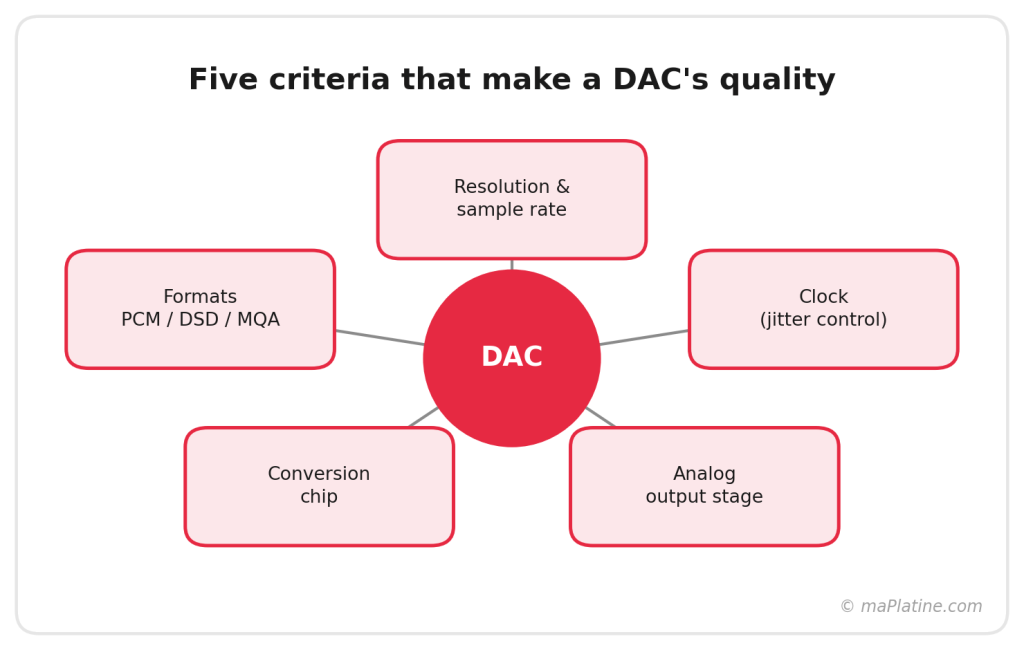
Comparing two DACs on price or looks alone makes no sense. Five parameters shape performance and explain price differences. Knowing them lets you read a spec sheet correctly and see where the money goes.
Which resolution and sampling rate should you choose?
These are the two essential figures on a DAC spec sheet. Resolution (in bits) sets the fineness of the dynamics: 16-bit is enough for a CD, 24-bit opens the door to hi-res. The sampling rate (in kHz) sets the timing precision: 44.1 kHz for CD, 96 and 192 kHz for Qobuz and Tidal hi-res, up to 384 or 768 kHz for masters. Most current DACs accept at least PCM 24-bit / 192 kHz, which covers the entire commercial hi-res catalogue.
Which audio formats should a DAC support (PCM, DSD, MQA)?
Three format families coexist. PCM (Pulse Code Modulation) is the legacy: CD and most FLAC, WAV, ALAC and AIFF files. DSD (Direct Stream Digital), developed for SACD, encodes information differently and appeals with its tight bass and smooth treble, in tiers from DSD64 to DSD512. MQA (Master Quality Authenticated), used by Tidal Masters, packs a hi-res stream into a smaller file but needs a certified DAC to be fully decoded.
Which conversion chip should you choose (ESS Sabre, AKM, Burr-Brown, R-2R)?
The conversion chip is the main component. ESS Sabre (ES9028, ES9038Pro) equips most modern DACs, known for precision and dynamics. AKM (AK4490, AK4499) offers a signature considered more organic and fluid. Burr-Brown (Texas Instruments) is still prized for its musical midrange. Finally, R-2R architectures (discrete resistors), rarer and pricier, appeal to a niche of audiophiles for their naturalness and absence of a digital filter.
Why is the analog output stage decisive?
An excellent chip is not enough: the signal leaving the chip is very low level and must be amplified to standard line level. The analog output stage (discrete transistors, op-amp or tubes) colours the result decisively. On high-end DACs, this stage absorbs a large share of the cost and design care, sometimes more than the chip itself.
What is jitter and why does the clock matter?
Conversion requires each sample to be processed at a perfectly precise instant. Jitter is the micro-fluctuation in clock timing: even tiny, it introduces audible distortion. Serious DACs invest in their internal clock (high-precision quartz oscillator, sometimes OCXO or femto-clock) and some accept an external master clock for very demanding systems.
What are the three main families of DAC?
The word DAC covers products of very different sizes, uses and prices. Before comparing spec sheets, identify the family that matches your main use.
What is a portable DAC and who is it for?
In a USB-stick or dongle format weighing a few grams, the portable DAC plugs directly into a computer’s USB port or a smartphone’s USB-C / Lightning port. It has a 3.5 mm jack output (sometimes 4.4 mm balanced) for headphones or in-ears. It is the ideal way to turn your phone into a mobile audiophile source without sacrificing conversion quality. Audioquest popularised the category with its DragonFly range; other brands now offer alternatives compatible with PCM 32-bit / 384 kHz and MQA.
What is a desktop DAC and who is it for?
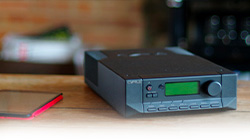
In a standalone unit format, to sit on a desk or in a hi-fi rack, the desktop DAC has several digital inputs (USB, optical TOSLINK, coaxial S/PDIF, sometimes AES/EBU) and RCA or balanced XLR analog outputs. Mains-powered, it benefits from a stable linear power supply, a carefully designed output stage and a more capable chip than portable models. It is the flagship category for a serious hi-fi setup, where the DAC stays put and centralises every digital source in the room.
What is a built-in DAC and who is it for?
Most recent network players and streamers, as well as many integrated amplifiers, now include a quality DAC. The Cambridge Audio and Atoll Electronique network players stocked at maPlatine.com are excellent examples, with recent ESS Sabre or AKM chips and refined output stages. Upsides: no extra box, no external digital cable to buy. The trade-off: it will be harder to upgrade just the conversion without changing the whole source.
| Criterion | Portable DAC | Desktop DAC | Built-in DAC |
|---|---|---|---|
| Main use | On the move: smartphone, laptop, headphones | Stationary: living-room hi-fi or audiophile desk | All-in-one source: network player, integrated amp, streamer |
| Power supply | From the USB port (bus-powered) | Mains, linear power supply | Mains, shared with the device |
| Inputs | USB only | USB, optical, coaxial, sometimes AES/EBU and HDMI | Varies with the host device |
| Outputs | 3.5 mm jack (sometimes 4.4 mm balanced) | RCA and/or balanced XLR | Built into the host chain |
| Max formats | PCM 32-bit / 384 kHz, sometimes DSD256, MQA | PCM 32-bit / 768 kHz, DSD512, MQA | Varies, often PCM 24/192 and DSD128 |
| Footprint | USB-stick size, a few grams | Hi-fi unit, 1 to 5 kg | None, already in the source |
| Upgradeability | Hard to integrate into a hi-fi system | High: replaced independently of the rest | Low: tied to the host source |
| Audience | Mobile music lovers, headphone owners | Audiophiles, stationary hi-fi systems | Turnkey system, beginners to experts |
How do you match your DAC to your hi-fi system?
The best DAC in the world stays underused in an incoherent system. Four points govern a successful match: input connectivity, output connectivity, range coherence and respect for the rules specific to analog sources.
Which input connection should you choose (USB, optical, coaxial, AES/EBU)?
Each digital link has its own characteristics. USB is the most universal for computer sources (computer, NAS, streamer), with enough bandwidth for PCM 32-bit / 768 kHz and DSD512; it often needs a dedicated driver on Windows. Optical TOSLINK offers perfect galvanic isolation (no ground loop), ideal for TVs and CD players, but caps at 24-bit / 192 kHz. Coaxial S/PDIF (orange RCA) is often considered slightly better than optical on jitter, at the same bandwidth. AES/EBU (3-pin XLR) is the professional standard, found on high-end DACs.
RCA or balanced XLR: which output should you choose?
On the output side, two standards coexist. RCA (unbalanced) is universal and perfectly suits short home links (under 2 metres between DAC and amp). XLR (balanced) offers a higher level and better immunity to interference over long distances: recommended as soon as the link exceeds 3 metres or the electrical environment is disturbed. Check that your amplifier has the matching inputs before buying.
How do you balance the DAC budget within the chain?
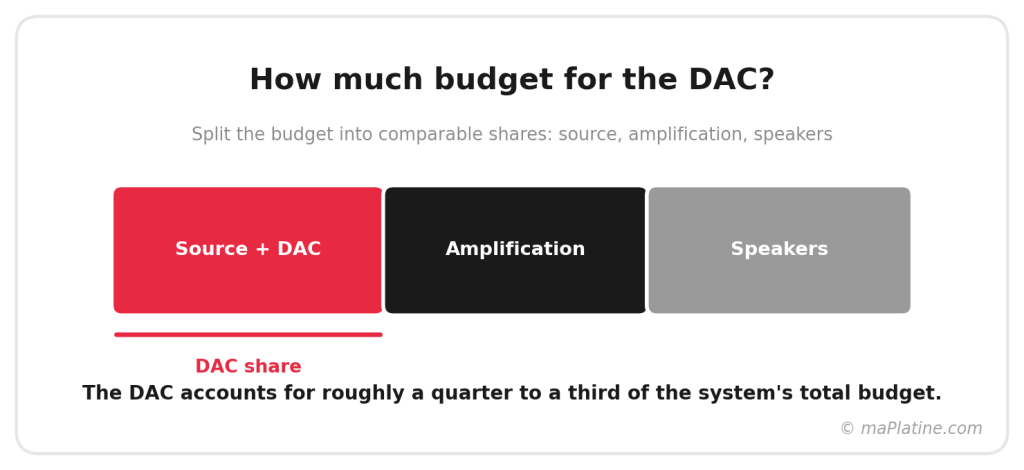
A DAC is not bought in isolation: its resolution must match the speakers and amplifier downstream. Plugging a high-end DAC into an entry-level amp and budget speakers creates an imbalance. The rule of thumb established at our Rennes auditorium: split the budget into comparable shares between source (network player or computer + DAC), amplification and speakers. On that basis, a DAC representing a quarter to a third of the total chain budget offers a coherent compromise.
Does a DAC replace a phono preamp for vinyl?
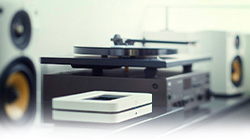
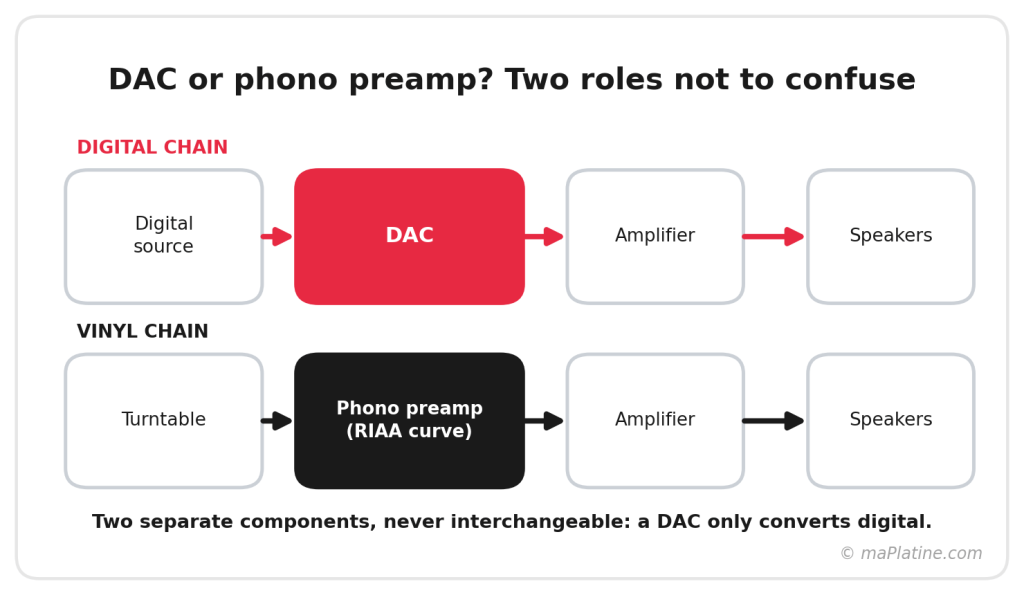
No, never. The DAC plays no role for a turntable. A cartridge’s signal is analog, not digital: it needs a phono preamplifier to be amplified and corrected to the RIAA curve, never a DAC. If your system combines digital sources (network player, computer) and a turntable, plan for both blocks: a DAC for digital, an external or built-in phono preamp for vinyl. This rule holds whatever the cartridge (MM or MC).
KEY TAKEAWAY
Before buying a DAC, check four points: (1) your main source (computer, smartphone, network player, CD player) and the matching input type; (2) budget coherence with amplification and speakers; (3) the presence of XLR inputs on your amp if you want a balanced output; (4) the separation of the digital and analog chains (a DAC never replaces a phono preamp for vinyl).
How do you install and connect your DAC?
Once the DAC is chosen, integrating it takes a few minutes. Here is what to do for the two most common scenarios.
How do you connect a portable DAC to a smartphone or computer?
The procedure takes three steps. One, plug the portable DAC into the USB-C port (Android smartphone, MacBook), Lightning (iPhone via the official adapter) or USB-A (computer). Two, plug your headphones or in-ears into the DAC’s jack output. Three, in the app (Qobuz, Tidal, Apple Music, Roon), enable exclusive or bit-perfect mode if available: the stream is sent to the DAC without going through the system mixer, guaranteeing native resolution. No driver on Mac, iOS and Android; Windows may need the manufacturer’s ASIO driver.
How do you connect a desktop DAC in a hi-fi system?
Connection involves three links. One, connect the digital source to the DAC with the right cable: USB for a computer or streamer, optical or coaxial for a CD player or TV. Two, connect the DAC’s analog output (RCA or XLR) to a spare line input on your integrated amplifier or preamp. Three, plug the DAC into the mains via its own power supply, ideally on a filtered power strip separate from the amplifier to limit electrical pollution.
Which cable should you choose to connect your DAC?
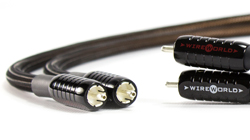
The quality of the digital cable linking the source to the DAC has a measurable influence. For USB, an Audioquest Cinnamon, Forest or Pearl cable brings an audible gain over the basic supplied cable. For coaxial S/PDIF and AES/EBU, dedicated cables with a precise 75 or 110 ohm impedance are essential. On the analog output side, quality RCA or XLR interconnects logically extend the investment. A selection of audio cables is available at maPlatine.com for each link.
FAQ: 10 frequent questions about DACs in hi-fi
What is the difference between a built-in DAC and an external DAC?
Every digital source includes a DAC, which is essential to produce sound. But the DAC built into a computer, a smartphone or an entry-level hi-fi device stays limited by constraints of space, power supply and cost. An external DAC, whether portable or desktop, benefits from a dedicated circuit, a clean power supply and a carefully designed output stage: the audible gain ranges from obvious (on a smartphone) to spectacular (on a complete hi-fi system).
Do you need a DAC to listen to Spotify or Deezer streaming?
On Bluetooth speakers or mainstream wireless headphones, an external DAC brings nothing significant. However, as soon as you listen on a hi-fi system (traditional speakers, dedicated amplifier) or audiophile headphones, an external DAC clearly improves playback, even on compressed streams. The effect is even stronger with a lossless or hi-res subscription (Qobuz, Tidal HiFi, Apple Music Lossless, Deezer HiFi).
Does a DAC really change the sound?
Yes, provided the rest of the system is good enough to reveal the difference. On quality speakers or audiophile headphones, moving from a generic built-in DAC to a quality external DAC produces an immediate change: airier highs, more present mids, a wider soundstage, suppressed background noise and restored dynamics. On an entry-level system the benefit is more modest and may be outpaced by a speaker upgrade.
Which resolution should you choose: 16-bit / 44.1 kHz or 24-bit / 192 kHz?
CD quality (16-bit / 44.1 kHz) remains excellent and covers the vast majority of listening. Hi-res files (24-bit / 96 or 192 kHz) bring extended dynamics and finer timing, audible on a good system. The scientific debate about audibility beyond 24 / 96 is still lively, but a DAC compatible with 24 / 192 (or even 32 / 384) usually costs no more and future-proofs your setup as hi-res catalogues evolve.
What is DSD and do you need a compatible DAC?
DSD (Direct Stream Digital) is an encoding format that is an alternative to PCM, developed for SACD. It encodes information on a single bit at a very high frequency (2.8 MHz for DSD64, up to 22.6 MHz for DSD512). Some audiophiles prefer its sound, considered more natural in the bass and smoother in the treble. DSD remains a niche format: compatibility is nice to have but not essential if your library is in FLAC or PCM streaming.
Can a portable DAC replace a desktop DAC in a hi-fi system?
Technically yes, with two limits. First, a portable DAC is powered by the USB port, which caps its performance because of electrical noise from the host device. Second, its 3.5 mm jack output must be adapted to RCA with a dedicated cable. For a stationary hi-fi system, a mains-powered desktop DAC remains recommended. The portable DAC is at its best on the move or on a modest desktop system.
Should you favour USB, optical or coaxial?
USB is the most versatile connection and the only one that carries native DSD and PCM beyond 24 / 192: recommended for computer sources. Optical TOSLINK offers perfect galvanic isolation, ideal for TVs and CD players, but is capped at 24 / 192. Coaxial S/PDIF performs close to TOSLINK with a theoretical advantage on jitter. In practice, on a well-designed DAC, the audible gaps between these three inputs stay modest.
Can my smartphone work with a USB DAC?
Yes, in almost all cases. Recent Android smartphones (since Android 5) support USB Audio Class 2.0 natively: a portable DAC connects to the USB-C port and works immediately, with no driver. On iPhone, the connection goes through Apple’s official Lightning-to-USB adapter; on iPhone 15 and later with USB-C, it becomes direct. Simply check that your playback app (Qobuz, Tidal, Apple Music) recognises the DAC’s USB output.
Does a DAC replace a phono preamp for vinyl?
No, never. A DAC converts digital to analog: it only handles digital signals (USB, optical, coaxial). A turntable produces a very low-level analog signal that requires a specific phono preamplifier to be amplified and corrected to the RIAA curve. If your system combines vinyl and digital, plan for two distinct blocks: a DAC for the digital side, an external or built-in phono preamp for the turntable. The two components can never substitute for one another.
From what budget is an external DAC worthwhile?
For a dongle-type portable DAC, the audible gain starts from around a hundred euros and stays very significant around 200 to 400 euros. For a desktop DAC dedicated to a hi-fi system, the entry point sits around 500 to 800 euros, with a clear step up beyond 1,000 euros. Above 2,000 euros you enter high-end territory, where every link is optimised. The best guideline remains coherence with the rest of the chain: a DAC representing a quarter to a third of the total budget is generally a sound balance.
The DAC, a strategic link in the modern hi-fi chain
The DAC is no longer an optional component reserved for seasoned audiophiles. As digital becomes the main music source, the quality of digital-to-analog conversion directly shapes listening pleasure. A well-chosen external DAC unlocks the full resolution of your hi-res files and streams, restores the dynamics and finesse a built-in chip cannot produce, and offers an upgradeable gateway to the high end.
Whether you are after a portable dongle to wake up your headphones on a smartphone, a desktop DAC to structure a living-room system or a network player with a built-in high-end DAC, the maPlatine.com team will guide you towards the choice best suited to your use and your system.
📌 Need tailored advice? Our team of experts is available on 0 810 810 121 (Monday to Friday, 9am to 5pm). Want to hear several DACs with your own music before deciding? The maPlatine.com auditorium in Rennes welcomes you by appointment for comparative listening sessions, in optimal conditions and with no sales pressure. Judging a DAC by ear, in a calibrated system, is still the only way to know if it is right for you.