







In brief: The Gold Note PH-5.2 is a fully analogue MM/MC phono preamplifier priced at €949. It covers every cartridge on the market (input sensitivity 0.1 mV to 10 mV), offers 3 equalisation curves (RIAA, Decca London, American Columbia) in standard and Enhanced versions, MC gain up to 66 dB, a 10 Hz / 36 dB-per-octave infrasonic filter, a balanced XLR output, and memory for 2 cartridge configurations.
When Gold Note introduced the PH-5.2, the Florentine manufacturer was not talking about an update, it was describing a complete evolution. This phono preamplifier sits at the entry point of Gold Note’s phono line, designed to bring the performance that made the PH-10’s reputation within reach of a wider audience. Its fully analogue architecture, redesigned anodised aluminium chassis, colour touchscreen interface, and breadth of adjustments make it a serious choice for any vinyl system looking to step up.
In this article, we cover what the PH-5.2 concretely delivers over the original PH-5, what it offers technically and sonically, and how to choose it for your situation.
Why use a separate phono preamplifier in your vinyl system?
This is the question most people ask when building their first system. The answer comes down to two essential points.
A phono cartridge generates an extremely weak electrical signal: a few millivolts for an MM cartridge, less than 1 mV for a low-output MC. That signal cannot be fed directly into a conventional amplifier without first being amplified and corrected. The phono preamplifier serves this dual function: it raises the signal to a usable level and applies RIAA equalisation, the standard that rebalances the frequencies as they were encoded during recording.
Some integrated amplifiers include a built-in phono stage. But these solutions share their power supply and circuitry with the main amplification section. A separate phono preamplifier has its own dedicated circuits, shielding, and power supply. That separation is what makes the difference in noise floor and retrieval of fine detail.
A separate phono stage is not reserved for high-end systems. It is the most direct way to reveal what your turntable and cartridge are truly capable of.
Gold Note PH-5.2 vs PH-5: a complete evolution, not a simple update
Gold Note states this clearly: the PH-5.2 is a complete design evolution, not a simple revision of the PH-5. Three structural changes distinguish the two versions.
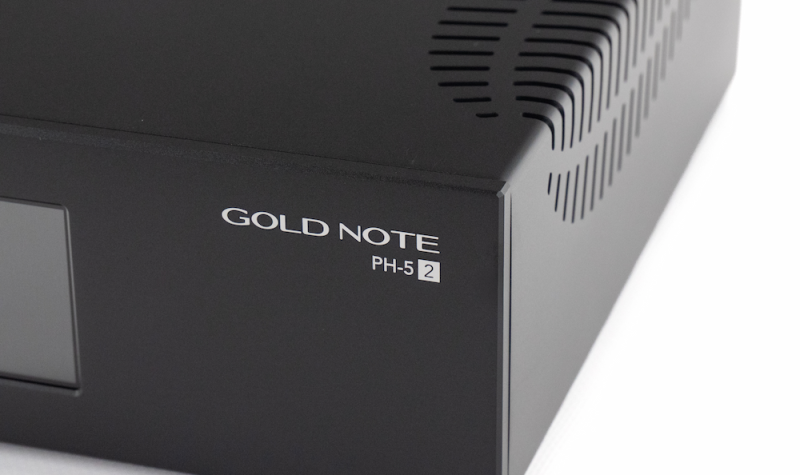
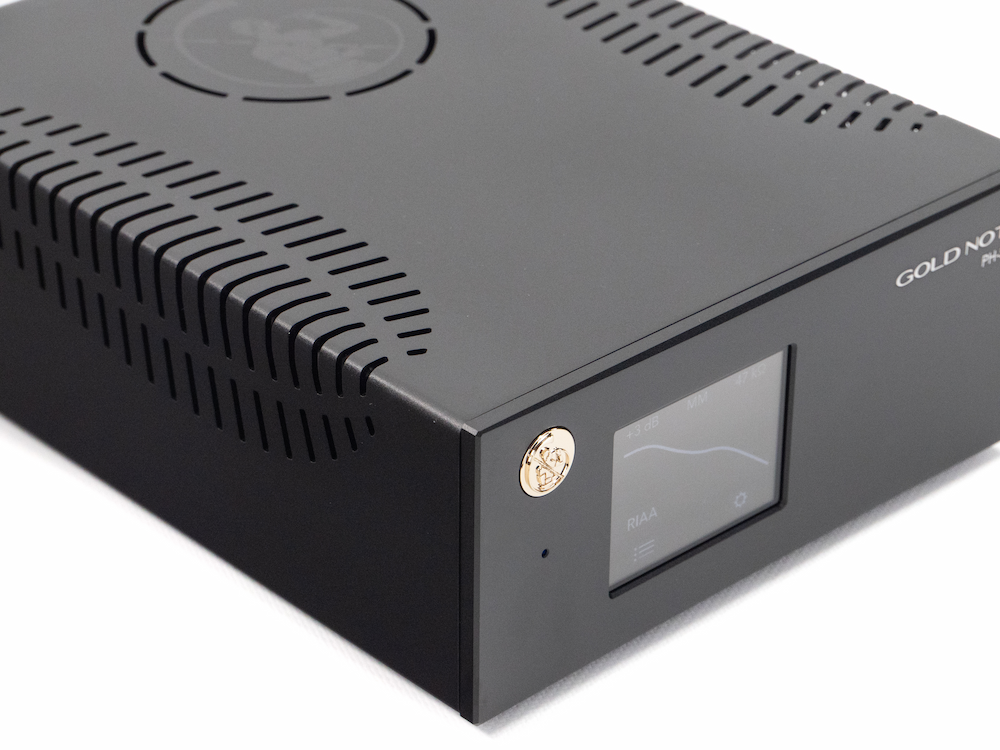
A new sandblasted anodised aluminium chassis
The PH-5.2 receives a sandblasted black anodised aluminium chassis, machined to minimise interaction with magnetic fields. This design creates a more stable electrical and mechanical environment, reducing the noise floor and improving the restitution of micro-detail. According to our expert Franck, this is the most significant technical difference from the previous version.
A redesigned colour touchscreen interface
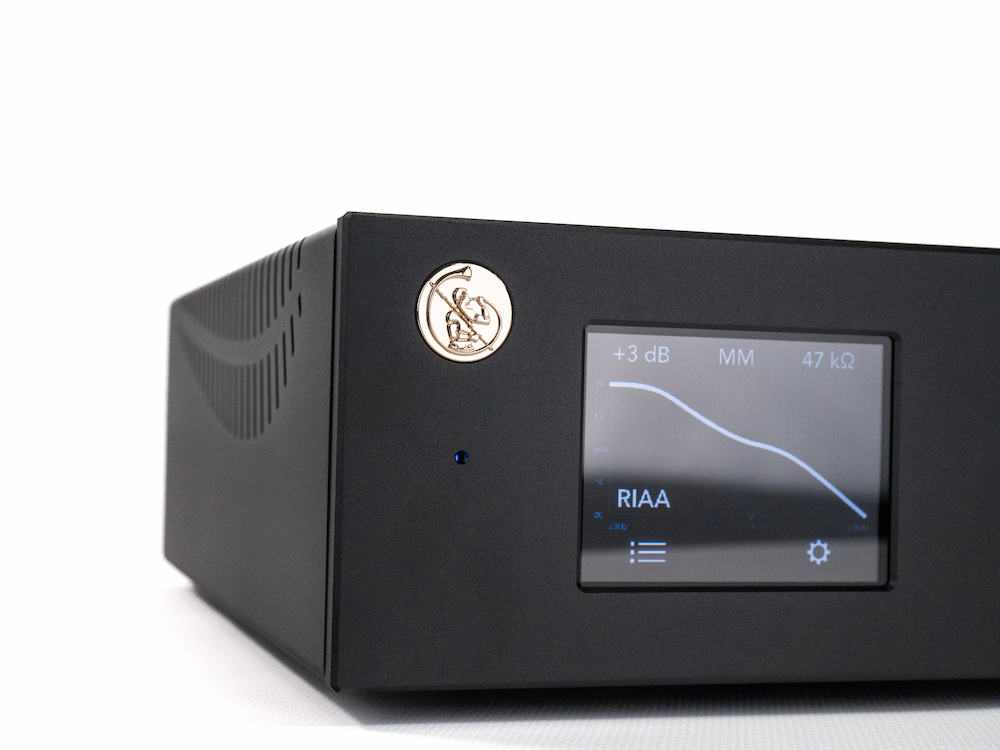
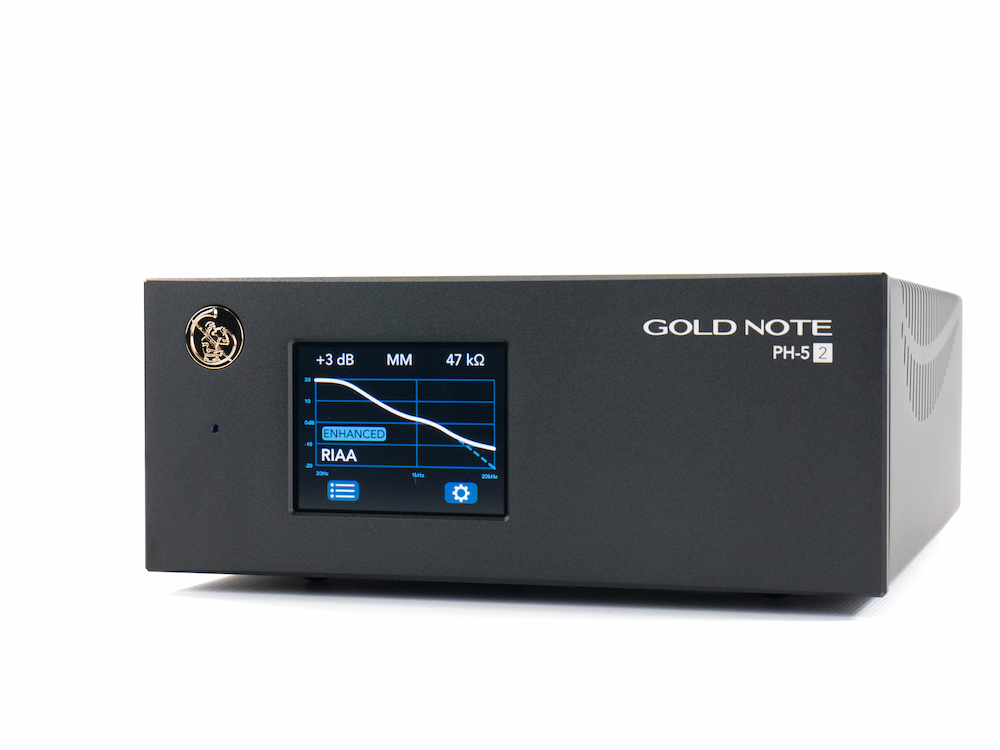
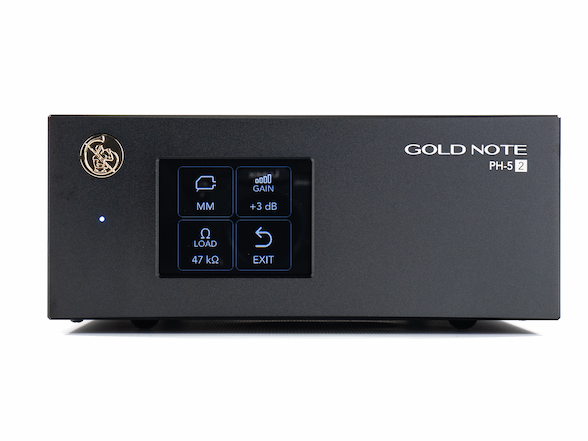
The front panel is built around a colour touchscreen whose navigation has been entirely rethought. Gain, cartridge type (MM or MC), load, capacitance, and equalisation curve are all accessible directly from the screen, with the curve displayed as a graph. The stated goal is to allow precise real-time adjustments without interrupting playback.
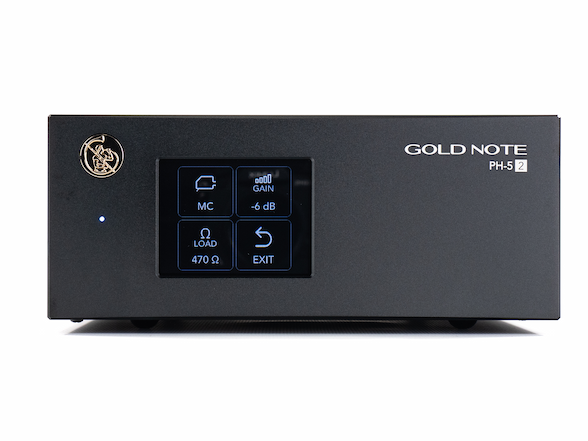
The PH-5.2 also introduces a feature absent from the PH-5: it can store two cartridge configurations, one MM and one MC, and switch between them from the Settings menu. For those using two tonearm wands or who change cartridges regularly, this is a practical time-saver.
An improved internal power supply
Gold Note has revised the power supply stage to deliver better dynamic control, a cleaner treble, and a more relaxed yet authoritative sound through complex passages. This internal supply remains the operating foundation; it can be supplemented by the optional external PSU-5.2, which Gold Note says allows the unit to reach its full potential.
A fully analogue signal path
The heart of the PH-5.2 rests on discrete audio components, and the signal path is designed to minimise distances and reduce potential interference. High-quality relays carry out the switching operations selected on the screen without introducing any digital circuitry into the signal chain. The interface is touch-controlled, but the processing remains entirely analogue.
Gold Note positions the PH-5.2 as a direct descendant of the PH-1000 and PH-10, sharing the same philosophy in a more compact and accessible format. High fidelity, according to Gold Note, is not a particular sonic signature, it is a responsibility towards the original recording.
Settings that cover every phono cartridge on the market
MM and MC gain, loading, and capacitance
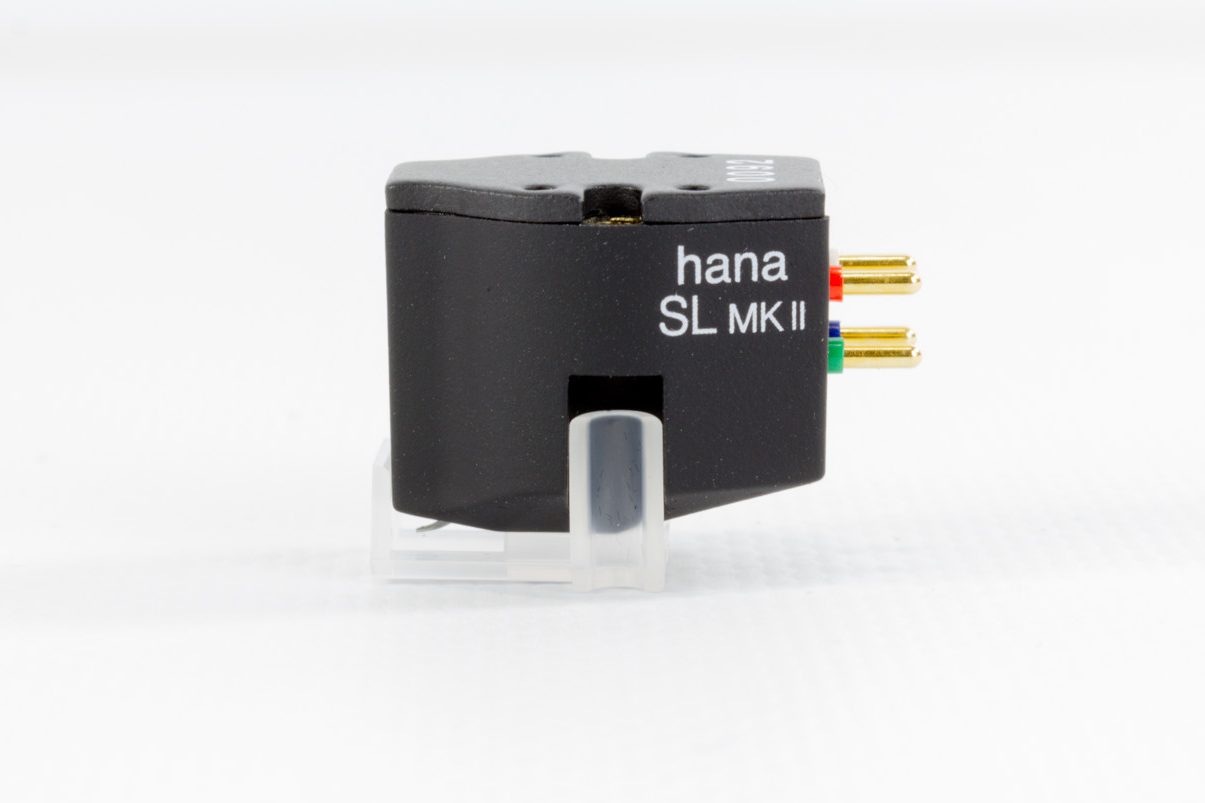
The PH-5.2 offers 40 dB of MM gain and 60 dB of MC gain, each adjustable across four options (0 dB, +3 dB, +6 dB, −6 dB). Input sensitivity ranges from 0.1 mV in MC mode to 10 mV in MM mode, covering every cartridge available on the market. MC gain can reach 66 dB for very low-output cartridges, a threshold that proves decisive with models such as the Hana SL Mk II (€759) and the Ortofon MC X40 (€999), both outputting 0.4 mV and tested successfully with the PH-5.2.
Nine load values are available: 10, 22, 47, 100, 220, 470, 1,000, 22,000 and 47,000 ohms. This range allows precise optimisation of an MC cartridge’s behaviour according to the manufacturer’s recommendations. Capacitance is fixed at 220 pF for MM cartridges.
Three equalisation curves and their Enhanced versions
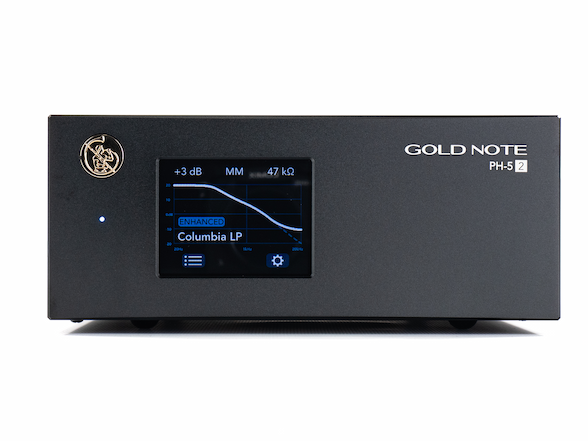
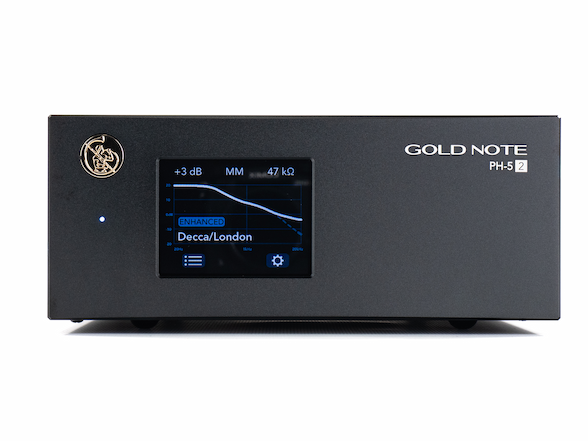
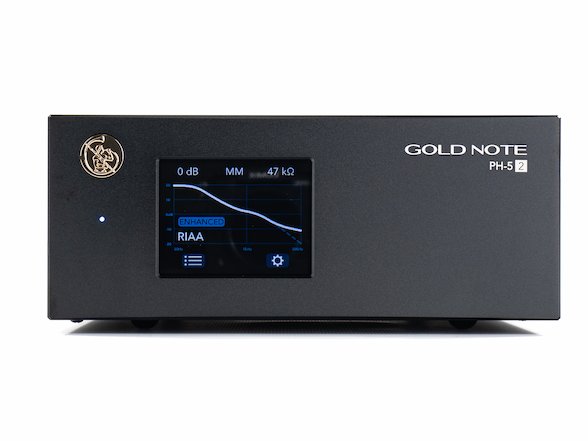
The PH-5.2 offers three equalisation curves: RIAA, Decca London, and American Columbia. RIAA is the reference standard for virtually all records produced since 1958. The Decca and Columbia curves concern specific pressings, mainly predating the introduction of stereo records in 1958, and occasionally used by certain labels into the late 1960s. The information is generally printed on the record sleeve.
Each curve is available in an Enhanced version, based on Gold Note’s proprietary technology inspired by Georg Neumann’s research. This version extends the frequency response to 50 kHz and increases dynamics and realism when desired.
The infrasonic filter: signal protection and clarity
The PH-5.2 incorporates an infrasonic filter at 10 Hz with a 36 dB-per-octave slope. This filter eliminates parasitic low-frequency content generated by the turntable’s mechanical vibrations, tonearm resonance, warp, which are inaudible but can saturate power amplifiers and speakers. It is a technically significant addition for both signal protection and clarity.
Full technical specifications – Gold Note PH-5.2
| Specification | Value |
| Compatibility | MM and MC (high and low output) |
| Analogue input | 1 × stereo RCA MM/MC |
| Input sensitivity | 0.1 mV (MC) to 10 mV (MM) |
| Audio outputs | 1 × unbalanced RCA + 1 × balanced XLR |
| Output impedance | 50 Ω |
| MM gain | 40 dB (options: 0 dB, +3 dB, ±6 dB) |
| MC gain | 60 dB (options: 0 dB, +3 dB, ±6 dB) |
| Available loads | 9 options: 10, 22, 47, 100, 220, 470, 1,000, 22,000, 47,000 Ω |
| Capacitance (MM) | 220 pF |
| Equalisation curves | RIAA, Decca London, American Columbia (all available in Enhanced version) |
| Infrasonic filter | 10 Hz / 36 dB per octave |
| Frequency response | 20 Hz – 20 kHz ±0.3 dB / Enhanced: 20 Hz – 50 kHz ±0.3 dB |
| THD | < 0.05% at 1 kHz |
| Signal-to-noise ratio | 89 dB |
| Dynamic response | 105 dB |
| Cartridge memory | 2 configurations (1 MM + 1 MC) |
| Firmware updates | Via Micro USB |
| Power consumption | 10 W / standby < 0.5 W |
| Optional external PSU | Gold Note PSU-5.2 |
| Dimensions | 200 × 80 × 260 mm (W × H × D) |
| Weight | 1.2 kg |
| Finish | Sandblasted black anodised aluminium |
| Price | €949 |
Front and rear panel
The PH-5.2‘s front panel is built around its colour touchscreen, the only visible control element. The half-width chassis is compact and unobtrusive, integrating easily into an existing rack.
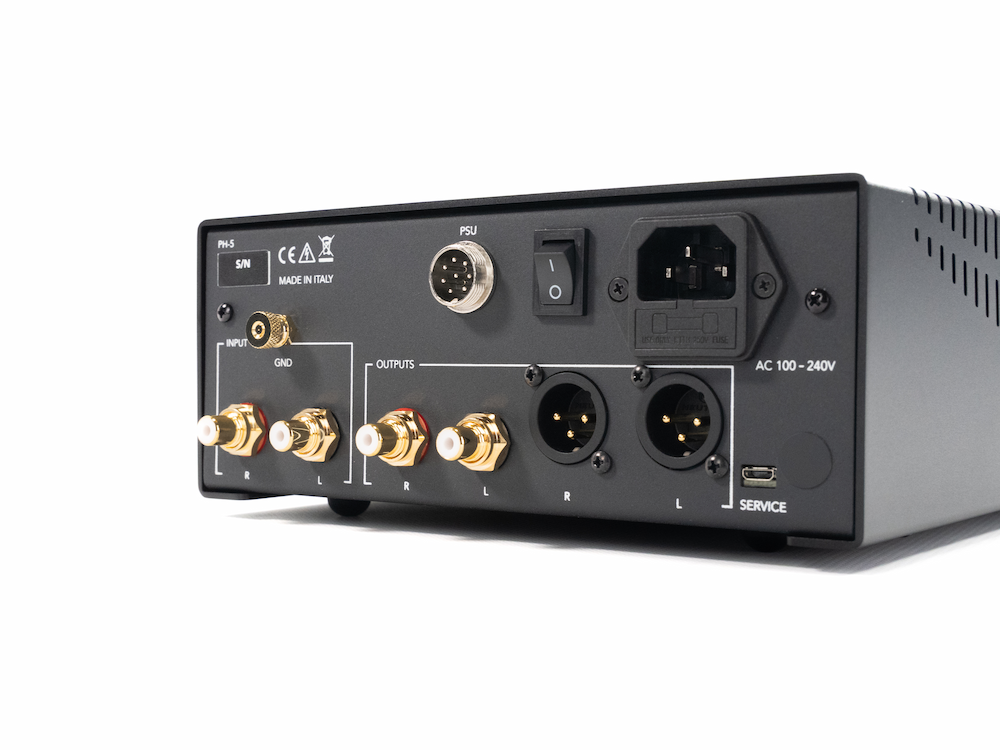
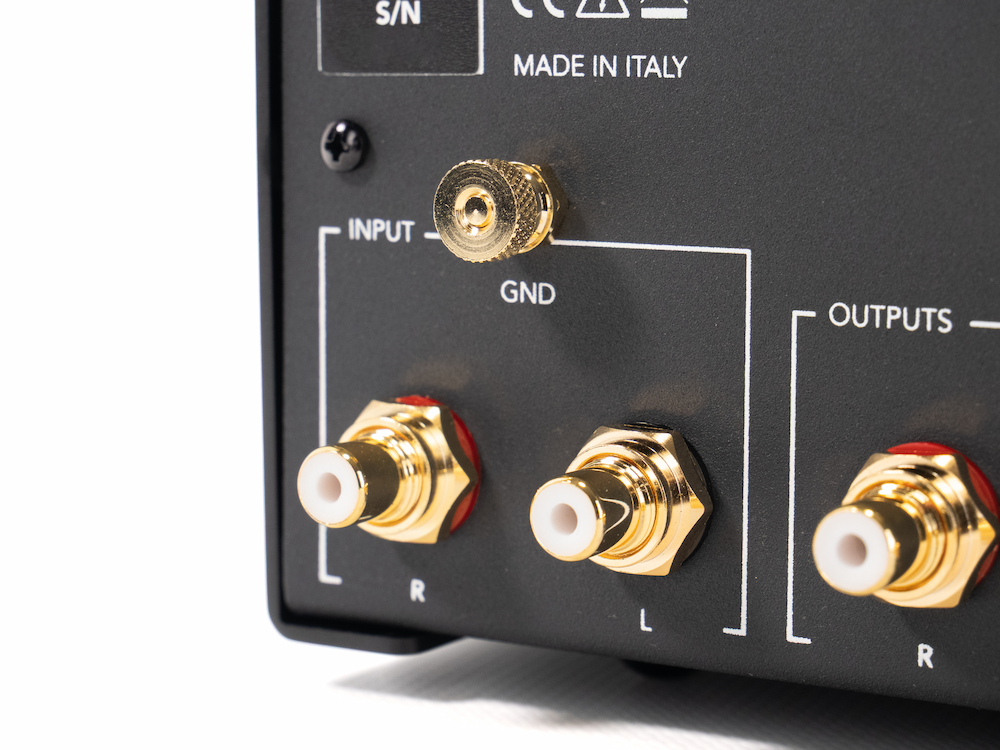
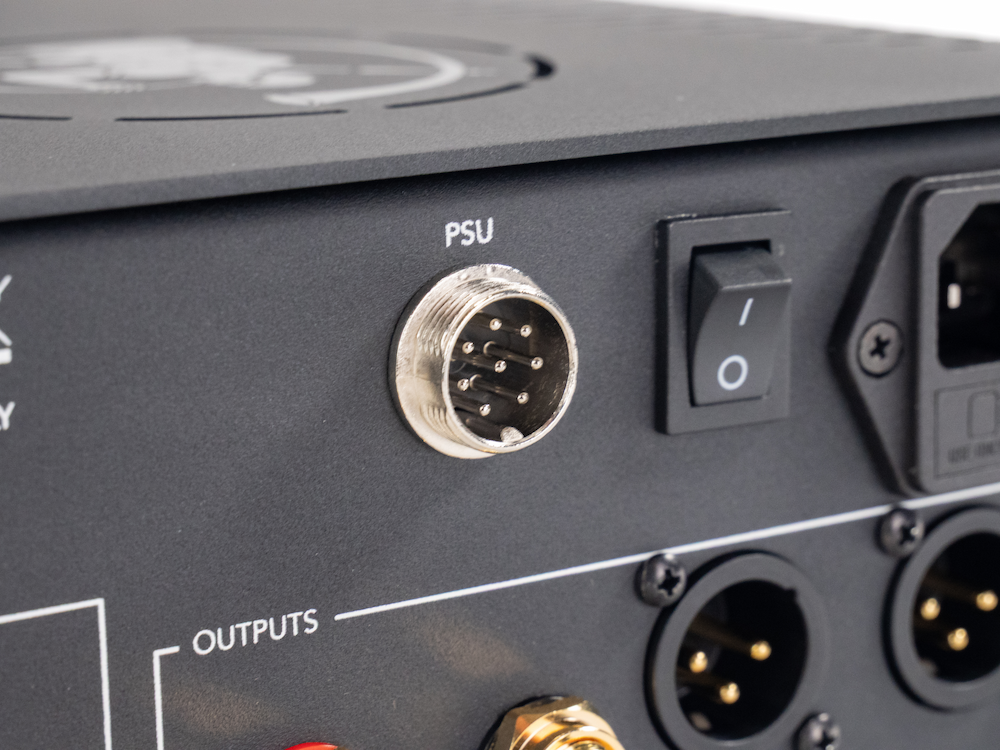
On the rear, you will find the RCA phono input, both RCA and balanced XLR outputs, an IEC mains socket, the multi-pin connector for the optional external power supply, and a Micro USB port for firmware updates. The XLR balanced output is a genuine advantage at this price point — to exploit it without restricting signal quality, a balanced interconnect such as the Viard Audio Premium HD XLR (€239 per metre, French-made, Cu-VHQ copper recrystallised via a patented thermal process) is a natural pairing in this context.
Listening impressions: what the Gold Note PH-5.2 reveals
From the very first listens, the Gold Note PH-5.2 delivers a highly detailed rendition paired with beautiful timbres. The sweet, silky treble characteristic of the Gold Note PH-10 is immediately recognisable here.
The soundstage is wide and precise, remaining stable and sharply defined with excellent focus. Voices and strings benefit from a strong sense of presence and realism. Dynamics are very slightly behind the PH-10, but they remain superior to everything we have tested against it in this price class.
Our top pick. At this price, we know of no musical or technical competitor. It is certainly the most versatile product in its category. Franck, expert maPlatine.com
How to integrate the Gold Note PH-5.2 into your system
The PH-5.2 connects between your turntable and your amplifier. The turntable plugs into the RCA input of the PH-5.2, and the PH-5.2 output (RCA or XLR) connects to a line input on your amplifier. If your amplifier already has a built-in phono stage, it is simply bypassed, the PH-5.2 takes over entirely.
Once connected, configuration is handled from the touchscreen: select MM or MC according to your cartridge, adjust gain and load according to the manufacturer’s recommendations, and choose the RIAA curve for the vast majority of records.
The dual configuration memory (one MM, one MC) is particularly useful if you run two tonearm wands or change cartridges regularly. Each profile can be recalled in a few taps from the menu.
Is the Gold Note PH-5.2 right for your situation?
Your amplifier has no phono stage, or it disappoints you
This is the most straightforward use case. The PH-5.2 replaces or bypasses your amplifier’s phono stage and handles all amplification and RIAA correction in a dedicated circuit.
You use or are planning an MC cartriadge
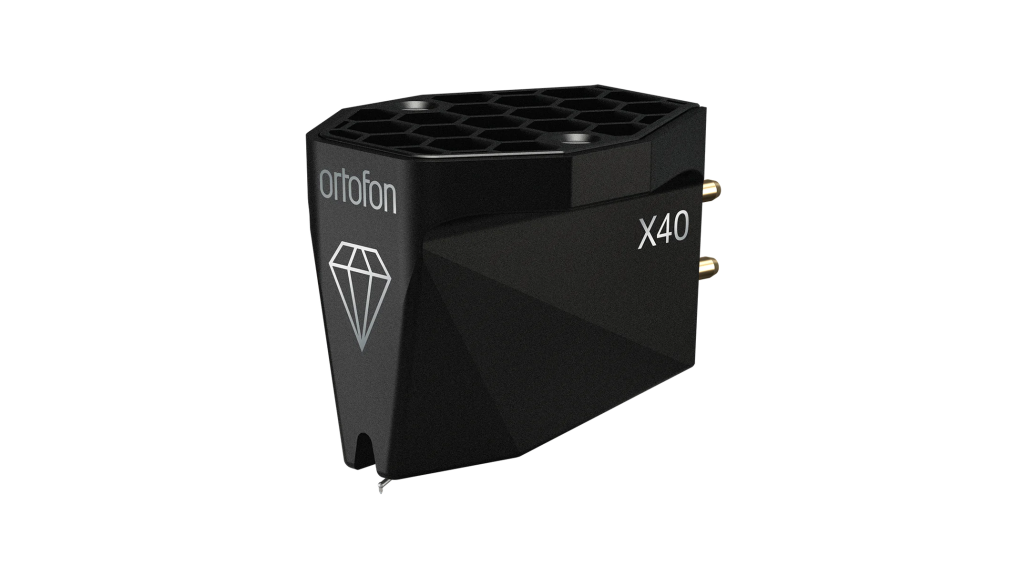
Low-output MC cartridges demand high gain levels that many integrated phono stages cannot deliver properly. The PH-5.2 reaches 66 dB of MC gain and accepts input signals from as low as 0.1 mV, making it fully compatible with the most demanding MC cartridges, such as the Hana SL Mk II (€759) and the Ortofon MC X40 (€999), two of the best pairings we have tested at this level.
You want to fine-tune your settings
If you use multiple cartridges or want to precisely optimise gain and loading, the PH-5.2‘s extensive adjustments and dual configuration memory address this need directly. Very few phono preamplifiers at this price offer this level of flexibility.
You are building your first quality vinyl system
The PH-5.2 can form the phono foundation of a first serious system. The only caveat is that the rest of the chain needs to be at a compatible level: a turntable and cartridge at the entry level will not allow you to hear what the PH-5.2 actually brings.
You are looking for an upgradeable phono preamplifier
The optional PSU-5.2 external power supply allows you to reach a higher performance level without replacing the preamplifier. Firmware updates ensure the unit can be improved over time. It is a design built to last.
Frequently asked questions about the Gold Note PH-5.2
What is the difference between the Gold Note PH-5.2 and the original PH-5?
Gold Note describes the PH-5.2 as a complete design evolution, not a simple update. The main changes are: a sandblasted anodised aluminium chassis for better isolation from magnetic fields, an improved internal power supply for better dynamic control, a redesigned touchscreen interface with graphical curve display, and a new memory function for two cartridge configurations (one MM, one MC).
Is the Gold Note PH-5.2 compatible with all phono cartridges?
Yes. Input sensitivity ranges from 0.1 mV in MC mode to 10 mV in MM mode, covering every MM and MC cartridge on the market. Nine load values from 10 to 47,000 ohms allow precise MC optimisation according to the cartridge manufacturer’s recommendations.
What does the Enhanced version of the equalisation curves do?
Gold Note’s proprietary technology, inspired by Georg Neumann’s research, extends the frequency response to 50 kHz (versus 20 kHz in standard mode) and increases dynamics and realism. It is available for all three curves: RIAA, Decca London, and American Columbia.
What does the infrasonic filter on the Gold Note PH-5.2 do?
The 10 Hz filter with a 36 dB-per-octave slope eliminates parasitic low-frequency content generated by the turntable’s mechanical vibrations, tonearm resonance, disc warp. These frequencies are inaudible but can saturate amplifiers and speakers. The filter removes them before they reach the rest of the chain.
Is the Gold Note PSU-5.2 external power supply essential?
No. The PH-5.2 performs very well with its improved internal supply. The optional PSU-5.2 is a separate upgrade that allows the unit to reach its full potential according to Gold Note, and can be purchased at a later stage to spread the investment.
What are the Decca London and American Columbia curves for?
These equalisation curves were used by certain labels before the RIAA standard became universal in 1958, and occasionally into the late 1960s. Applying the correct curve to vintage pressings restores the intended tonal balance from the original recording. The relevant curve is usually printed on the record sleeve.
How do you store two cartridge configurations on the Gold Note PH-5.2?
The PH-5.2 can store one MM profile and one MC profile, each with its own gain, load, and curve settings, from the Settings menu on the touchscreen. Configure each profile and save it. Switching between the two then takes only a few taps, without reconfiguring any parameter.
What is the price of the Gold Note PH-5.2?
The Gold Note PH-5.2 is available on maPlatine.com for €949. The optional external power supply PSU-5.2 is sold separately.
Does the Gold Note PH-5.2 have a balanced XLR output?
Yes. The PH-5.2 provides both an unbalanced RCA output and a balanced XLR output. The availability of an XLR output at this price is a genuine advantage for users whose amplifier offers balanced XLR inputs.
Why choose a separate phono preamplifier over a built-in phono stage?
Built-in phono stages share their power supply and circuits with the main amplification section. A dedicated unit like the Gold Note PH-5.2 has its own circuits, shielding, and power supply — the separation that improves the noise floor, detail retrieval, and access to precise settings not available on most integrated stages.
Conclusion: the Gold Note PH-5.2, a benchmark at €949
The Gold Note PH-5.2 is the new foundation of Gold Note’s phono line and a direct descendant of the PH-10. In a compact format and at an accessible price, it delivers the essentials of what distinguishes a high-end phono preamplifier: a fully analogue architecture, an exceptional range of adjustments for this price bracket, three equalisation curves in standard and Enhanced versions, an infrasonic filter, a balanced XLR output, and the ability to evolve with an external power supply.
Sonically, it delivers on its promises: detailed rendition, rich timbres, a precise and stable soundstage, and silky treble. At this price, we know of no musical or technical competitor.
To complete the system, the Hana SL Mk II (€759) and the Ortofon MC X40 (€999) are among our favourite pairings with the PH-5.2 on maPlatine.com.
Discover and purchase the Gold Note PH-5.2 on maPlatine.com — €949