





Headphone listening represents one of the most intimate and revealing experiences in the audiophile universe. Where speakers interact with a room’s acoustics, Hi-Fi headphones create an immediate, direct sound bubble where every detail of the recording unveils itself without compromise. This comprehensive guide helps you choose the best Hi-Fi headphones suited to your needs and budget in 2025.
What is a Hi-Fi headphone?
A Hi-Fi (high-fidelity) headphone is a personal audio listening device designed to reproduce music with maximum fidelity to the original recording, without artificial sound coloration. Its primary objective: reproduce the audio signal with precision, tonal neutrality, and respect for instrumental timbres.
The 4 main advantages of Hi-Fi headphone listening
1. Superior acoustic precision
- Elimination of interactions with room acoustics
- Surgical instrumental separation
- Revelation of recording micro-details
- Precision of the stereophonic soundstage
2. Maximum freedom of use
- High-volume listening without disturbing others
- Nighttime use possible
- Independence from room acoustics
- Total intimacy with the music
3. Relative financial accessibility
- Lower cost than an equivalent speaker setup
- No acoustic treatment necessary
- Less electronics required
- Progressive upgradeability possible
4. Portability and flexibility
- Easy transport for certain models
- Use in different environments
- Installation flexibility
Open vs closed headphones: how to choose?
Open Hi-Fi headphones
An open headphone features perforated or mesh earcups that allow air and sound to circulate. This open architecture offers a natural soundstage where instruments seem positioned in a coherent three-dimensional space, close to speaker listening. The sound breathes, timbres express themselves more naturally, and natural ventilation reduces heat accumulation for prolonged comfort.
Ideal for: home listening in a quiet environment, seeking ample soundstage, extended listening sessions.
Closed Hi-Fi headphones
A closed headphone acoustically isolates the listener through hermetic earcups. This design offers total sound isolation without sound leakage, ideal for listening in the presence of others. The closed acoustic chamber naturally reinforces low frequencies for a more impactful rendering.
Ideal for: transportation, shared offices, noisy environments, bass enthusiasts.
Understanding the technical characteristics of Hi-Fi headphones
Headphone impedance: what you need to know
Impedance, measured in Ohms (Ω), represents the headphone’s electrical resistance and determines its compatibility with your audio sources:
Low impedance (16-32 Ω): Easily driven from smartphones or portable players, requires little power. Perfect for mobile use.
High impedance (250-600 Ω): Requires a dedicated headphone amplifier but offers better linearity and superior control. Recommended for fixed Hi-Fi installation.
Sensitivity: efficiency indicator
Sensitivity (expressed in dB/mW) indicates the headphone’s efficiency in converting electrical signal to acoustic pressure. A sensitive headphone (>100 dB/mW) will produce high volume with little power, while a less sensitive model will require more amplification.
Transducer types
The transducer (or driver) converts the electrical signal into acoustic vibrations:
Dynamic transducers: Most common technology, using a diaphragm and moving coil. Robust, efficient, capable of deep bass.
Planar transducers: Ultra-thin membrane for exceptional responsiveness and precision. Higher cost but extraordinary fidelity.
Best Hi-Fi headphones by budget (2025)
Entry-level Hi-Fi headphones (€150-250)
Grado SR60x – Best Value for Money (€149)
Grado SR60x represents one of the best value propositions for discovering Hi-Fi listening. This American open headphone delivers an energetic signature with emphasis on midrange and treble. Its 44mm dynamic transducer offers an unusual soundstage for this price point.
- Strengths: Lively signature, simple but effective construction, easy to drive
- Ideal for: Rock, folk, acoustic music
- Recommended amplification: Pro-Ject Head Box S2
Grado SR80x – The logical evolution (€179)
Grado SR80x refines the SR60x’s proposition with optimized transducers. Notable definition gain and better control during complex passages.
- Strengths: Improved timbre texture, superior crescendo management
- Recommended amplification: Pro-Ject Head Box S2
Grado SR125x – Accessible balance (€249)
Grado SR125x achieves a qualitative leap with earcups incorporating aluminum elements. The bass gains body to balance the midrange-treble focused presentation.
- Strengths: Better defined bass, refined transients, reveals differences between sources
- Recommended amplification: Pro-Ject Head Box S2
Sivga Robin SV021 – The elegant closed headphone (€249)
Sivga Robin SV021 offers a closed alternative with genuine walnut earcups. Its signature favors warmth and cohesion with generous bass. Excellent sound isolation.
- Strengths: Artisanal aesthetics, high sensitivity (104 dB), detachable cable
- Ideal for: Jazz, downtempo electronic, acoustic music
- Recommended amplification: Pro-Ject Head Box S2
Mid-Range Hi-Fi headphones (€300-600)
Grado SR225x – Serious audiophile (€329)
Grado SR225x marks entry into audiophile territory with superior neodymium magnets and aluminum-magnesium alloy earcups. Resolution and soundstage reach a revealing level.
- Strengths: Revealed recording details, impressive dynamics, increased transparency
- Recommended amplification: Pro-Ject Head Box S2
Sivga Luan – The asian open headphone (€399)
Sivga Luan represents Sivga’s first foray into open architecture. Perforated solid walnut earcups, 50mm transducer, balanced signature favoring naturalness.
- Strengths: Exceptional comfort, ample soundstage, natural tonal balance
- Ideal for: Eclectic music lovers, all musical genres
- Recommended amplification: Feliks Audio Echo Vibe
Grado SR325x – Accessible high-end (€449)
Grado SR325x sports fully brushed aluminum earcups. Exceptional transparency, detail resolution rivaling more expensive models, captivating dynamics.
- Strengths: Clockwork precision of transients, typed but balanced signature
- Ideal for: Rock, chamber classical music, acoustic jazz
- Recommended amplification: Feliks Audio Echo Vibe
Sivga Oriole – Premium closed headphone (€499)
Sivga Oriole represents the pinnacle of Sivga’s closed range. Padauk and Nappa leather construction, optimized 50mm transducer. Excellent isolation and exceptional comfort.
- Strengths: Artisanal craftsmanship, mini-XLR detachable cable, versatility
- Recommended amplification: Feliks Audio Echo Vibe
Sivga SV023 – Balanced openness (€549)
Sivga SV023 prioritizes linearity with its 50mm transducer. Perforated walnut earcups, coherent reproduction without excessive coloration.
- Strengths: Neutrality, remarkable comfort, generous soundstage
- Recommended amplification: Feliks Audio Echo Vibe
High-End Hi-Fi headphones (€700-1600)
Fostex TH610 – Japanese exoticism (€749)
Fostex TH610 marks entry into audiophile luxury. Japanese cherry wood earcups, 50mm biodyna transducer with bio-cellulose membrane. Semi-open architecture offering an interesting compromise.
- Strengths: Deep and impactful bass, impeccable finish
- Ideal for: Electronic, hip-hop, modern rock
- Recommended amplification: Feliks Audio Echo Vibe
Grado RS2x – Brooklyn craftsmanship (€899)
Grado RS2x inaugurates the “Reference” series with mahogany earcups. Superior quality neodymium magnets, OFC copper winding. Exceptional transparency and explosive dynamics.
- Strengths: Natural timbres enriched by wood, three-dimensional soundstage
- Recommended amplification: Feliks Audio Echo Vibe
Focal Clear Mg – The french reference (€1,499)
Focal Clear Mg transposes Focal expertise into a reference headphone. 40mm pure magnesium membrane, exemplary tonal neutrality, microscopic resolution.
- Strengths: Reference transparency, holographic soundstage, exceptional comfort
- Ideal for: Demanding audiophiles, audio professionals
- Recommended amplification: Lehmann Audio Linear II
Grado RS1x – The prestige of wood (€1,599)
Grado RS1x crowns the Reference series with machined solid mahogany earcups. Manual assembly, selected components, exceptional sonic maturity.
- Strengths: Resolution rivaling planars, emotional impact
- Ideal for: Collectors, enthusiasts seeking artisanal excellence
- Recommended amplification: Lehmann Audio Linear II
Premium Hi-Fi headphones (€1600-2500)
Fostex TH900 MK2 – Biodyna luxury (€1,649)
Fostex TH900 MK2 represents the biodyna quintessence with hand-varnished zelkova earcups. 50mm transducer generating 1.5 Tesla, deep and controlled bass.
- Strengths: Jewelry-like finish, ample spatialization, exceptional bass
- Ideal for: Music with strong bass content, no compromise
- Recommended amplification: Lehmann Audio Linear II
Fostex TH909 – Planar perfection (€2,399)
Fostex TH909 adopts planar magnetic technology. Ultra-thin membrane, Urushi-lacquered zelkova earcups, absolute reference neutrality and resolution.
- Strengths: Holographic stage, lightning speed, exemplary tonal balance
- Ideal for: Purists seeking absolute transparency
- Recommended amplification: McIntosh MHA200
Prestige Hi-Fi headphones (€2500-3500)
Grado GS1000x – The Brooklyn monument (€2,499)
Grado GS1000x dominates the regular range with massive cocobolo earcups. 50mm X-Driver transducers, soundstage of exceptional amplitude.
- Strengths: Microscopic resolution, explosive dynamics, orchestral formations
- Ideal for: Symphonic classical music, big band jazz, progressive rock
- Recommended amplification: McIntosh MHA200
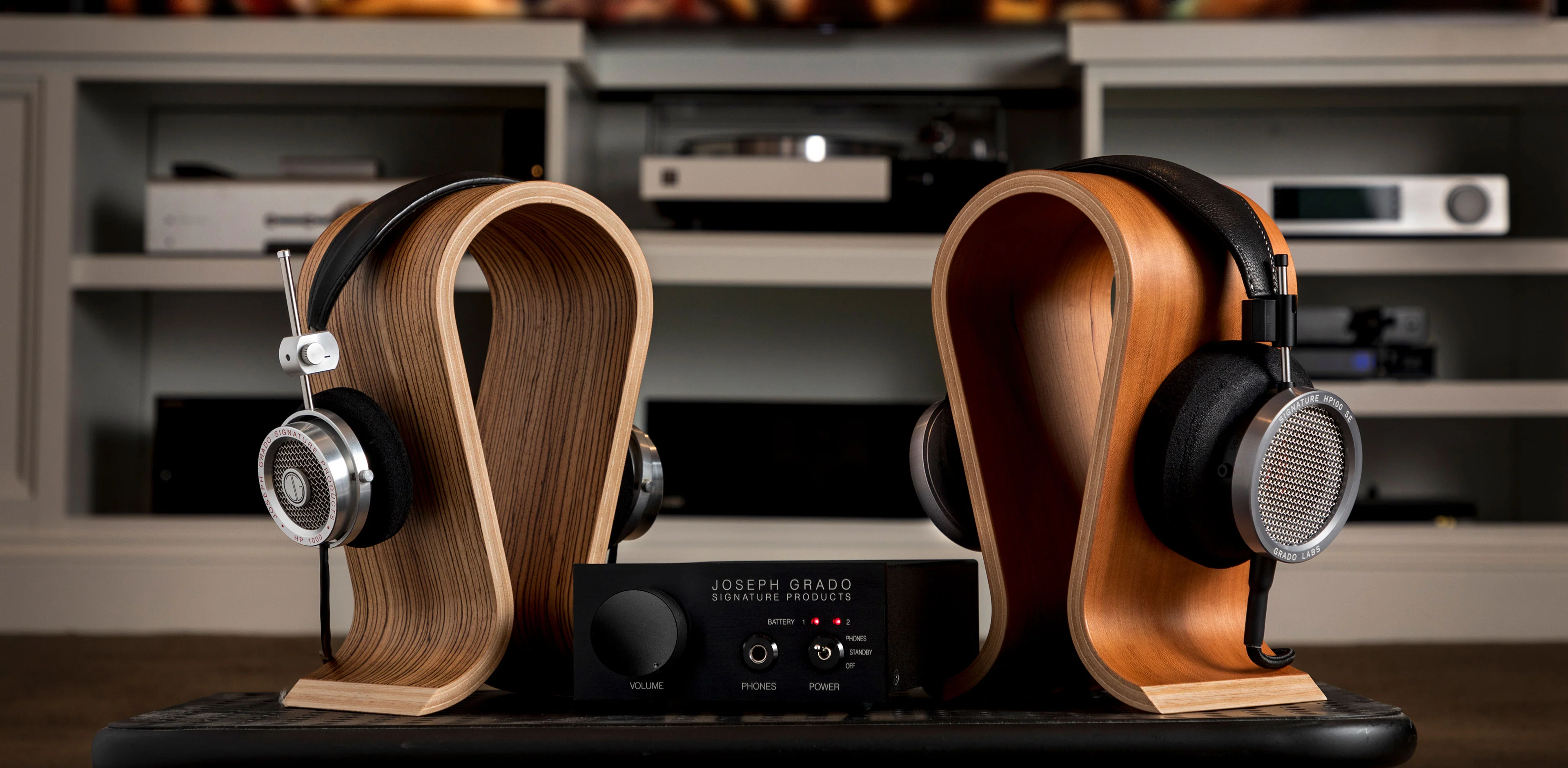
Grado Signature HP100 SE – Limited edition (€2,999)
Grado Signature HP100 SE offers a semi-open architecture with specific 52mm transducers. Limited edition with selective component sorting.
- Strengths: Balanced signature, three-dimensionality, harmonic richness
- Recommended amplification: McIntosh MHA200
Grado Signature S950 – Collector’s edition (€3,499)
Grado Signature S950 represents the ultra-limited numbered edition. Exotic wood and precious metal earcups, pure silver conductors.
- Strengths: Exceptional refinement, ultimate resolution, mature balance
- Ideal for: Affluent collectors, uncompromising audiophiles
- Recommended amplification: McIntosh MHA200
Do you need an amplifier for Hi-Fi headphones?
Why a headphone amplifier is necessary
A headphone amplifier significantly improves the sound reproduction of your Hi-Fi headphones:
Sufficient power: High-impedance headphones require considerable power that portable sources cannot provide
Optimal control: Low output impedance for constant control regardless of frequency
Sound quality: Better linearity, reduced background noise, minimized distortion
Types of headphone amplifiers
Integrated amplifier with headphone output: Hi-Fi integrated amplifiers often offer a quality headphone output, an economical and compact solution.
Dedicated headphone amplifier: Optimizes every parameter for headphone listening with short circuits, careful power supply, adapted connectivity.
Combined DAC/Amplifier: Integrates digital-to-analog conversion and amplification, elegant solution for digital sources.
Our amplifier recommendations by budget
- HHeadphones up to €390: Pro-Ject Head Box S2
- Headphones €399 to €1000: Feliks Audio Echo Vibe
- Headphones €1000 to €2000: Lehmann Audio Linear II
- Headphones over €2000: McIntosh MHA200
Maintenance and care of Hi-Fi headphones
Cleaning Hi-Fi headphones
- Earcups: Dry microfiber cloth
- Ear pads: Slightly damp cloth
- Frequency: Regular cleaning after each extended session
Parts replacement
- Ear pads: Replace every 1-2 years depending on use
- Cables: Regularly check connectors
- Availability: Most manufacturers offer spare parts
Headphone storage
- Stand: Protects from dust and prevents deformation
- Case: Optimal solution for high-end headphones
- Handling: Cables without excessive twisting
Frequently asked questions about Hi-Fi headphones
What’s the difference between Hi-Fi headphones and regular audio headphones?
A Hi-Fi headphone prioritizes fidelity to the original recording with tonal neutrality and precision, while a regular audio headphone may have a colored signature to please the general public.
Open or closed headphones for beginners?
Open headphones offer better soundstage for home listening. Closed headphones are better suited for noisy environments and mobile use.
What impedance to choose for your headphones?
Low impedance (32 Ω) for mobile use, high impedance (250+ Ω) for Hi-Fi system with dedicated amplifier offering better control.
Can you use Hi-Fi headphones without an amplifier?
High-sensitivity headphones work with portable sources, but a headphone amplifier reveals the full potential of demanding models.
How to improve the sound of your Hi-Fi headphones?
Invest in a quality headphone amplifier, use high-resolution sources (vinyl, FLAC), replace worn ear pads, and care for cable quality.
Are Hi-Fi headphones suitable for gaming?
Open Hi-Fi headphones excel for gaming thanks to their precise soundstage allowing excellent spatial localization, although closed models offer better isolation.
High-end Hi-Fi headphones transform your relationship with music. From the accessible Grado SR60x à 149 € to the Grado Signature S950 à 2 569 €, each model offers a particular vision of sound reproduction.
At maPlatine.com, we select only Hi-Fi headphones meeting our demanding criteria for sound quality, construction, and value for money. Our Grado, Sivga, Fostex, and Focal catalog covers all budgets and musical preferences.
Each headphone can harmoniously pair with our Hi-Fi turntables, integrated amplifiers, and accessories to build a coherent listening chain.
Hi-Fi headphone listening does not represent a fallback solution but a deliberate choice for a form of intimacy with music, attention to detail, a quest for transparency revealing artistic intention in all its depth.