The Dan D’Agostino Pendulum is the most accessible amplifier from the American high-end manufacturer. Despite its positioning, it retains the brand’s unmistakable sonic identity, characterized by refined, fluid, and highly musical reproduction.
Dan D’Agostino Pendulum: Chassis
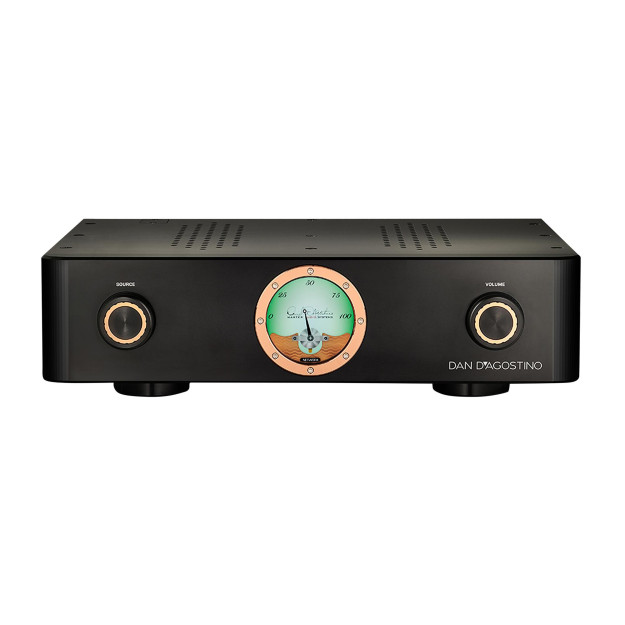
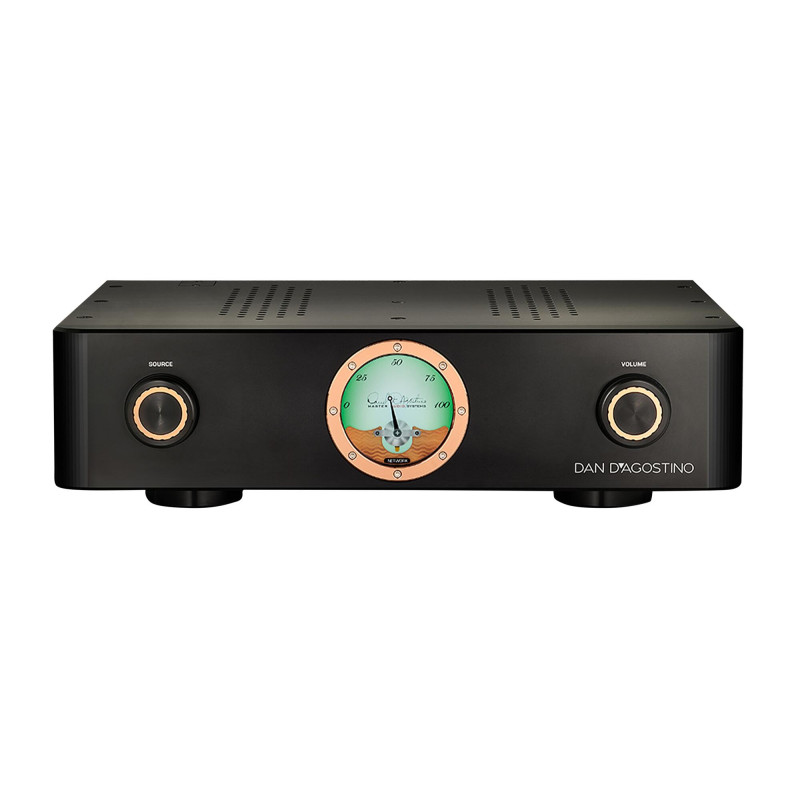
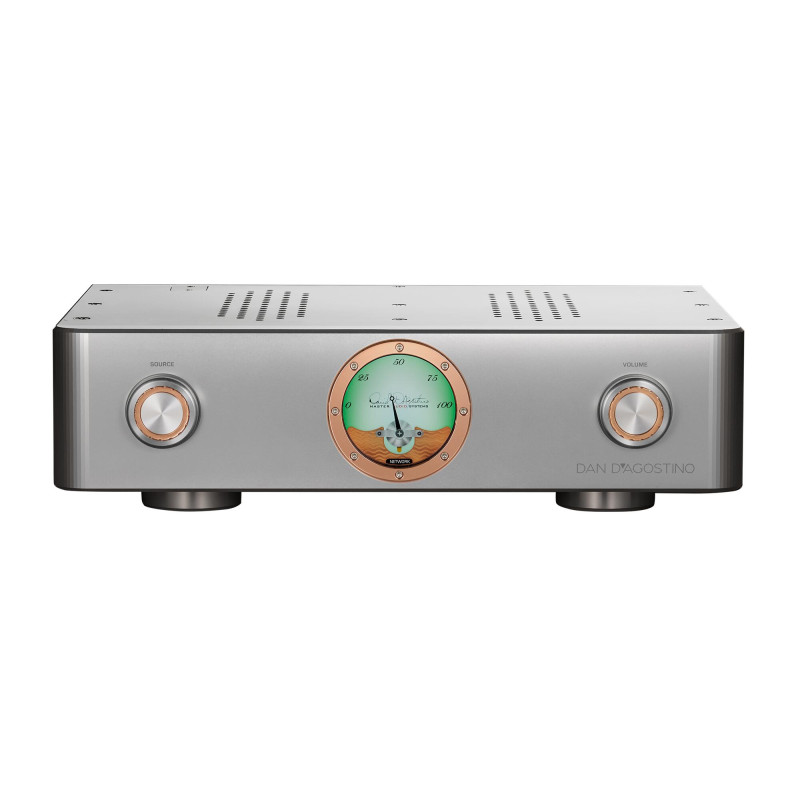
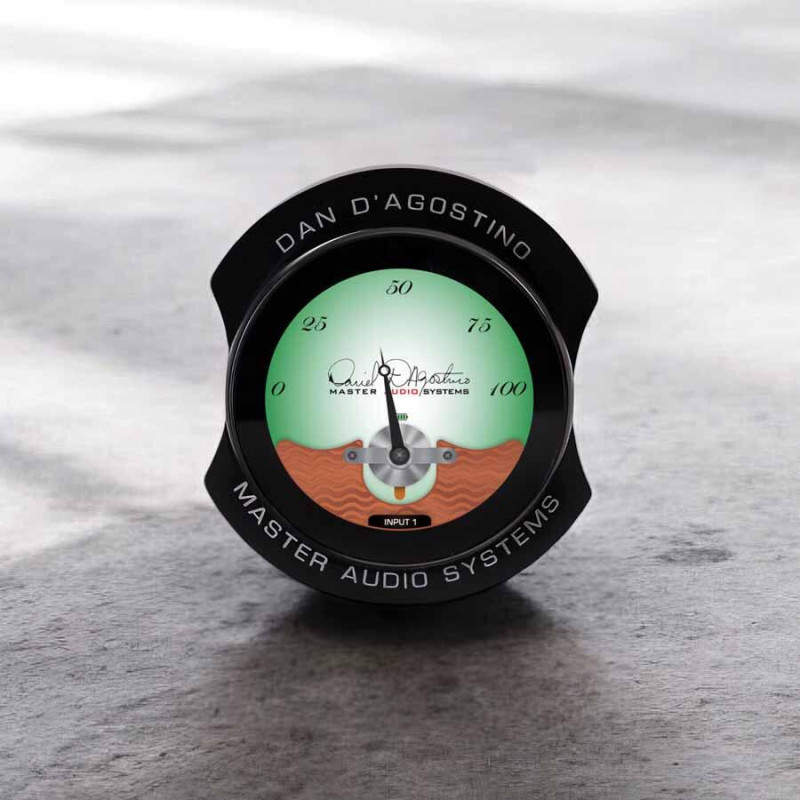
The Pendulum integrated amplifier features a central LCD display inspired by Swiss watchmaking. It provides real-time information about system status, operating functions, and metadata. A dark mode can be enabled to turn off volume display after 10 seconds, and overall screen brightness is adjustable from bright to a softer, more subdued level.
On the left, a rotary control handles power and menu navigation. On the right, a second rotary control is dedicated to volume adjustment.
Dan D’Agostino Pendulum: Connectivity
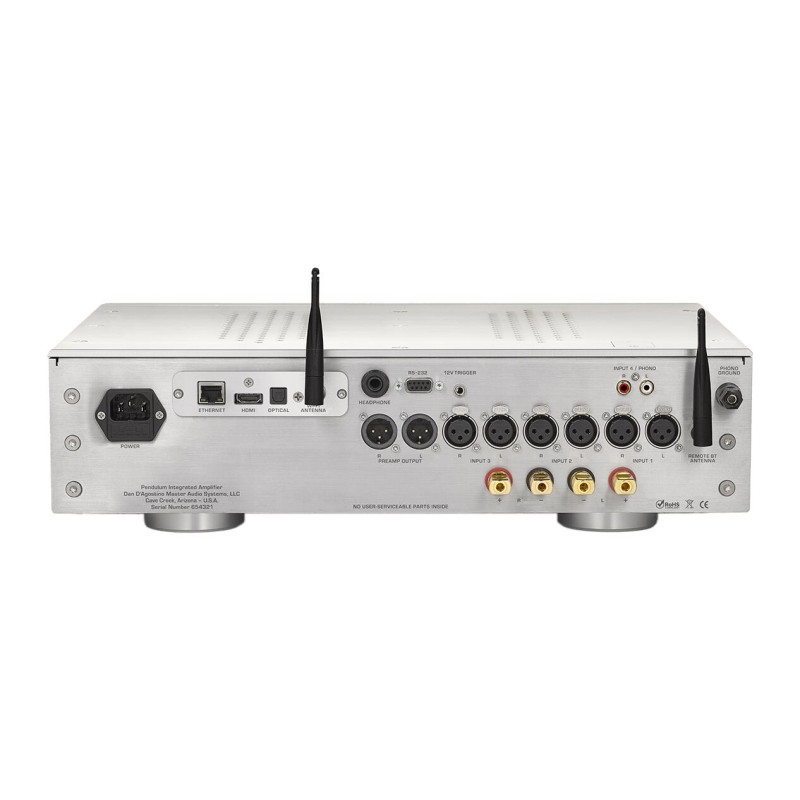
The Pendulum offers three balanced XLR stereo inputs and one XLR preamplifier output. The analog section also includes a single-ended input for turntables (phono stage available as an option).
A 6.35 mm headphone output is also located on the rear panel.
A Bluetooth antenna is present, but it is used exclusively for remote control connectivity.
Dan D’Agostino Pendulum: Technology
At the heart of the Pendulum integrated amplifier lies a redesigned JFET input topology derived from the renowned Momentum C2 preamplifier. This refined architecture enhances circuit precision and overall performance, ensuring exceptional sound quality for an amplifier of this size.
Power is supplied by a dedicated 750 VA toroidal transformer combined with approximately 25,000 µF of filtering capacitance. This robust power supply ensures stable performance and minimizes distortion, allowing the amplifier to drive even demanding loudspeakers with ease.
Dan D’Agostino Pendulum: Options
The Pendulum can be optionally equipped with a full digital module, ensuring seamless integration with modern audio systems. With optical inputs, RJ45 and Wi-Fi connectivity, it offers extensive networking capabilities. It is also the first D’Agostino component to include an HDMI input with eARC support, simplifying integration into home theater setups.
An optional moving-coil phono stage is also available, enabling compatibility with high-end turntable systems. It offers multiple loading options via DIP switches accessible through a small top-panel window, with selectable impedance settings of 50, 100, 250, 500, 1000 ohms and 47 kΩ.
Dan D’Agostino Pendulum: Sound Performance
From the first notes, the Pendulum does not aim for exaggerated showmanship but instead impresses through finesse and articulation. It delivers remarkable harmonic density combined with outstanding dynamic capability.
Few solid-state amplifiers achieve such speed on transients. As with classic Krell designs of the past, it demonstrates exceptional authority and control in the bass region, while maintaining superb fluidity and surprising physical impact.
The amplifier retrieves a vast amount of information without ever sounding clinical or harsh. One of its strongest qualities is its ability to create a wide, stable, and highly precise soundstage. In orchestral works, the presentation becomes almost holographic, with excellent separation between layers.
Vocals are rendered with a level of presence and realism typically associated with the finest tube electronics.
The Dan D’Agostino Pendulum embodies the ideal modern integrated amplifier, combining performance and musicality without compromise. It stands as a highly compelling product in its category, offering speed, power, refinement, and exceptional build quality. It deserves serious attention from anyone seeking a high-end integrated amplifier.
FAQ: Everything you need to know before buying the Dan D'Agostino Pendulum amplifier
Who is Dan D'Agostino and what defines the brand's amplifiers?
Dan D'Agostino is an American manufacturer known for amplifiers with a refined, fluid and highly musical sound — the brand's historic sonic DNA, which the Pendulum faithfully preserves. Within the range, the Pendulum is the most accessible model. Its sound combines great harmonic density with remarkable dynamics and, as with the Krell electronics of years past, impressive authority and grip in the bass.
Why choose an integrated amplifier like the Pendulum?
An integrated amplifier brings together everything you need to power your speakers and connect your sources in a single compact unit. Despite its small size, the Pendulum delivers comfortable, stable output with very little distortion, enough to get the best out of even demanding speakers. It accepts several sources (three XLR stereo inputs, a turntable input, and optional digital connections) and includes a headphone output. It embodies the DNA of the modern integrated amplifier, combining performance and musicality without compromise.
Can you connect a turntable to the Pendulum?
Yes. The amplifier has a dedicated turntable input (the phono card is available as an option). There is also an optional moving-coil (MC) phono module, designed to pair the amplifier with a turntable fitted with a high-end cartridge. This module offers several load settings (50, 100, 250, 500, 1000 ohms and 47 kohms), accessible through a small window on the top of the unit.
Does the Pendulum let you connect headphones?
Yes. A 6.35 mm stereo jack headphone output is located on the back of the unit.
Can you listen to music wirelessly with the Pendulum?
The unit's Bluetooth antenna is used only to connect the remote control, not to stream music. However, a complete set of digital connections is available as an option: optical inputs, RJ45 and Wi-Fi ports, plus an HDMI input with eARC. The latter makes it easy to integrate the Pendulum into a home-cinema setup with a television.
Is the Pendulum powerful enough for my speakers?
Yes. Despite its compact size, it is powered by a dedicated 750 VA toroidal transformer paired with nearly 25,000 µF of filtering. This power supply delivers comfortable, stable output with very little distortion, allowing the amplifier to get the best out of even the most demanding speakers.
FranckFrequency response: 20 Hz to 20 kHz, ±0.1 dB
Signal-to-noise ratio: 0.015% at 1 kHz, 120 W per channel at 8 Ω
Input impedance: 1 MΩ
Output power (per channel): 120 W at 8 Ω / 240 W at 4 Ω
Output impedance: 0.1 Ω
Balanced analog inputs: 3 pairs of XLR connectors
Unbalanced analog inputs: 1 pair of RCA connectors
Digital inputs: optional
Analog output: 1 pair of XLR connectors
Headphone amplifier: 1 x 6.35 mm jack
Speaker outputs: Stereo
Control protocol: RS-232
Dimensions: 43.2 x 11.8 x 36.6 cm
Weight: 19.5 kg
Finish: Silver or Black