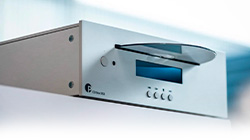
The QUAD 33 is one of the rare emblematic high-fidelity products. It has left its mark on several generations of music lovers and audiophiles.
It still remains one of the most popular models in history and from Quad, one of the best-known Hi-Fi brands in the world. The first QUAD 33 left the manufacturer's factories in 1967 and, throughout all these years, it has symbolised a benchmark in terms of high fidelity.
By revisiting the QUAD 33, the brand demonstrates its wish to reconnect with authenticity and history!
QUAD 33: Front panel
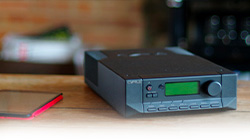
The QUAD 33 offers a design that completely evokes QUAD's past while firmly belonging to an evident modernity.
The steel housing is very rigid and is perfectly assembled with quality. The anodised front panel is precisely machined. It takes up all the codes of its illustrious ancestor, but with a far superior component and build quality. This new version will not be prone to cracks or discolouration as the QUAD 33 of the 1970s was.
The controls completely echo the original concept. Grouped logically to make programme selection and control easier, a backlit LCD screen indicates statuses, adjustments and values. The same backlighting principle is applied to each of the push-buttons, which makes the functions very legible. A row of three endless rotary encoders offers intuitive and immediate control of the fine settings.
It is possible to adjust the brightness and contrast, and to carry out a simple on/off setting to suit the user's preferences.
QUAD 33: Connections
The QUAD 33 is equipped with fully balanced unbalanced analogue (RCA) and balanced XLR inputs and outputs!
The speakers are powered through the power amplifier using dedicated stereo pre-outputs, with an RCA line level and a balanced XLR pre-out option. For added versatility and functionality, there is also an AUX output.
QUAD 33: Phono input
The all-new phono preamplifier is compatible with moving magnet (MM) and low-output moving coil (MC) cartridges. This stage has been particularly carefully designed and offers unprecedented performance for a device in this range. It uses only components with very low noise and very low distortion specifications. With a gain of 46 dB for the MM and 63.5 dB for the MC, the Quad 33 is compatible with the majority of phono cartridges on the market.
QUAD 33: Technology
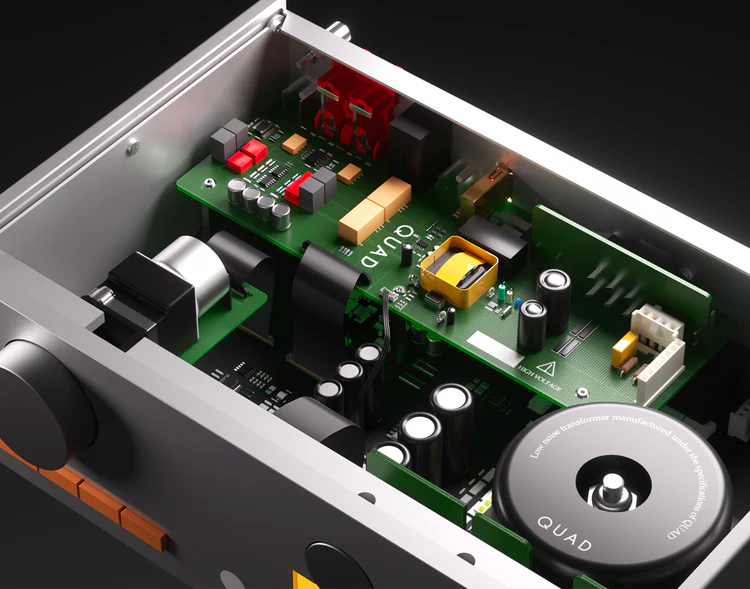
The Quad 33 preamplifier is QUAD's first solid-state design, following several famous tube designs.
The R&D was entrusted to a "dream" team consisting of Rob Flain and Paul McConville (the most experienced QUAD service engineers in the world), Jan Ertner (30 years of experience in QUAD design), Peter Comeau (the acoustic director behind some of the QUAD loudspeakers) and David McNeill (the industrial designer responsible for two decades of QUAD innovations). They all took part in this work without making any compromise. At every design stage of the new circuit, these designers sought to get as close as possible to the original sound and, if possible, to improve it.
This QUAD 33 is equipped with digital microprocessor control, but it remains faithful to a fully analogue design.
The main volume control is entrusted to a fully analogue motorised ALPS potentiometer. This excellent-quality component is precise, offers a low noise level and a long service life.
The original QUAD 33 offered filters considered essential in 1967. Today these controls are no longer necessary; the new QUAD 33 offers a bass adjustment, a tilt control and a balance control to allow fine tuning without needlessly encroaching on the harmonic range essential to realistic reproduction.
The bass control allows an adjustment from -3 to 3 dB. It is ideal for subtle adjustments in the low frequencies, in order to add body to thinner source material. Or, conversely, to reduce the low tones in the event of a room effect.
Developed by QUAD's founder, the legendary Peter Walker, the Tilt control is an audiophile-quality solution for tonal adjustment. Its design stems from the conviction that traditional tone and equalisation controls are inadequate and clumsy when it comes to adjusting the tonal balance.
The Tilt control differs in that it adjusts both ends of the frequency spectrum together, either by attenuating the bass and boosting the treble, or by boosting the bass and lowering the treble in 1 dB steps. It pivots or tilts the audible frequency range on a 700 Hz axis, thus adjusting the overall sound balance with "warm" or "cold" notes without changing the volume or adding colour to the sound. This function is unique to this device. It offers a subtle, precise and consistent way to adjust the system's performance and to compensate for recordings or the environment.
These Tilt, Bass and Balance controls are all composed of low-noise optoelectronic amplifiers, electronic switches and MELF low temperature coefficient metal film resistors, forming a negative feedback adjustment circuit.
QUAD 33: Test and listening
When launching this project, it was decided that the new Quad 33 and 303 combination would only see the light of day if performance was improved over the original creations. Every stage of development and every innovation was thoroughly tested and fully agreed with QUAD's technical design and service team.
The numerous circuit improvements and the addition of an impressive number of regulators place the new QUAD 33 technically well above its ancestor.
As chance would have it, we have in our hands a QUAD 33/303 pair from 1970. We can confirm that we find in the new Quad 33 all the musicality and smoothness of the original models. But the 33 preamp marks a huge difference from the original version. The transparency and definition are well above, without distorting the timbre. The noise and distortion levels are very low, even inaudible. This little preamp is remarkable for its breadth and the presence it gives in the midrange. The quality of its phono input must also be highlighted, which seems, moreover, unprecedented in this price range. I always found that the Quad 33 was not up to the amplification, and well, now it is done! This new version is far superior to the earlier models.
This Quad 33, coupled with the 303 (or not), offers a remarkable value for money.
FAQ: Everything you need to know before buying the Quad 33 preamplifier
Does the Quad 33 include a phono input for my turntable?
Yes. It features a brand-new phono stage compatible with MM cartridges and low-output MC cartridges. This carefully designed stage uses only very low-noise components and offers 46 dB of gain in MM and 63.5 dB in MC, making it compatible with the majority of phono cartridges on the market.
What do the Tilt, Bass and Balance controls do?
The bass control works from -3 to +3 dB, ideal for subtle low-frequency tweaks or to compensate for a room effect. The Tilt control, developed by Peter Walker, tilts the whole spectrum around a 700 Hz axis in 1 dB steps, making the sound warmer or cooler without changing the volume or adding colouration. The Balance control rounds out the set for fine, consistent adjustment.
What connections does it offer?
The Quad 33 has fully balanced unbalanced (RCA) and balanced (XLR) analogue inputs and outputs, dedicated stereo pre-outs to feed the power amplifier, and an AUX output. Volume is handled by a fully analogue motorised ALPS potentiometer, precise and low-noise.
Which amplifier should I pair it with?
It is designed to form a pair with the Quad 303, but also works with most balanced power amplifiers. This Quad preamplifier marks a clear step up from the original version: superior transparency and definition without altering the timbre, very low noise, and a phono input of a quality that is unheard of in this price range.
FranckUnbalanced inputs: 3 x RCA
Balanced input: 1 x XLR
Unbalanced output: 1 x RCA
Balanced output: 1 x XLR
Trigger : In /OUT
Phono Input: MM and MC
Gain Phono MM : 46 dB
Gain Phono MC : 63.5 dB
Distortion Line: <0.0005%
Phono Distortion: <0.002%
Output impedance: 120 ohms
Remote control: Yes
Weight: 4kg
Dimensions : 258 x 94 x 165 mm